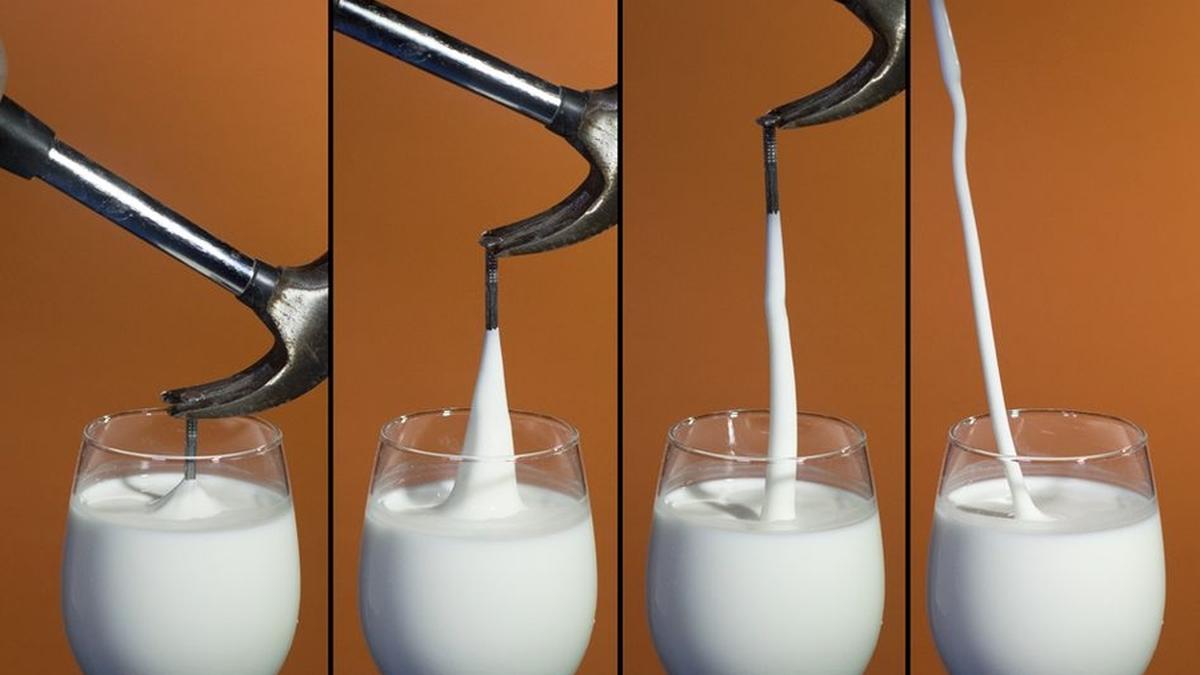
Fast-moving cornstarch acts like a liquid before hardening
The Hindu
A new study reveals how cornstarch behaves like a liquid before solidifying, with implications for 3D printing and soft robotics.
If you mix cornstarch and water, you will have a substance that defies common sense. If you punch it with your first, it will feel like you hit a solid wall. But if you move your finger through it slowly, the substance will flow like honey. And scientists have long struggled to understand how this transition happens.
A new study in Physical Review Letters has figured it out using high-speed photography and direct force measurements. The authors, from the University of Minnesota, reported that at an extreme speed, the cornstarch mixture behaves like a liquid first before becoming tougher.
For these studies, scientists have usually watched how a drop spreads when it falls on a surface using high-speed cameras. For the new study, the researchers built a specialised rig. They dropped mixtures of cornstarch and water with concentrations ranging from 30% to 43%, on a sensitive force sensor at speeds of up to 7.2 m/s, and recorded it with high-speed cameras.
Thus they could ‘see’ and ‘feel’ the impact simultaneously.
The team thus identified three ways in which the drops responded to the surface. The low-concentration mixture behaved like water: the impact force peaked early and then faded as the liquid spread. At a higher concentration and low impact speed, however, the fluid jammed” almost instantly, behaving like a solid sphere, exerting a symmetric force as it struck the surface and abruptly stopped spreading.
Then the team made its surprising discovery. At high concentrations and high impact speed, the mixture behaved like a re-entrant liquid. The drop acted like a liquid for the first fraction of a millisecond, then quickly transitioned to becoming a jammed solid.


Astronauts honor Reid Wiseman's late wife by naming a lunar crater "Carroll" during historic Artemis II mission.

NASA's Artemis II crew reaches the moon, approaching a historic distance record from Earth in their Orion capsule.

Inspired by Maharani Gayatri Devi the designer’s new Spring/Summer 2026 edit blends regal detailing with modern sportswear, from hand-painted jackets to embroidered suspenders

Former advertising man Mohan Menon’s new novel takes its protagonists across Kolkata in search of a ninja who enables people to satisfy their bloodthirsty whims

Discover how microRNAs enable early detection and personalized treatment for PCOS and endometriosis, enhancing women's health outcomes.

A study reveals a reproducibility crisis in social sciences, with only half of analyzed research findings being reliably replicable.

ISRO's Mission MITRA in Ladakh tests astronauts' mental and physical strengths, enhancing insights for the Gaganyaan programme.

Artemis II astronauts prepare for a historic lunar flyby, aiming to capture and analyze unique lunar features during their mission.

Explore the geopolitical implications of NASA's Artemis II mission as it competes with China's lunar ambitions for space supremacy.

Explore the geopolitical implications of NASA's Artemis II mission as it competes with China's lunar ambitions for space supremacy.

Artemis II astronauts reach halfway to the Moon, with the lunar flyby milestone celebrated by mission control.

Explore how six architectural firms are transforming Indian bars with immersive designs that blend culture, storytelling, and vibrant aesthetics.

Explore how offices are transforming into boutique hotel-inspired spaces that prioritize employee experience and wellbeing.