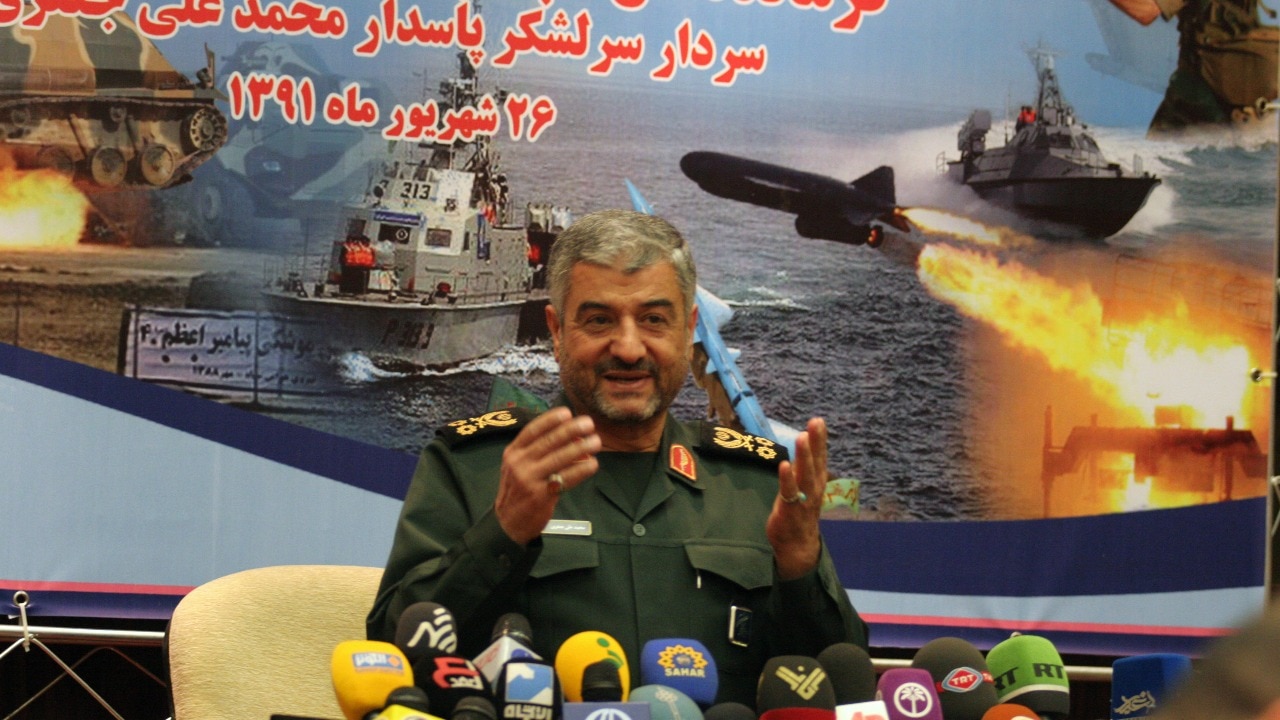
Who is Ali Jafari, the mastermind who made Iran's defeat impossible?
India Today
Despite the US wiping out Iran's top leadership on the first day of the strikes, Tehran continues to fight on fiercely. This is due to the Mosaic Defence Doctrine of Mohammad Ali Jafari. Jafari took lessons from the US invasion of Iraq in 2003, and ensured Tehran would remain resilient even if its top leadership was taken out.
The US might have thought it could achieve in 2026 in Iran what it could in 2003 in Iraq. In 2003, when the US invaded Iraq, it took just 26 days of active military operation to dismantle the military of Saddam Hussein. But someone in Iran had closely studied the Iraq war of 2003, and resolved to prevent the collapse of the Iranian regime like Saddam's did. That person was Major General Mohammad Ali Jafari, a former commander-in-chief of the Islamic Revolutionary Guard Corps (IRGC).
On February 28, 2026, US and Israeli forces launched Operation Epic Fury, a sweeping decapitation campaign involving warplanes, drones, and precision missiles targeting Iran's highest command echelons. The strikes killed Supreme Leader Ayatollah Ali Khamenei, IRGC Commander-in-Chief Major General Mohammad Pakpour, Defence Minister Brigadier General Aziz Nasirzadeh, Armed Forces Chief of Staff Lieutenant General Seyyed Abdolrahim Mousavi, and other senior figures.
The objective of these strikes, according to a report by the Institute for the Study of War, was to shatter Iran's command-and-control apparatus and forestall retaliatory action. But the collapse the US and Israel expected never came. It's been almost two weeks and a resilient Iran is firing at will, setting fire to the entire Middle East.
That has been possible for Iran because Mohammad Ali Jafari created the concept of "Decentralised Mosaic Defence". Designed to ensure Iran could continue fighting even if its leadership were wiped out, the doctrine disperses authority across semi-independent units capable of operating on pre-established plans.
Retaliation from Iran began almost immediately after the joint strikes on February 28. Within hours, salvos of ballistic missiles and drones hammered US military facilities in Bahrain, Qatar, the UAE, Kuwait, and Jordan, while strikes hit targets inside Israel and allied Gulf infrastructure. Despite President Masoud Pezeshkian's apology for attacking neutral states like Oman and Bahrain and promises of respecting the sovereignty of Gulf states, the barrages continued unabated, with attacks persisting even as the war entered Day 14 on March 13. Despite having most of their senior leadership killed, Iranian forces swiftly responded with missile and drone attacks across the Middle East, including this warehouse in Sharjah city in the UAE. (Image: AP)
This rapid, sustained response defied expectations of collapse. In a post on X on March 1, Iranian Foreign Minister Seyed Abbas Araghchi explained Iran's defence strategy. He wrote, "We've had two decades to study the defeats of the US military to our immediate east and west. We've incorporated lessons accordingly. Bombings in our capital have no impact on our ability to conduct war. Decentralised Mosaic Defence enables us to decide when and how war will end."


The profiles of at least three of China's leading nuclear, missile and radar experts were scrubbed from the website of the Chinese Academy of Engineering, the country's most prestigious academic body. This comes as a series of purges under Premier Xi Jinping's anti-corruption campaign have decimated the upper echelons of China's military and scientific community.

The aircraft had also been used by senior Iranian officials and military figures for both domestic and international travel, and for coordinating with allied countries, the Israeli military said. Meanwhile, Dubai International Airport has resumed flight operations after a temporary suspension of about seven hours caused by a drone strike near a fuel tank facility.

A government school teacher's gesture of buying a new uniform for an orphaned student has received widespread attention after a video of the act was shared on Instagram.

A father travelling with his toddler addressed fellow passengers ahead of a flight, asking for patience and understanding if his child became unsettled.

The lottery system for a segment of Green Cards, known as the Diversity Immigrant Visa programme, has been restarted. However, the stricter rules being enforced by the US won't impact Indian Green Card aspirants. Here's why.

Instead of putting an end to rumours, the video has triggered another wave of speculation about Netanyahu's fate. Several users on 'X' (formerly Twitter) have claimed that the video posted on 'X' was an AI-generated deepfake.

US jets strike military facilities near Iran's Chabahar free trade zone

The video, recorded inside the train coach, shows the compartment littered with snack packets, water bottles, soiled spoons and bedsheets scattered on the floor.

The US is planning to deploy a third aircraft carrier in the Middle East amid the war with Iran. Aircraft carriers, one of the most expensive defence systems, are floating military bases that project power. Here's how aircraft carriers are used and where India stands.

Donald Trump warned that Nato could face a 'very bad' future if member states fail to help reopen the Strait of Hormuz, and to support Washington's efforts amid the ongoing US-Israeli war with Iran.

When we look at Iran through the prism of religion and see a Shia Islamic country, we negate its thousands of years of rich pre-Islamic Persian culture. A dive into the world of Zoroastrianism and Vedas shows us how Indians and Iranians have been sharing languages, Gods, sciences and a sacred fire for thousands of years.

Israeli Prime Minister Benjamin Netanyahu responded directly to his death rumours by releasing a new video intended to show he was alive and continuing his duties.

A couple and two children were killed when Israeli fire hit their car in the West Bank. Two injured boys survived, their story reveals the terrifying final moments inside the vehicle.