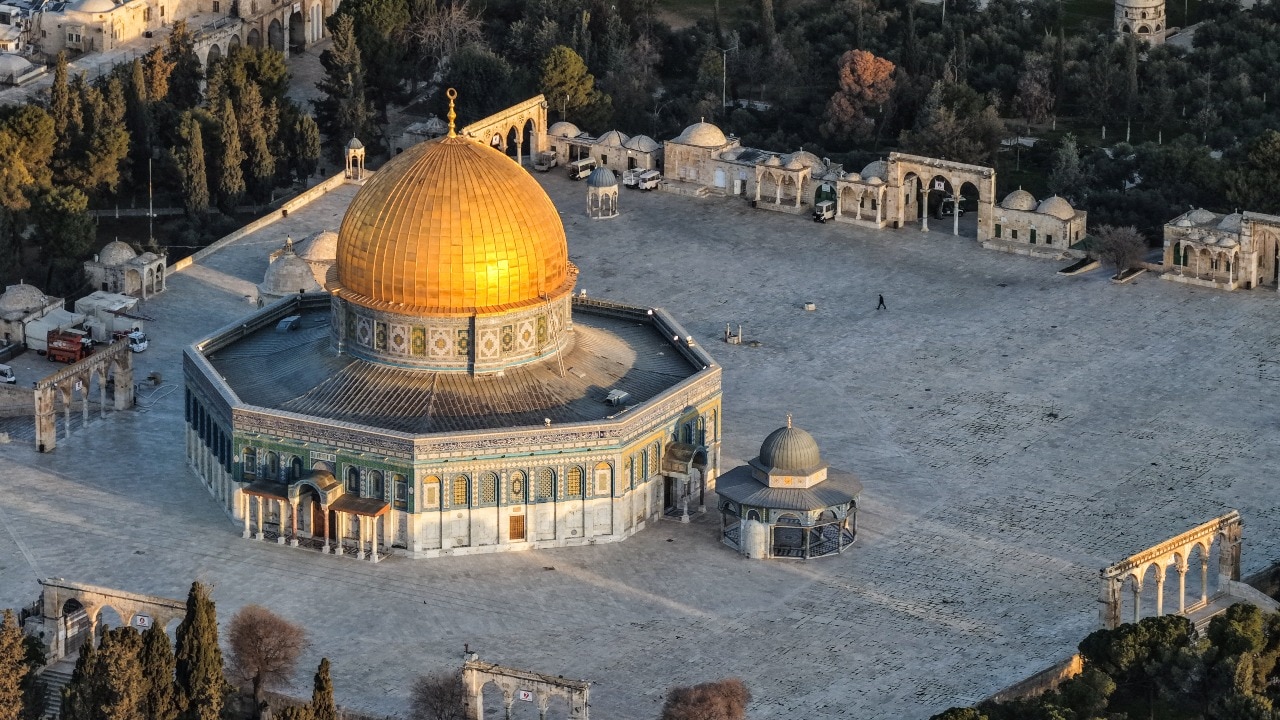
A sombre Laylatul Qadr in war-hit Middle East this year
India Today
Laylatul Qadr is considered one of the holiest nights in Islam. The Night of Decree, when Muslims keep up late into the night for prayers, is different this year. It is a sombre Laylatul Qadr night amid fears for life and safety amid the US-Israel-Iran war in the Middle East.
The dusk on Sunday marked the beginning of one of Islam's holiest nights, the Laylatul Qadr. But across the Middle East, the mood has been anything but joyous. On the occasion, also known as the Night of Power, the mood across the Gulf nations has been tense, as there is fear of missiles raining down from neighbouring Iran, which is at war with Israel and the US.
This year, Laylatul Qadr falls between March 15 and 16.
The compound of Jerusalem's Al Aqsa Mosque, also known to Jews as the Temple Mount, was empty. Instead of buzzing with prayers and community gatherings, worshippers prayed at makeshift spots outside the mosque.
Ramadan is a time of prayers. The attacks on Iran and the killing of its Supreme Leader, Ayatollah Ali Khamenei, along with several other leaders had already made the month of prayers a grim time this year.
The night holds deep meaning in Islam. It is when Muslims believe the first verses of the Quran were revealed to Prophet Muhammad by the angel Gabriel.
The Quran describes it as "better than a thousand months", a time of blessings, forgiveness, and decree where one's fate for the year is decided. Traditionally observed on one of the odd nights in the last 10 days of Ramadan, it involves extra prayers, Quran recitation, and charity.


A father travelling with his toddler addressed fellow passengers ahead of a flight, asking for patience and understanding if his child became unsettled.

The lottery system for a segment of Green Cards, known as the Diversity Immigrant Visa programme, has been restarted. However, the stricter rules being enforced by the US won't impact Indian Green Card aspirants. Here's why.

Instead of putting an end to rumours, the video has triggered another wave of speculation about Netanyahu's fate. Several users on 'X' (formerly Twitter) have claimed that the video posted on 'X' was an AI-generated deepfake.

US jets strike military facilities near Iran's Chabahar free trade zone

The video, recorded inside the train coach, shows the compartment littered with snack packets, water bottles, soiled spoons and bedsheets scattered on the floor.

The US is planning to deploy a third aircraft carrier in the Middle East amid the war with Iran. Aircraft carriers, one of the most expensive defence systems, are floating military bases that project power. Here's how aircraft carriers are used and where India stands.

Donald Trump warned that Nato could face a 'very bad' future if member states fail to help reopen the Strait of Hormuz, and to support Washington's efforts amid the ongoing US-Israeli war with Iran.

When we look at Iran through the prism of religion and see a Shia Islamic country, we negate its thousands of years of rich pre-Islamic Persian culture. A dive into the world of Zoroastrianism and Vedas shows us how Indians and Iranians have been sharing languages, Gods, sciences and a sacred fire for thousands of years.

Israeli Prime Minister Benjamin Netanyahu responded directly to his death rumours by releasing a new video intended to show he was alive and continuing his duties.

A couple and two children were killed when Israeli fire hit their car in the West Bank. Two injured boys survived, their story reveals the terrifying final moments inside the vehicle.

A Bengaluru resident's social media video documenting his struggle with severe traffic congestion on his short daily commute has drawn attention to the persistent problem faced by city commuters.

A CISF officer at Delhi's Terminal 3 tracked down a passenger who left his passport at security after arriving from the US, earning public thanks and highlighting the agency's commitment to service.

In a post on X, Ali Larijani, secretary of the Supreme National Security Council of Iran, said, "I've heard that the remaining members of Epstein's network have devised a conspiracy to create an incident similar to 9/11 and blame Iran for it."