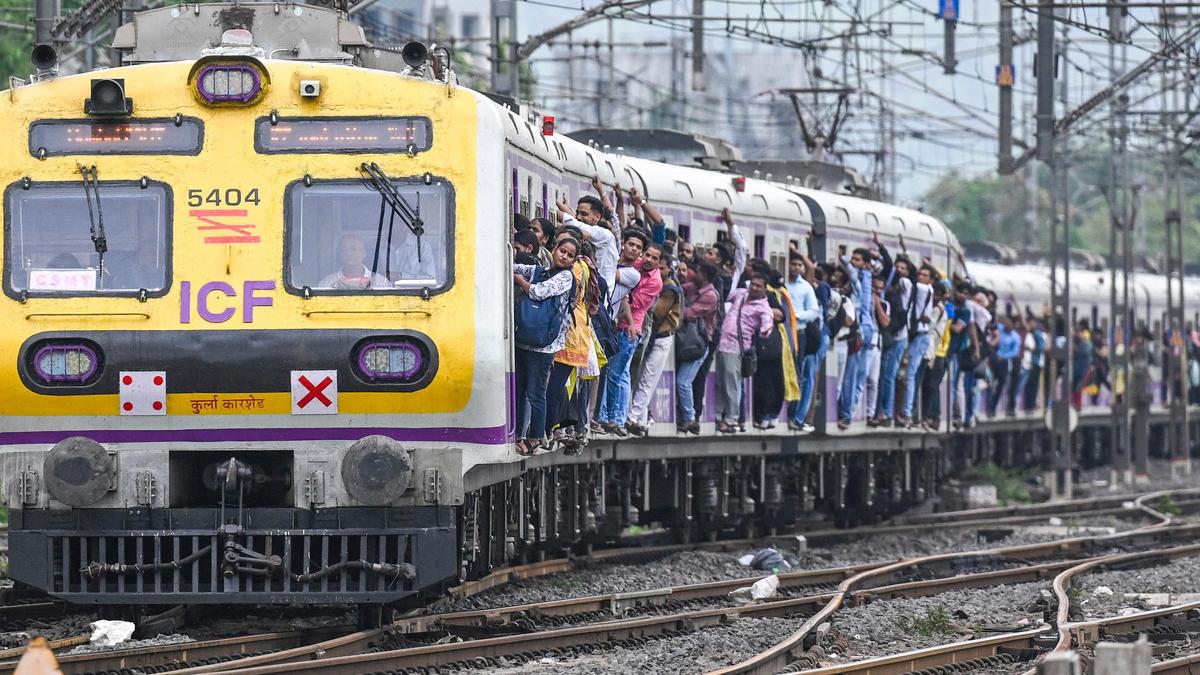
What does the Budget offer urban India?
The Hindu
The Union Budget 2026 signals a concerning fiscal contraction for urban India, prioritizing metros over essential services like housing and sanitation.
As the Union Budget 2026 was placed before Parliament, the Finance Minister once again invoked the familiar triad of capital investment, growth momentum and the long-held vision of ‘Viksit Bharat’. Cities were spoken of as engines of development, enablers of productivity and sites of future opportunity. Yet when one moves from rhetoric to arithmetic, urban India emerges not as a priority but as a sector quietly absorbing fiscal contraction.
The headline fact is stark: the total central outlay for urban development has fallen from ₹96,777 crore in the previous year to ₹85,522 crore in 2026-27. This is a reduction of ₹11,255 crore, amounting to a shrinkage of about 11.6%. When inflation is factored in, the real cut is even sharper. In effect, urban India is being asked to do more with less, at precisely the moment when cities face mounting pressures of migration, climate stress, infrastructure fatigue and job creation.
This contraction also signals a deeper problem: while the government continues to foreground capital expenditure at the macro level, urban development is no longer seen as a growth-critical investment space, but rather as a residual category to be adjusted once larger fiscal priorities are met.
Within this shrinking envelope, the structure of spending remains deeply skewed. Metro rail projects continue to dominate urban allocations, even as overall urban spending contracts. The allocation for metro and mass rapid transit projects has declined from ₹31,239.28 crore to ₹28,740 crore, a reduction of ₹2,499.28 crore. In percentage terms, this is a cut of roughly 8%. While this appears as moderate, the larger picture tells a different story.
Out of the total urban outlay of ₹85,522 crore,metro rail alone accounts for ₹28,740 crore, which translates to approximately 33.6% of all central urban spending. In other words, one-third of India’s urban budget continues to be absorbed by a single transport mode.
This is not a neutral policy choice. Metro systems are capital-intensive, spatially limited and socially selective. They primarily serve dense corridors in large cities and cater disproportionately to formal, middle-class commuters. They are important, but they are neither the most inclusive nor the most scalable solution for India’s urban mobility crisis. What is missing is proportional investment in bus-based public transport, non-motorised transport, suburban rail, and last-mile connectivity — modes that actually carry the urban majority. By continuing to privilege metros even within a shrinking budget, the state reinforces an urban imagination that prioritises visibility over universality.


A 4.6-magnitude earthquake shook Kashmir's Baramulla district early Monday, with no reported damage.

The Hindu Morning Digest gives a select list of stories to start the day. Read the top news today on February 2, 2026

Delhi experiences a colder February start with a maximum temperature of 24.6°C, slightly above seasonal averages.

Discover waste-to-energy technology, transforming non-recyclable waste into fuel while balancing environmental benefits and drawbacks.

Explore Sunny Singh's "Refuge: Stories of War (and Love)," an anthology revealing resilience and tenderness amid the devastation of war.

Assam's government faces backlash for allegedly transferring tribal lands to corporations for mining and hydropower projects, risking displacement.

Himachal CM Sukhu criticises the Union Budget for being inequitable and neglecting crucial State priorities and financial support.

The Madras Canine Club's dog show celebrated its Golden Jubilee with a grand finale featuring diverse breeds and prestigious awards.

Union Budget 2026 leaves low-income families like A. Nagaraj's grappling with rising costs and stagnant earnings, seeking relief.

Coimbatore MSMEs welcome the budget's focus but express disappointment over unaddressed raw material challenges and rising operational costs.

Srinagar youth share their aspirations and challenges in a PDP initiative, inspiring hope amid silence and despair, says Mehbooba Mufti.

State Highways Dept. begins ₹17.65-crore bridge project over Viruthasiri river, benefiting 28 villages in Ranipet district.

National Fibre scheme to integrate various schemes for natural and man-made fibres under Textiles Ministry