Valivil Ori - a great archer and one of the Last Seven Philanthropist Chieftains Premium
The Hindu
Valvil Ori, a philanthropist chieftain from Sangam period, is celebrated annually in Tamil Nadu with archery competitions and festivals.
A poem in Thirikatukam, an ancient Tamil literary work, says the only purpose of making money is charity (Eetharku Seika Porulai). While Thirikatukam belonged to the post-Sangam period, Tamil kings in the Sangam period stood testimony to the concept espoused by it. Prominent among them were Kadaiyezhu Vallalkal (Last Seven Philanthropist Chieftains), and Valivil Ori was one of them. He ruled the Kolli Hills. The Tamil Nadu government organises a festival every year in memory of Ori.
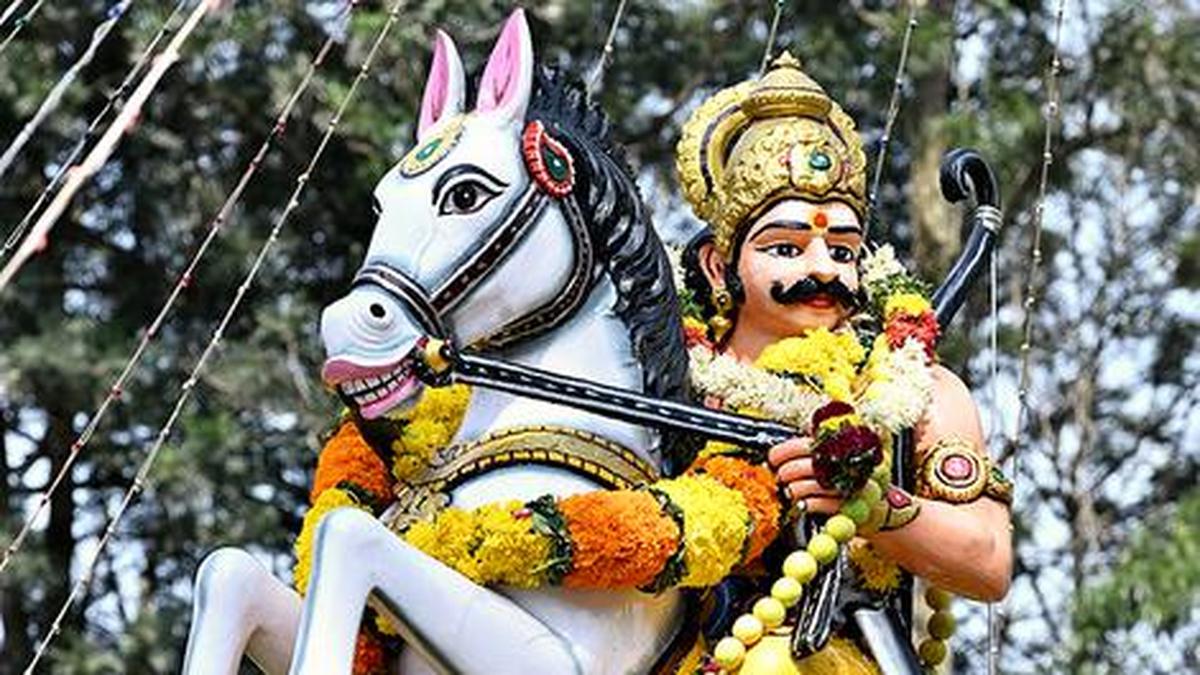
Though Sangam literary works make a reference to these chieftains, Sirupanaatru Padai, one of the ten literary works (Pattuppattu), praises the deeds of all of them. As his name suggests, Valvil Ori was a great archer. Poet Paranar says he was able to kill an elephant, a tiger, a deer, a wild boar, and a monitor lizard in a single shot. According to Tamil Lexicon, ori means the dark blue colour of matured honey, and it is believed that it was also the skin colour of Ori. The name of his horse with a mane was also called Ori.
According to Sirupanaatru Padai, he donated tracts of land boasting small hills and populated by sura punnai trees (Alexandrian laurel) with sweet-smelling flowers to koothars (dancers and singers). He constantly fought with another chieftain, Malaiyaman Thirumudikari, and was finally killed in a battle. Ori is said to have been born in the Kongu region. Through his skills in archery, he freed some parts of the Kongu region (the Kolli Hills and Rasipuram) from the Chera dynasty and ruled them. The Kolli Hills, ruled by Ori, is the natural boundary that separates the Chera and Chola countries.
The Kolli Hills is a major mountain range in the Eastern Ghats in Namakkal district. It is 48 km from Namakkal and there are 70 hairpin bends in the Kolli Hills. The mountain ranges from 3,500 feet to 4,500 feet above sea level. This mountain finds a mention in the works of Sangam literature. Earlier, there were 14 countries in the Kolli Hills that were ruled by Ori. In the present day, these countries have become 14 panchayats comprising 773 villages. Besides these 14 countries, Ori ruled four countries (the present-day Rasipuram). Information about Valvil Ori is available in Agananooru, Purananooru, Kurunthogai, Natrinai, and Sirupanaatru Padai.
Ori is said to belong to the last Sangam period. Historians define the period as from 145 AD to 200 AD and reckon that he had ruled from 145 AD to 165 AD. He was a great warrior who secured a place in Tamil history through charity. Tamil literary works say Ori gave gold to poets, elephants to Sri Lankans, and money to folk dancers. Every day, Ori used to donate an elephant. The people who received money or elephants would also receive food from him. Poets Paranar, Vanparanar, Kabilar, Kazhaithin Yanaiyar, Perunchithiranar, Nallur Nathanar, and Palathanar had sung in his praise. Ori was also said to be a relative of Adhiyaman, another philanthropist chieftain, who ruled Thagadur (the present-day Dharmapuri). Ori married Venmalai and they had a daughter, Paavai, alias Porkodi. Ori worshiped Kollikuzhiraraipalli Sivan (the Arappaleeswarar Temple).
Ori had a fort at Valappur in the Kolli Hills. He refused to be a vassal of Chera King Perum Cheral Irumporai. Already, there was enmity between Valvil Ori and Malaiyaman Thirumudikari. Following Ori’s refusal to accept Irumporai’s proposal, Malaiyaman joined hands with Perum Cheral Irumporai’s army and invaded the Kolli Hills. In the battle, Ori, his wife, and daughter were killed. Later, his country was given to Perum Cheral Irumporai’s army general Pittang Kottran.
It was late Chief Minister M. Karunanidhi who started the annual festival to commemorate Ori. Since 1975, on every 17th and 18th day of the Tamil month of Aadi, the Valvil Ori Festival has been celebrated as a government function. Karunanidhi himself participated in the first edition held at the Kolli Hills on September 6, 1975, and unveiled a statue of Valvil Ori near the Kolli Malai bus stop at Semmedu. In this statue, Valvil Ori is sitting on his horse.


TIMS Sanathnagar inauguration on Ugadi uncertain as construction, staffing gaps persist

Mumbai's water crisis escalates as corporators highlight irregular supply and reliance on costly private tankers amid administration neglect.

Explore the evolution of cooking fuels in Madras, from wood and coal to the rise of LPG, amid recent shortages.

Protests against the Sharavathi Pumped Storage Hydroelectric Project in the Western Ghats just got new life

51 couples take thebig plunge at Udaipur mass wedding event

A bridge collapse in Roop Nagar kills a woman; Delhi government forms a probe panel amid rising safety concerns.

Tribunal halts Colonel Purohit's retirement, pending promotion decision after his acquittal in the 2008 Malegaon blast case.

Pinarayi Vijayan launches his election campaign in Dharmadam, aiming for a third consecutive term amid tightening competition.

Delhi Speaker Vijender Gupta has written to Lieutenant-Governor Taranjit Singh Sandhu seeking directions to instal audible signals at traffic intersections across the city to ensure the safety of mobility-impaired individuals and senior citizens.

GVMC council concludes its five-year term, highlighting significant development projects and global events that enhanced Visakhapatnam's recognition.

Karnataka SC/ST Commission discusses internal reservation issues amidst confusion over reduced quotas for Scheduled Castes and Tribes.

President Droupadi Murmu serves Akshaya Patra’s 5 billionth meal, highlighting child nutrition and education at Rashtrapati Bhavan.

PM Modi and UAE President agree on ensuring safe navigation through the Strait of Hormuz amid regional tensions.