Udhagamandalam’s own Charing Cross and its London disconnect Premium
The Hindu
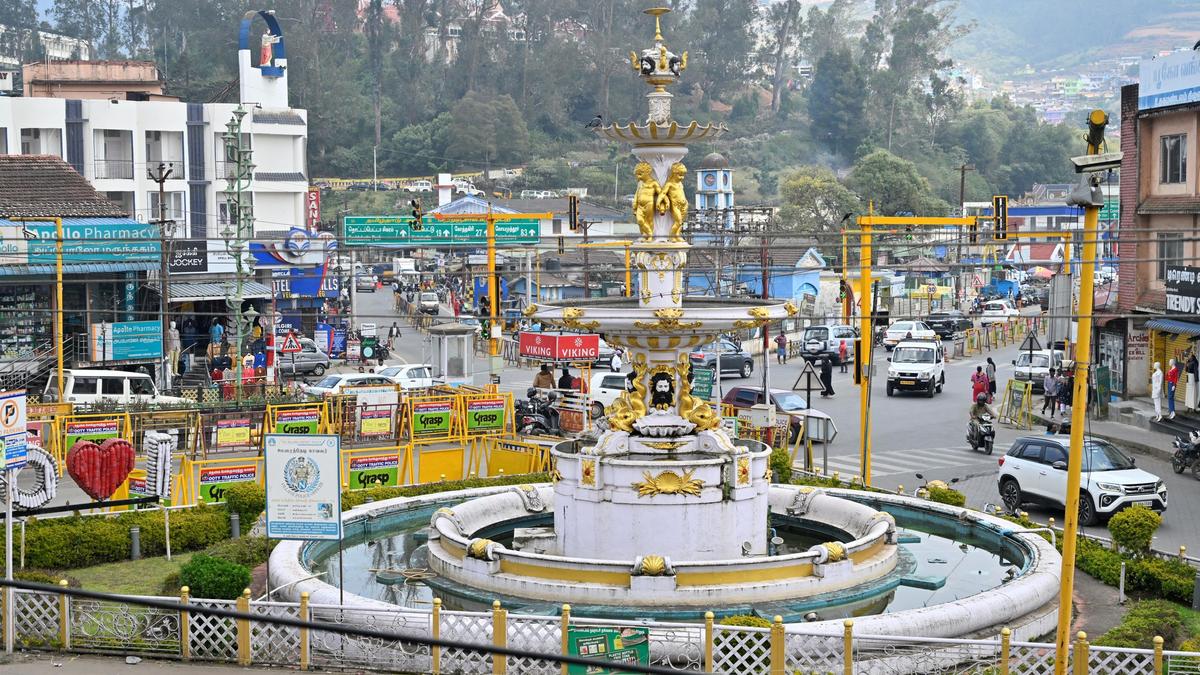
Explore Udhagamandalam's Charing Cross, its historical significance, and the amusing London connection that confuses visitors.
It is a matter of amusement among residents of The Nilgiris that visitors to the hill station, looking to find Charing Cross on navigation services, are confused at being redirected to the location of the same name in London.
Charing Cross, which has also come to be spelled Charring Cross over the years, has long been the entrance to Udhagamandalam, the district headquarters. However, little is known about how its name came to be. “The name of this busy London railway station has long been applied to the road junction in Ootacamund below Breeks School, where the Coonoor Road makes connection with the Mysore Road, Kotagiri Road, Garden Road and Commercial Road... In its centre is an ornate public fountain commemorating William Patrick Adam, a Governor of Madras,” writes anthropologist Paul Hockings in his Encyclopedia of The Nilgiri Hills.
Hockings says the “Ootacamund crossroads and the London railway station could not be more dissimilar, for while Ootacamund’s Charing Cross is just a crossroads,” while Charing Cross in “Central London recalls a no-longer-extant memorial stone cross that Kind Edward I erected, the last of a series spread across the country from Lincolnshire where his Queen Eleanor had died in 1290, marking the places where her corpse had rested on the way back to London.”
Despite these observations on the dissimilarities of the two sites, it has become an enduring myth among many residents that the Charing Cross in Udhagamandalam is modelled on the one in London.
P.J. Vasanthan, a resident interested in The Nilgiris’ history, told The Hindu that the name first appeared in 1838, a few years after the Coonoor Ghat Road was opened and the junction at the entrance of Udhagamandalam was formed. In 1847, British explorer Sir Richard Francis Burton mocked the name as “established but underwhelming”.
Local historians believe the Charing Cross in Udhagamandalam could have been named for its function as a four-road junction, similar to its namesake in London. Mr. Vasanthan said that after the Coonoor Ghat Road was opened, shops and businesses came up around the area and people started calling it Charing Cross because of the influence of the British administration. “Before the opening of the Coonoor Ghat Road, travellers would make their way up the slopes to the village of Dhimbatty near Kotagiri, travel through Thummanatty and to Doddabetta, and walk downwards into the heart of what is today Udhagamandalam town,” he said. “Since a cluster of shops was being formed at the time owing to the opening of the Ghat Road, the name of Charing Cross stuck,” he said.


Scientists in Kashmir develop early-maturing wheat varieties to enhance crop cycles and boost food production for local farmers.

Karnataka to introduce 10% women’s quota in firefighter recruitment, promoting gender neutrality in the Fire and Emergency Services Department.

Venezuela's legislature approves an amnesty bill, potentially releasing hundreds detained for political reasons amid ongoing human rights concerns.

Explore the challenges and potential revival of India's sandalwood industry amidst high demand and economic shifts.

Here are the top news for the day from The Hindu's Morning Digest, on February 20, 2026

Student groups demand Delhi University reverse its protest ban, calling it undemocratic and harmful to campus dialogue.

Supreme Court questions a pharma firm over cough syrup deaths, highlighting significant damage to India's image and legal violations.

Discover captivating mysteries and haunting tales in February 2026's top book recommendations for thrilling reads this month.

Explore Udhagamandalam's Charing Cross, its historical significance, and the amusing London connection that confuses visitors.

Kishtwar's regulation of Ramadan charity sparks criticism from political leaders, citing concerns over religious freedom and government interference.

PSMO College hosts a historic reunion of 57 alumni serving as political leaders, celebrating their contributions to public service.

Explore Periyar's controversial views on Tamil as a "barbaric language" and their implications for cultural identity and progress.

Explore the importance of early dental visits in preventing tooth decay and fostering lifelong oral health in children.