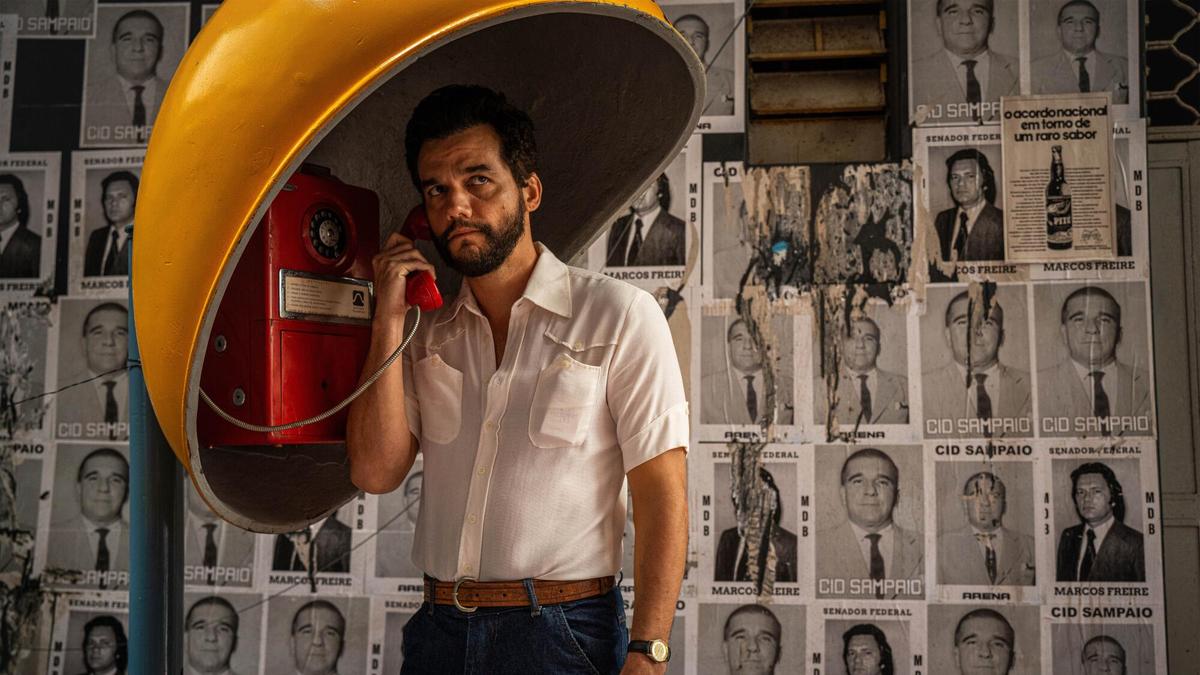
‘The Secret Agent’ movie review: Wagner Moura smoulders in Kleber Mendonça Filho’s masterful anatomy of political fear
The Hindu
The Secret Agent movie review: To anatomise fear as fiction is to recognise its very real mechanics in the places we actually live, and that uncomfortable truth is what elevates ‘The Secret Agent’ above and beyond the year’s more self-satisfied seriousness
I wasn’t bracing myself for this to end up as my absolute favourite film of the year, especially with its Cannes contemporaries in Jafar Panahi’s It Was Just an Accident and Joachim Trier’s Sentimental Value making perfectly reasonable claims for the crown, but the deal was effectively sealed once I realised that The Secret Agent intended to feature a great white shark both on screen and off it — as flesh-and-blood predator that populates the headlines like an idée fixe, and as Jaws (Tubarão in its Brazilian incarnation) tearing through Recife’s cinemas for the first time — because any film that keeps Spielberg’s great communal fright carried by my preferred apex predator in active circulation has already anticipated my weaknesses.
That personal bias may have tipped the film towards something generational for me even once it became clear that Kleber Mendonça Filho wasn’t indulging trivia or nostalgia. With his Oscar-nominated follow-up to his 2023 Recife-set documentary, Pictures of Ghosts, the Brazilian auteur seems to fully grasp that cinema tutors its audiences where to deposit their fears, and once something as absurd as a shark becomes the popular container for civic anxiety, the real machinery of violence gains room to operate elsewhere with minimal scrutiny.
Set in Recife in 1977, at the height of Carnaval and deep into a regime that had learned how to disappear people quietly, the film follows Marcelo (played by a bravura Wagner Moura) a widowed university researcher traveling under a false name after crossing a federal official who attempted to privatise his publicly funded work. Unsurprisingly, the act of professional resistance soon turns into a death sentence administered through hired killers and obliging police.
The Secret Agent is the most concentrated articulation yet of what Mendonça Filho has been circling throughout his career, that extends the spine of ‘60s-’70s Cinema Novo, and tells the same story of people fighting to keep their bearings while global capitalism, state power, and cultural vandalism close in from every side, with restless ingenuity. Each film finds a new formal route, yet the pressure remains constant, as persecuted individuals improvise flotation devices from memory, cinema, rumour, and stubborn attachment to place, trying to stay afloat while an unseen war grinds away at the conditions that once made their world legible.
Moura is introduced through one of Mendonça Filho’s most rigorously designed openings, as Marcelo stops his striking, yellow Beetle at a rural gas station where a corpse lies decomposing under cardboard while the police ignore the body and focus on extorting him. The opener established a moral order under Brazil’s erstwhile military dictatorship in which violence has been fully absorbed into administrative habit.
A still from ‘The Secret Agent’ | Photo Credit: Neon


Khalid Rahman is reuniting with Malayalam superstar Mammootty after Unda (2019). The Thallumaala director has teamed up with the veteran for Mattancherry Mafia.

Bollywood actor Akshay Kumar paid tribute to the martial arts grandmaster and Hollywood’s action star, Chuck Norris, who passed away on Thursday, March 19, 2026.

Renowned Odissi dancer Madhumita Raut, aged 59, dies of cardiac arrest, leaving behind a legacy of artistic achievements.

Chuck Norris, iconic martial arts master and actor, dies at 86, leaving behind a legendary legacy and internet memes.

South African naturalist Steve Boyes speaks on ghost elephants, ancestral tracking, and Werner Herzog’s documentary exploring Angola’s elusive highland giants

Actor-director Amol Palekar will receive META's Lifetime Achievement award for 2026 on March 25 in New Delhi.

India's artists unite against rising censorship, advocating for creative freedom and support for marginalized voices in the arts.

Written and directed by Kunal, the film also stars Sparsh Shrivastava and Vanshika Dhir

This year, Bharatnatyam artistes will present the Tyagaraja Aradhane as a dance performance

This year, Bharatnatyam artistes will present the Tyagaraja Aradhane as a dance performance

The actor, along with director Sushant Shah, speak about their upcoming series ‘Chiraiya’, Divya’s process of working on the dialect, Sushant’s approach to telling a story about women, and more

An independent video, ‘Feel the Spark’ by Raleigh Rajan with vocals by Ciera Dumas that celebrates Tamil literary giants, garnered 1.4 million views in less than 36 hours.

In ‘Jack Ryan: Ghost War’, John Krasinski is back as the savvy CIA analyst, diving headfirst into a high-stakes mission that unravels a deadly conspiracy and pits him against a rogue black-ops unit