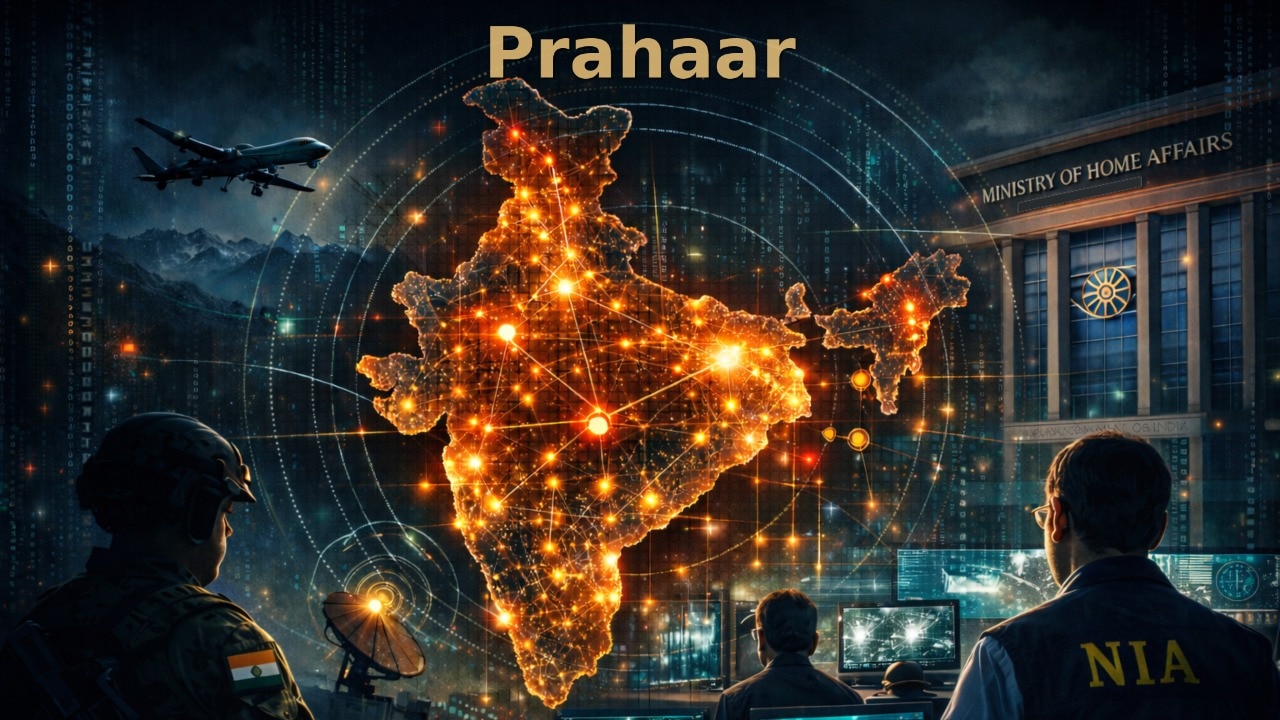
The grammar of counter-terrorism: What Prahaar really signals
India Today
Prahaar codifies India's counterterrorism doctrine, prioritising intelligence-led disruption, legal rigor, uniform state capacities, tech-enabled surveillance, and international coordination to pre-empt, deter, and prosecute threats.
India’s counter-terrorism story has been anything but linear. It has been forged in blood in the lanes of Amritsar, in the apple orchards of Jammu and Kashmir, in the smoke-choked dome of the Taj Mahal Palace Hotel, and in the forward posts across the Line of Control. Each decade has forced doctrinal introspection, and each attack has redrawn the grammar of response.
The newly unveiled Prahaar (National Counter-Terrorism Policy & Strategy) by the Ministry of Home Affairs (MHA) is therefore less an isolated thunderclap and more an articulation in a long, evolving doctrine, one that has moved from reactive policing to intelligence-led disruption, from territorial defence to transnational response.
The first doctrinal phase was territorial and kinetic. In the crucible of Punjab in the 1980s and in the protracted insurgency in Jammu and Kashmir, the State refined a template built on granular human intelligence, domination of terrain, disruption of overground networks, and political reabsorption once the insurgent arc was broken. Counterterrorism was state-driven, police-led, and geographically bounded. It was a doctrine of attrition.
The second inflection followed the attacks of November 2008. The siege at the Taj Mahal Palace Hotel was a forensic exposure of systemic gaps - stovepiped intelligence, uneven coastal security, fractured intelligence dissemination, and delayed specialised response. The response was institutional architecture.
The creation of the National Investigation Agency (NIA) provided a federal investigative spearhead; the expansion of hubs of the National Security Guard (NSG) shortened response timelines; and the institutionalisation of the Multi Agency Centre (MAC) embedded intelligence fusion into routine practice. Counterterrorism became intelligence-guided and legally structured. Structure acquired primacy over spectacle.
A third doctrinal inflection followed the 2016 Uri attack, the 2019 Pulwama bombing, and Operation Sindoor. India demonstrated calibrated punitive capability through overt cross-LoC action and air power. Deterrence entered the lexicon. Counter-terrorism was confined no longer to neutralisation; it had acquired external signalling.


India Today's OSINT team identified at least 22 Indian-flagged vessels operating in the Gulf region, including seven LPG carriers, seven oil tankers, four container ships, two bulk carriers, one tug and one dredger.

India on Monday said it has not held bilateral talks with the United States on deploying naval vessels to secure merchant shipping in the Strait of Hormuz. The clarification came after US President Donald Trump urged countries to send warships to keep the strategic waterway open amid tensions with Iran.

After attacking his wife, Nafees attempted suicide by inflicting injuries on himself with the same scissors. Neighbours intervened after hearing the commotion and stopped him from taking his own life.

The victim, identified as Naitik Kumar, allegedly rammed his speeding Bullet motorcycle into a scooter near Janeshwar Mishra Park in Lucknow, triggering a crash that left him dead and two others injured.

RJD MLA who skipped Bihar Rajya Sabha poll voting cites mother's illness

West Bengal Chief Minister Mamata Banerjee led a protest march in Kolkata against the alleged LPG shortage, accusing the PM Narendra Modi-led Centre of failing to ensure adequate supply.

Himayani Puri, daughter of Union Minister Hardeep Singh Puri, has moved the Delhi High Court over "false and malicious" reports linking her to convicted sex offender Jeffrey Epstein.

The family, a resident of Thyagaraju Street in Punganur town, had recently repaired the engine of their two-wheeler vehicle. A local mechanic advised the family to keep the engine running overnight to "set" the newly installed parts. However, this turned out to be fatal for the family.

The Supreme Court closed criminal proceedings against Ashoka University professor Ali Khan Mahmudabad after the Haryana government said it would not grant sanction to prosecute him over social media posts related to Operation Sindoor.

Three Congress MLAs in Bihar are reportedly out of contact as voting for five Rajya Sabha seats is underway, with the INDIA bloc and the BJP-led NDA locked in a tight contest for the fifth seat that could hinge on cross-voting.

Bunty Solanki stabbed his wife to death following a quarrel at their residence in Vadodara's Bakrawadi area. Rita died on the spot.

The girl's family members were angered over the friendship, and as a result, they called Jadhav last Saturday evening and allegedly beat him.

External Affairs Minister S Jaishankar has said that direct talks with Iran to restore shipping through the war-hit Strait of Hormuz have yielded results, stressing that direct engagement with Tehran is the most effective way to address the disruption.