The grammar of belonging in Barpeta’s Dol Jatra
The Hindu
Barpeta’s Dol Jatra reveals how theology, ecology and shared labour can reimagine community in an age of fragmentation.
The shimalu trees burn red before anyone speaks of colour. Their petals fall on the earth like scattered embers, staining the late winter light with a restlessness that only Phagun understands. In the courtyards of Barpeta Satra, the air thickens with dust and anticipation. It smells of oil, of dusty soil, of woodsmoke waiting to rise. The season does not announce itself with spectacle. It gathers slowly. Then it overtakes the town.
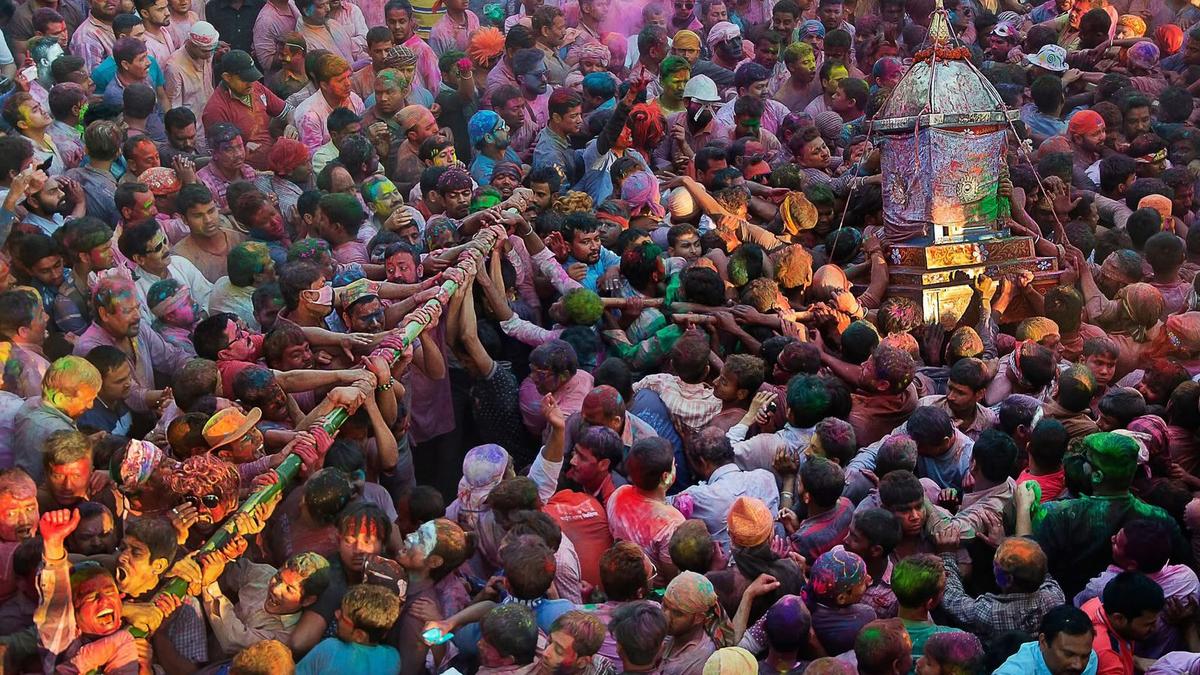
Across India, spring festivals arrive as dates on a calendar, often compressed into long weekends and social media carousels. But in Barpeta, the Dol Jatra started by the Srimanta Sankardeva tradition unfolds differently. It is not merely observed. It reorganises society momentarily. The front yard of the Barpeta Satra becomes a civic square without barricades. Professional hierarchies blur. Domestic routines pause. The festival does not escape the world; it redraws it.
We live in a country that prides itself on mobility and speed. Cities grow vertically. Work migrates online. Identities are debated in news studios and on social media timelines. We inhabit high rises and timelines, but rarely each other’s company. Modern life has perfected segmentation. We are efficient, connected, and increasingly alone. Even public disagreement has acquired a metallic edge. It is sharp, amplified, and rarely patient. In such a social landscape, the Dol Jatra of Barpeta appears less as nostalgia and more as proposition.
At the theological level, the Neo Vaishnavite imagination that Srimanta Sankardev shaped refuses to separate the sacred from the soil. The divine is not remote. It breathes in pollen and river wind. The Holi geets sung in the satra front yards do not hover above nature as abstraction; they sink into it. Rain, dust, riverbank, reed. The vocabulary is ecological before it is doctrinal. Spiritual health, the songs insist, is inseparable from the health of land and water. A society that poisons its river cannot purify its conscience. That sentence may sound severe. It is meant to be. The theology here is not insulated from consequence.
From theology, the festival moves seamlessly into economy. In the days of Dol Jatra, the lanes around the kirtanghar thicken with enterprise. Artisans arrive with iron korahis and coils of firewood. Jilapis coil in hot oil. Tepar nimki is shaped by hand. Bogori chops wait in the glass vessels. Shops that usually sell vanity bags and hair clips clear their counters for aloo bhaja and ranga dima. Commerce does not retreat from devotion; it participates in it. The festival democratises storefronts. It dissolves rigid distinctions between sacred and profane labour. In a time when economic growth is measured in quarterly reports, here growth is measured in shared sustenance.
The performance of Holi geet deepens the architecture of equality. A pathak begins a verse. The palis respond. The rhythm builds. Dwipchandi slows the pulse before Kaharwa quickens it. When the jhumri phase arrives and the dholak answers the khanjari, the line between performer and listener collapses. Participation replaces spectatorship. The frenzied claps becomes argument. In that collective tempo, hierarchy loosens its grip. One does not consume the song. One enters it.


Farmer Rajeev dies in Wayanad, Kerala, suspected elephant attack; locals demand better protection and compensation for wildlife-related incidents.

A 33-year-old software employee was found dead in his car alongside ORR, prompting a police investigation in Hyderabad.

Negotiations continue in Maharashtra as MVA seeks consensus on Rajya Sabha candidate amid BJP's announcement of four nominees.

Join the 'Shakti' exhibition at Alliance Française Madras on March 7, celebrating female power through textile art and workshops.

Barpeta’s Dol Jatra reveals how theology, ecology and shared labour can reimagine community in an age of fragmentation.

The Iran war disrupts global supply chains, affecting oil, pharmaceuticals, and electronics, leading to potential shortages and price increases.

South Western Railway reports ₹8,550 crore revenue, with freight and passenger earnings showing significant growth in February 2026.

Klook’s Spring Readiness Index shows how Asia’s travelers are preparing for spring travel across Japan, South Korea, and Mainland China

NIA court seeks China's legal aid to trace GoPro linked to Pahalgam terror attack, uncovering critical evidence for investigation.

Vigilance court grants statutory bail to former TDB president A. Padmakumar in Sabarimala gold misappropriation case.

State-level training on creating a child-friendly society begins at Central University of Karnataka with 55 participants from across the state.

164 stranded Maharashtra tourists return home from West Asia on flights arranged by Deputy Chief Minister Eknath Shinde amid conflict.

Vaishnavi Adkar advances to the second round of the ITF W35 tennis tournament in Kalaburagi after a dominant victory.