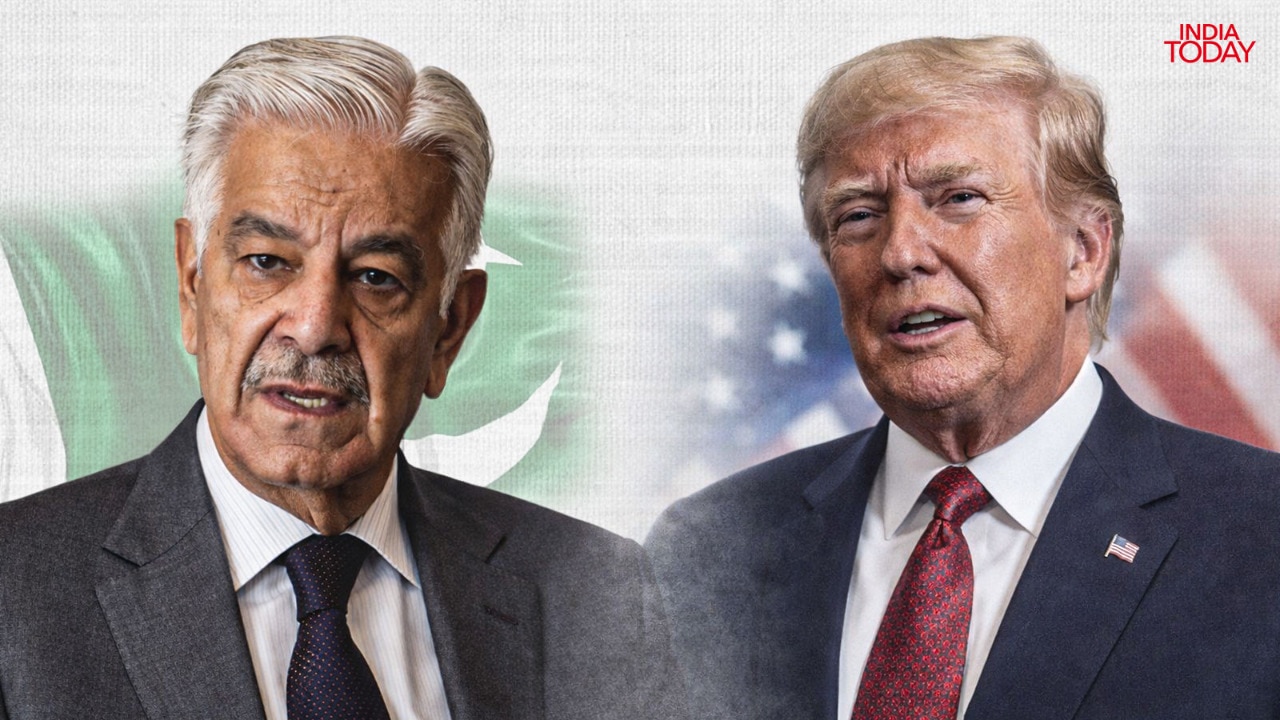
The Biography of a Toilet Paper: How Pakistan became America's Disposable Ally
India Today
For seven decades, Pakistan has repeatedly offered itself as America's strategic pawn, only to be discarded when no longer useful. It is a pattern of servitude enabled through its own desperation and greed.
In a candid admission of Islamabad's transactional alliance with Washington, Pakistan's Defence Minister Khawaja Asif lamented in Parliament that his country has been treated “worse than toilet paper” by the United States.
The relationship between the US and Pakistan since 1947 represents one of the most complex and tumultuous partnerships in Cold War and post-Cold War geopolitics. But Pakistan has only itself to blame for this predicament.
Soon after its birth, Pakistan was desperate to sit in Washington's lap. The United States did not immediately embrace Pakistan after it emerged from India's partition in 1947. India, as the larger democracy under Jawaharlal Nehru's leadership, initially appeared the more attractive partner. However, Nehru's commitment to non-alignment frustrated American policymakers seeking allies to check Soviet expansion.
In 1949, Pakistan managed an invitation from Joseph Stalin to visit Moscow. This was largely seen as a diplomatic stunt to prompt an invitation from the US, which had been somewhat lukewarm toward the new nation. When the US invitation arrived, Prime Minister Liaquat Ali Khan accepted it and postponed the Soviet one.
Khan's 1950 visit to the US marked a pivotal moment. His decision was driven by Pakistan's desperate need for military and economic assistance to counter what it perceived as an existential threat from a larger India, particularly over Kashmir.
In his address to the US Congress, Liaquat portrayed Pakistan as a bulwark against communism" and emphasised its strategic location at the crossroads of South Asia, the Middle East, and Central Asia.


The newspaper, citing officials familiar with the conversations, said the Saudi leader has been in frequent contact with Trump during the conflict and encouraged him to "keep hitting the Iranians hard" as the fighting intensifies across the region.

A video showing a woman holding a child near a moving train window for him to urinate has gone viral, stirring public outrage over safety risks.

Amid the widening US, Israel–Iran war, the cyber front intensifies as the Handala hacker group claims attacks on US companies and Israeli intelligence-linked figures.

A post about a software developer's salary in Bengaluru and savings amount has started a conversation among X users about how to save wisely.

The profiles of at least three of China's leading nuclear, missile and radar experts were scrubbed from the website of the Chinese Academy of Engineering, the country's most prestigious academic body. This comes as a series of purges under Premier Xi Jinping's anti-corruption campaign have decimated the upper echelons of China's military and scientific community.

The aircraft had also been used by senior Iranian officials and military figures for both domestic and international travel, and for coordinating with allied countries, the Israeli military said. Meanwhile, Dubai International Airport has resumed flight operations after a temporary suspension of about seven hours caused by a drone strike near a fuel tank facility.

A government school teacher's gesture of buying a new uniform for an orphaned student has received widespread attention after a video of the act was shared on Instagram.

A father travelling with his toddler addressed fellow passengers ahead of a flight, asking for patience and understanding if his child became unsettled.

The lottery system for a segment of Green Cards, known as the Diversity Immigrant Visa programme, has been restarted. However, the stricter rules being enforced by the US won't impact Indian Green Card aspirants. Here's why.

Instead of putting an end to rumours, the video has triggered another wave of speculation about Netanyahu's fate. Several users on 'X' (formerly Twitter) have claimed that the video posted on 'X' was an AI-generated deepfake.

US jets strike military facilities near Iran's Chabahar free trade zone

The video, recorded inside the train coach, shows the compartment littered with snack packets, water bottles, soiled spoons and bedsheets scattered on the floor.

The US is planning to deploy a third aircraft carrier in the Middle East amid the war with Iran. Aircraft carriers, one of the most expensive defence systems, are floating military bases that project power. Here's how aircraft carriers are used and where India stands.