Temples and mosques as a marker to study the life and times of Aurangzeb Premium
The Hindu
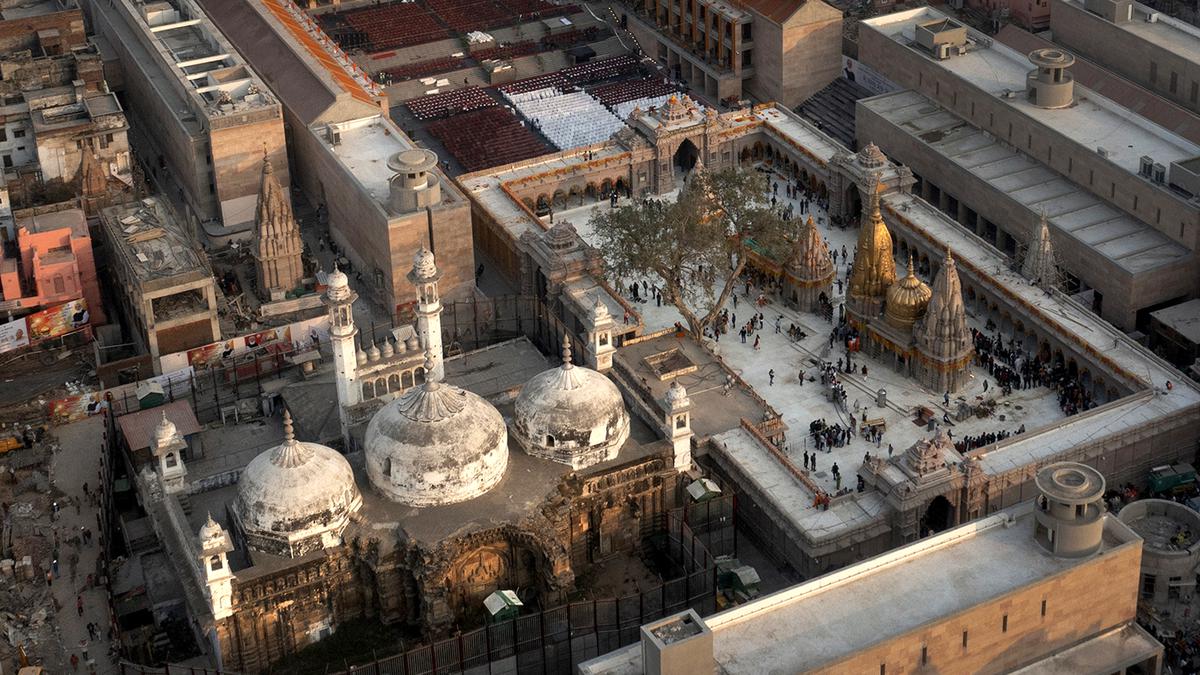
Muslims and Hindus clash over the Gyanvapi Masjid in Varanasi, a mosque built by Aurangzeb on a demolished temple.
On February 2 this year, Muslims thronged the Gyanvapi Masjid in Varanasi in almost unprecedented numbers for Friday prayers. It was not out of a new-found love for the Mughal emperor Aurangzeb who is said to have built the mosque in the 17th century but a desperate bid to stand up for a mosque, now under increasing pressure from Hindutva forces. On the same day, local Hindus thronged for darshan at the cellar or ‘Vyasji ka tehkhana’.
When and how did the masjid come up? Well, in one line, Aurangzeb demolished a temple on the land occupied by some recalcitrant zamindars and built a mosque to deprive the local warlords of their bastion. It did not start on that note though. Soon, after Aurangzeb replaced his father Shah Jahan on the Mughal throne, he is said to have shown great respect towards Brahmins and even requested them to pray for the well-being of the empire.
Writing in Aurangzeb: The Man and The Myth, historian Audrey Truschke explains, “Hindu and Jain temples dotted the landscape of Aurangzeb’s kingdom. These religious institutions were entitled to Mughal state protection, and Aurangzeb generally endeavoured to ensure their well-being. By the same token, from a Mughal perspective, that goodwill could be revoked when specific temples or their associates acted against imperial interests. Accordingly, Aurangzeb authorised targeted temple destructions.” Another noted historian, Richard Eaton, puts the figure around 12 for such temples. Amazingly, some time before he became the Emperor, Aurangzeb is said to have condemned any king who resorted to bigotry! A couple of years after assuming power, he issued a ‘farman’ in 1659 wherein he asked his officials not to disturb the Brahmins of Benares.
Expresses Truschke, “Writing in February of 1659 Aurangzeb said he had learned that ‘several people have, out of spite and rancour, harassed the Hindu residents of Benares and nearby places, including a group of Brahmins who are in charge of ancient temples there.’ The king then ordered his officials: ‘You must see that nobody unlawfully disturbs the Brahmins or other Hindus of that region, so that they might remain in their traditional place and pray for the continuance of the Empire.” Indeed, of the tens of thousands of temples during his almost 50-year reign, most stood safe and secure when his reign ended in 1707. Unfortunately, the Benares temple was not among them.
Writing in Architecture of Mughal India, noted historian Catherine Asher, states: “The destruction of Raja Man Singh’s famous Vishvanath [Vishwanath] temple in Benares was largely to punish Hindus, especially those related to the temple’s patron, who were suspected of supporting the Maratha Shivaji.” According to Asher, “The demolition of the Vishvanath Temple was intended as a warning to anti-Mughal factions, in this case troublesome zamindars and Hindu religious leaders who wielded great influence in this city.”
It is a point agreed upon by Truschke who writes, “Political events incited Aurangzeb to initiate assaults on certain Hindu temples. For example, Aurangzeb ordered Benares’s Vishvanath Temple demolished in 1669.” Incidentally, the temple had been built during the reign of his great-grandfather Akbar by Raja Man Singh. It was believed Man Singh’s great-grandson helped Shivaji flee from Aurangzeb’s court in 1666, and hence Aurangzeb’s wrath. A new Vishwanath temple was built on an adjacent site to the Gyanvapi Masjid by the Maratha ruler Ahilyabai Holkar in the 18th century.
In History of Medieval India, Satish Chandra provides a different take on the temple destruction. “He (Aurangzeb) began to look upon temples as centres of spreading subversive ideas…. Thus, he took strict action when he learnt in 1669 that in some temples in Thatta, Multan and especially at Benares, both Hindus and Muslims used to come from great distances to learn from the Brahmans.”


Vehicles in the convoy of Puducherry Chief Minister N. Rangasamy were checked by officials of a Static Surveillance Team of the Election Commission of India at Aviyur police check post on Madurai-Thoothukudi highway on Thursday.

Decorated homes, busy temples and shared feasts mark Ugadi in Hyderabad

Housing Minister seeks ₹260 crore to develop 50 slums for Karnataka's golden jubilee, urging CSR support for infrastructure enhancement.

Congress opposes VBSA Bill, citing constitutional overreach, State power encroachment, and politicization of higher education funding.

Hyderabad Airport wins Skytrax 2026 award for Best Airport Staff in India and South Asia for the fifth time.

General and Election Expenditure Observers assumed charge in Krishnagiri to monitor election processes and expenditure across six constituencies.

A detailed analysis of Puducherry’s evolving political landscape and election trends since 2011.

CPI(M) insists on six Tamil Nadu Assembly seats, while DMK offers five, causing a stalemate in alliance talks.

Unaccounted cash, articles worth ₹13.58 lakh seized in Tirunelveli in five days

Ugadi Asthanam at Tirumala temple celebrated with rituals, Vedic recitations, floral decorations, and grand festivities honoring the Telugu new year.

Srirangam temple offers herbal buttermilk and paanakam to devotees to help them stay cool during the summer heat.

VMRDA invites global bids for the Vizag Bay City project to develop a world-class integrated waterfront hub by 2026.

Civil society urges Amit Shah to direct police vigilance against open threats of communal violence in Uttam Nagar, Delhi.