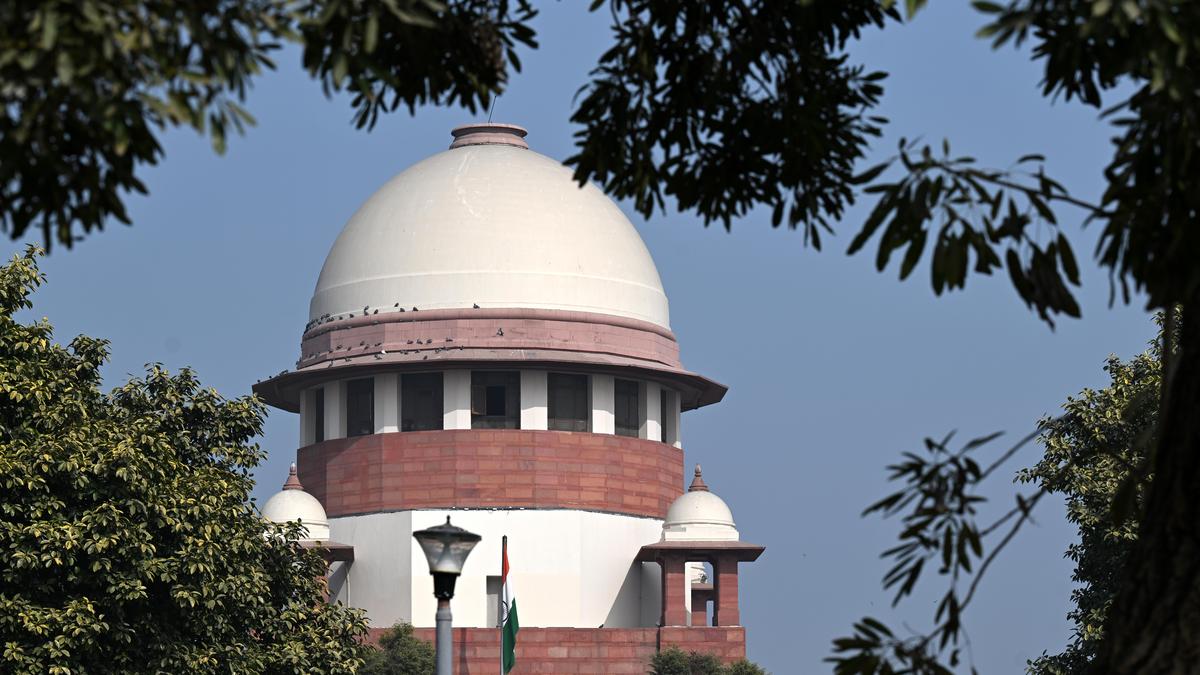
Nine-judge Supreme Court Bench reserves verdict on ambit of ‘industry’
The Hindu
Supreme Court reserves verdict on defining 'industry' under Industrial Disputes Act, impacting educational and healthcare sectors.
A nine-judge Bench of the Supreme Court reserved judgment on Thursday (March 19, 2026) on whether educational institutions, hospitals, and sovereign functions of the government and its instrumentalities would fall within the definition of ‘industrial activity’ under the Industrial Disputes Act.
The Bench headed by Chief Justice of India Surya Kant and comprising Justices BV Nagarathna, PS Narasimha, Dipankar Datta, Ujjal Bhuyan, Satish Chandra Sharma, Joymalya Bagchi, Alok Aradhe and Vipul M Pancholi reserved its verdict on the third and final day of oral arguments.
The question of law in the reference before the proposed nine-judge Bench concerns a 1978 judgment delivered in Bangalore Water Supply and Sewerage Board v. A. Rajappa by Justice V.R. Krishna Iyer as a member of a seven-judge Bench.
The 1978 judgment had expanded the definition of ‘industry’ under Section 2(j) of the Industrial Disputes Act, 1947. The judgment had introduced a triple test and included hospitals, educational institutions and municipalities as industries.
States like Uttar Pradesh, Maharashtra and Punjab, represented by Additional Solicitor General KM Nataraj and senior advocates Shekhar Naphade and Shadan Farasat, respectively, urged the apex court to relook the seven-judge Bench judgment. Senior advocates like Indira Jaising, CU Singh, and Gopal Sankaranarayan argued in favour of keeping the reasoning of the 1978 judgment intact.
Ms. Jaising had submitted that bringing enterprises under the definition of industry provide workmen with a remedy to ventilate their grievances in relation to fair wages, health and safety, occupational safety, security of employment and challenge unfair dismissals before a judicial authority. “A democratic society governed by the rule of law is dutybound to provide a grievance redressal forum of a judicial nature to all its citizens, where their substantive rights can be ventilated,” she submitted.


Modi and Jaishankar advocate for dialogue as India and France collaborate to de-escalate tensions amid escalating strikes on energy infrastructure.

The star-studded event was held in Mumbai and was attended by rithik Roshan, Alia Bhatt, Bobby Deol, Shahid Kapoor, Vijay Varma, Sonakshi Sinha, Jyotika, Ali Fazal, Sonali Bendre, Preity Zinta, Ravi Kishan and others

Shorts News:We are working on securing LPG, petroleum to meet our energy security needs: MEA

P. Veldurai served five years as MLA and was later asked to repay ₹21 lakh in Tamil Nadu.

Supreme Court reserves verdict on defining 'industry' under Industrial Disputes Act, impacting educational and healthcare sectors.

Dindigul Collector S. Saravanan held a meeting with Election Observers to ensure smooth election monitoring across seven constituencies.

Despite delays from the Centre, 24 States allocate funds for a new rural jobs program, using past MGNREGA expenditure as a baseline.

Congress’s third candidate list for Assam Assembly elections highlights the Pradyut factor and notable party shifts among MLAs.

Scholars foresee political shifts and governance concerns at BRS Ugadi celebrations, predicting potential opposition strength amid public dissatisfaction.

Election observers deployed in Thoothukudi; field inspection begins

Sri Sathya Sai Prema Sadan celebrated Ugadi with Vedic chants, Ugadi Pachadi, and Sri Rama Navami preparations in Visakhapatnam.

Visakhapatnam celebrated Ugadi with Panchanga Sravanam, cultural events, and auspicious predictions for a prosperous new year.

Celebrating diverse top talents, including visually impaired achievers, artists, and cultural icons honored with Ugadi awards.