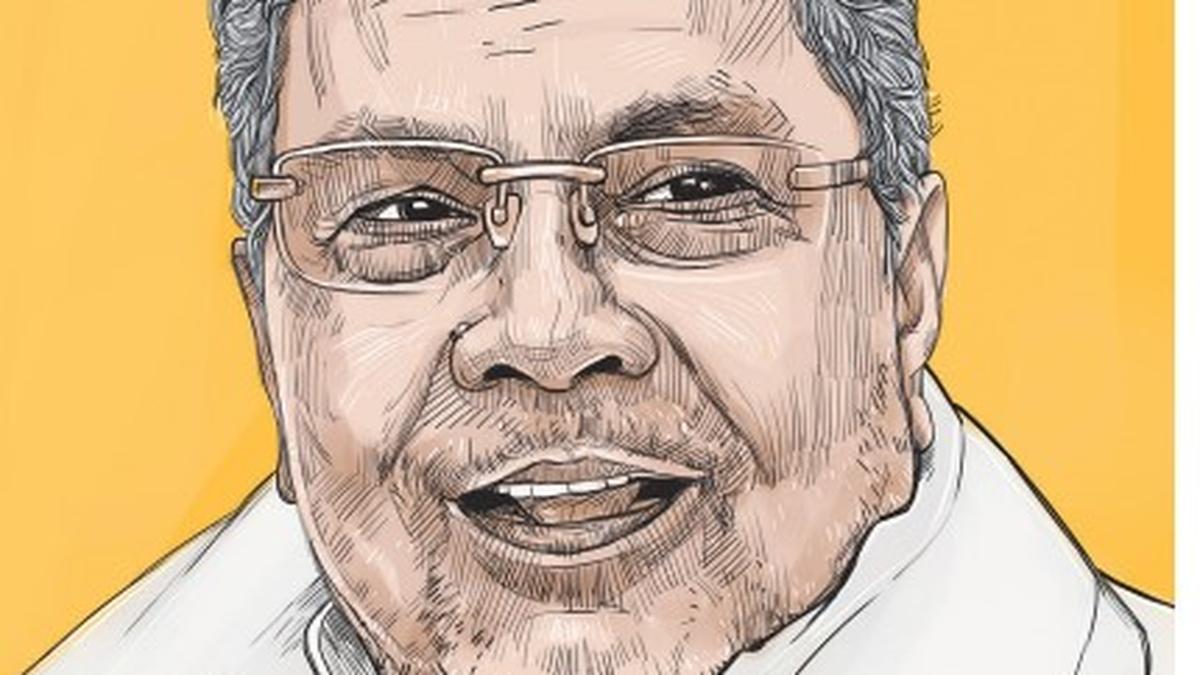
Siddaramaiah | An AHINDA leader’s new innings Premium
The Hindu
The Hindu profiles: Siddaramaiah | An AHINDA leader’s new innings
A year-old video that has resurfaced and gone viral after Siddaramaiah was finalised as Karnataka’s Chief Minister shows him keeping pace with a group of folk Veera Makkala Kunita dancers at a temple jathre (fair) in his native village Siddaramanana Hundi in Mysuru district. The 75-year-old, who on Saturday was sworn in for a second term after a full-term stint between 2013 and 2018, is a leader who has been able to retain a rustic connect with the last man in a hierarchical society through not just gestures of this kind but also pro-poor schemes often pejoratively referred to as “freebies.”
Born in a disadvantaged family of the shepherd community (Kuruba, an OBC caste), the unfavourable family circumstances had compelled him to skip schooling for some years. He took to cattle grazing to help the family and danced with the temple’s Veera Makkala Kunita troupe when free. He eventually joined Class 4 directly, thanks to a local teacher who spotted his potential. Mr. Siddaramaiah went on to complete a B.Sc. from Mysore University, the first to do so from his family, and later studied law. During the announcement of the Anna Bhagya (free rice) scheme in the very first Cabinet meeting after being sworn in back in 2013, Mr. Siddaramaiah had said his aim was to make Karnataka free of hunger, which he had seen all around him in his growing years. The first Cabinet meeting in his second term too, on Saturday, began with announcements of the Congress manifesto’s “guarantees” or welfare schemes. Mr. Siddaramaiah was drawn to Socialist ideals of Rammanohar Lohia during his student days and often cites them as one of the reasons behind his abiding faith in welfarism.
In fact, Mr. Siddaramaiah’s political life began in the 1970s when Socialism was a big influence in Karnataka. It was in 1978 that he became a member of the then Taluk Development Board. His association with M.D. Nanjundaswamy, the pioneer of farmers’ movement in Karnataka and founder of the Karnataka Rajya Raitha Sangha, grew during these years which he has acknowledged as a significant influence in his politics. Mr. Siddaramaiah fought the Lok Sabha election in 1980, but lost. He contested the Assembly election next in 1983 from Chamundeshwari seat (in Mysuru district) as a candidate of the Lok Dal and won.
As a legislator who had supported the Ramakrishna Hegde-led Janata Party government then, he was made chairman of Kannada Kavalu Samiti (Kannada Watchdog Committee). A linguistic and regional pride slant in his style of politics, sown in this phase, has remained throughout his career, with his last tenure as Chief Minister being headlined by moves such as the demand for an official State flag. In a career spanning over four decades marked by several electoral gains and losses, Mr. Siddaramaiah has been associated with the Janata Party, the undivided Janata Dal, the Janata Dal(S) and eventually the Congress since 2006.
What led to Mr. Siddaramaiah’s shift to the Congress was the famous falling out with JD(S) patriarch H.D. Deve Gowda when he felt that he was deliberately denied a chance to be the Chief Minister in the Congress-JD(S) government in 2004, when the late Dharam Singh was picked for the post. His decision to organise and be part of an AHINDA (Kannada acronym for minorities, backward classes and Dalits, fashioned by his ideological predecessor the late D. Devaraj Urs) meet at Hubballi was deemed as an anti-party activity and he was expelled from the JD(S). Though there was a brief period when it was believed that he would float a regional party, Mr. Siddaramaiah eventually joined the Congress in the presence of the then Congress president Sonia Gandhi in a huge rally in 2006. The old antagonism with the Gowda family has refused to entirely go way, and this is one of the reasons why he was partially blamed for the fall of the Congress-JD(S) coalition government formed after the 2018 Assembly election.
Mr. Siddaramaiah has often said it was the Congress’s commitment to secularism that was a key deciding factor in his choice. True to this, Mr. Siddaramaiah has remained a trenchant critic of Hindutva politics and has never minced words even when the BJP has always attempted to paint him as “anti-Hindu”. Faith in welfarism and secularism have remained constants in Mr. Siddaramaiah’s long political career.
Now, as he takes charge again, Mr. Siddaramaiah is not the same man who as Leader of the Opposition in 2010 led a historic 320-km Ballari Padayatra from Bengaluru to Ballari against illegal mining activities of Gali Janardhan Reddy and his associates. The money from these activities, it is alleged, had funded the first “Operation Kamala” (engineered defections to the BJP) in 2008. This Padayatra is credited to be among the factors that galvanised the party ahead of the 2013 election, which the Congress won against a divided BJP (with B.S. Yediyurappa having then formed the Karnataka Janata Paksha) and led to Mr. Siddaramaiah occupying the top post for the first time.


India pledges 60% non-fossil fuel power by 2035, targeting 47% emissions reduction per GDP unit and enhanced carbon sinks.

Supreme Court rules land acquisition compensation and interest must uphold constitutional guarantees, unaffected by financial burdens.

Election officials accept 23 nominations for Bagalkot bypolls, rejecting three, with polling scheduled for April 9.

Students and women’s self-help groups in Madurai engage in vibrant voter awareness campaigns promoting 100% voting participation.

Congress signals a "friendly fight" with allies in select Puducherry Assembly seats ahead of the April 9 elections.

Airstrike in western Anbar kills 7 Iraqi soldiers, injures 13, prompting condemnation for violating international laws on medical facilities.

Plaque unveiled in Bengaluru honors 11 victims of RCB stampede, emphasizing safety responsibility for future events.

India and the U.S. reaffirm commitment to enhance strategic defense cooperation at the 18th Defence Policy Group meeting in New Delhi.

Chhattisgarh's Deputy CM reports only 30-40 Maoists remain in Bastar, highlighting recent surrenders and future development plans.

Explore the historical and industrial significance of Ariyalur constituency, highlighting its challenges, agriculture, and political landscape.

Dindigul and Madurai Collectors conduct joint inspection

In this episode, Kalki Subramaniam speaks to us about why the Transgender Persons Amendment Bill has sparked protests, and how these amendments threaten to push a marginalised community back into the shadows.

India's EU FTA is poised to attract more German companies, boosting bilateral trade and investment opportunities.