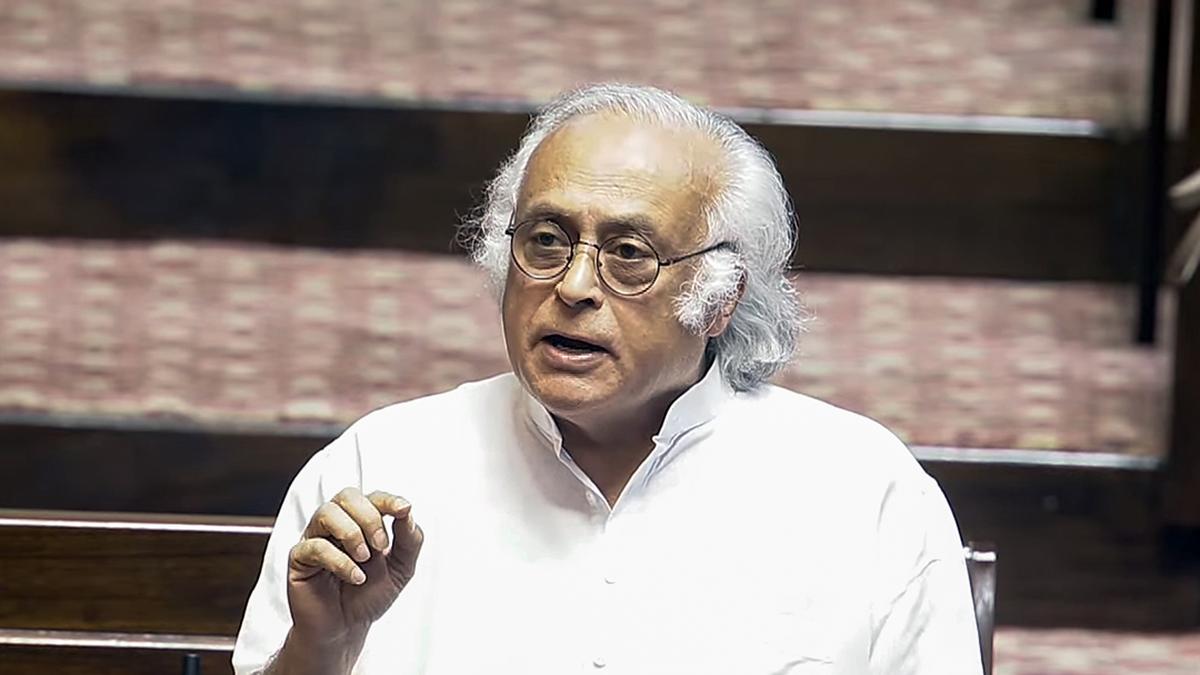
Sharpening inequality now firmly embedded in nature of country's economic growth: Congress
The Hindu
Congress criticizes Modi government for manipulating data on poverty reduction, calls for tax reforms and income support for families.
Attacking the Centre citing a World Bank report, the Congress on Sunday (April 27, 2025) claimed that sharpening inequality is now firmly embedded in the nature of the country's economic growth, and asserted there is a compelling need for tax reforms in GST, ending "brazen corporate favouritism" and providing income support for families.
Congress general secretary in-charge communications Jairam Ramesh said the World Bank has released its Poverty and Equity Brief for India this month, and the report raises several concerns even as the Modi government spins it to its benefit.
In its report, the World Bank has said, "Over the past decade, India has significantly reduced poverty. Extreme poverty (living on less than USD 2.15 per day) fell from 16.2 per cent in 2011-12 to 2.3 per cent in 2022-23, lifting 171 million people above this line." In his statement on the report, Ramesh noted that as per calculations based on the international poverty line (USD 2.15/ day), poverty has continued its downward trend in recent years to reach extremely low levels.
"This reflects the success of India's growth story - which began with liberalisation in June 1991 and which has since taken a momentum of its own - and that of several social welfare interventions developed by Dr Manmohan Singh's government during 2004-14," he said.
Ramesh claimed the most important intervention is the MGNREGA, 2005 which has effectively set a floor on the annual income for crores of families, acting as a safety net to keep families out of poverty and the National Food Security Act, 2013 that provides the foundation for the Pradhan Mantri Garib Kalyan Anna Yojana (PMGKY).
He, however, pointed out that the World Bank has also warned that more updated data --adoption of purchasing power parity conversion factor from 2021 as compared to that of 2017 — would result in a higher rate of extreme poverty.
"Changes in the questionnaire design, survey implementation, and sampling in the Household Consumption Expenditure Survey 2022-23 present challenges from making comparisons over time', he said, citing the report.


Delhi CM Rekha Gupta presents the Economic Survey 2025-26, highlighting growth in income and fiscal deficit details.

Ready for IPL 2026? The Chennai Super Kings’ 'Roar 26' event delivered several Dhoni moments, fan frenzy and an energetic AR Rahman concert.

An alleged dating app scam in Hyderabad's Jubilee Hills has reportedly swindled a man of ₹28,000 at a pub.

T.N. Chief Secretary and DGP visit Governor at Lok Bhavan, presenting flowers in courtesy call.

Eight TSPC Maoists arrested in Hazaribag, Jharkhand, with weapons and ammunition seized during a police operation.

Four ambulances of a Jewish community service in London were set ablaze in a suspected antisemitic hate crime.

Gautham Manohar hopes his photographs serve as reminders of the Earth’s delicate beauty

Thousand Lights faces parking chaos and traffic congestion despite its political significance and ongoing development efforts.

Generic semaglutide increases accessibility, but doctors caution against misuse and quality concerns

Haryana Police removes 857 links to Badshah's 'Tateeree' for objectionable content, ensuring a safer digital environment.

Congress criticises Modi for not leveraging the upcoming BRICS+ Summit to address the West Asia crisis amid U.S. tensions.

Nagapattinam faces underdevelopment and resource challenges, impacting its rich heritage and the livelihoods of its fishing community.

One of the best games of 2025 makes it over to the PC, with a harder mode and bristling with new graphic tech