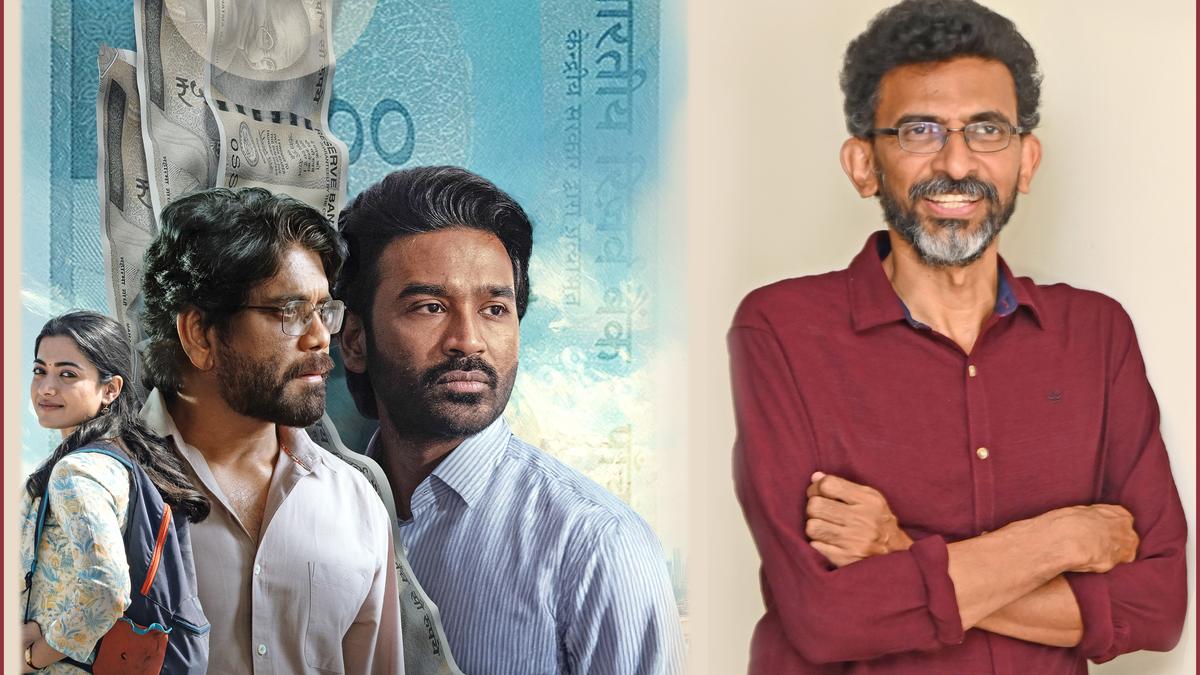
Sekhar Kammula interview: Nagarjuna and Dhanush stepped into ‘Kuberaa’ with complete trust
The Hindu
Director Sekhar Kammula discusses his upcoming film Kuberaa, a socio-political thriller with a star-studded cast, in an interview.
It has been a race to the finish for director Sekhar Kammula and his team as they wrap post-production on Kuberaa, set to release on June 20. When we meet him at the Asian Cinemas production house in Hyderabad, Sekhar appears relieved but visibly worn out. The film, starring Nagarjuna Akkineni, Dhanush, Rashmika Mandanna and Jim Sarbh, is his most ambitious yet, with a budget exceeding ₹100 crore.
Kuberaa also marks a personal milestone — 25 years since Sekhar’s debut with Dollar Dreams (2000), which won the National Award for Best First Film of a Director. When asked what he believes has kept him relevant all these years, he smiles: “I’m just happy that I am. It’s easy for a writer-director to get carried away. I stay connected with people and don’t treat cinema only as business. It’s an art form rooted in social awareness and sensitivity. I must also credit my direction team and co-writer Chaitanya Pingali, who help keep me grounded.”
Sekhar has always placed the story above the director, and says Kuberaa marks a deliberate departure from his usual romantic and family dramas. “It’s not a departure from who I am or my filmmaking style, just the canvas and story are larger,” he says. The film, he explains, is a socio-political thriller where a billionaire capitalist (Jim Sarbh) and a beggar (Dhanush) are brought into conflict through a middle-class man (Nagarjuna). “It’s a story about how survival instincts and selfish motives clash across three economic strata.”
The film begins as a thriller before delving into the emotional arcs of its characters. “The challenge was to make the emotional undercurrent as compelling as the thriller narrative. This kind of conflict is rare in Indian cinema,” says Sekhar. “I’m proud of the film, but also a bit anxious, it could go either way. I just hope it makes audiences go ‘wow’.”
Fifteen years after his political drama Leader, Kuberaa draws once again from Sekhar’s observations of society. “I can’t pinpoint exactly when this story began, but it evolved as we explored the characters,” he says. He recalls that even his previous film, Love Story, which tackled caste and childhood trauma, went through several drafts. Kuberaa too was complex to write, balancing multiple narratives. He credits co-writer Chaitanya Pingali with bringing in deeper empathy for the marginalised: “Our belief systems are what distinguish us as writers. People call me empathetic, but she is more so, especially towards the oppressed. That comes through in the film.”
Sekhar’s storytelling is firmly rooted in the real world. Unlike many of his peers, he never moved to the industry hub of Film Nagar, choosing instead to remain in Secunderabad. His instincts were shaped by his time at Howard University, USA, where a professor once advised him to look to life, not just films, for inspiration. “I didn’t plan it this way, it’s just how I am,” he reflects.
In a climate dominated by high-octane action entertainers, Sekhar remains steadfast in his preference for realism. “I enjoy watching those films. But when I tell stories, I want them to stay grounded. I don’t follow trends. For me, the creative struggle to build something original is exhilarating.”


Khalid Rahman is reuniting with Malayalam superstar Mammootty after Unda (2019). The Thallumaala director has teamed up with the veteran for Mattancherry Mafia.

Bollywood actor Akshay Kumar paid tribute to the martial arts grandmaster and Hollywood’s action star, Chuck Norris, who passed away on Thursday, March 19, 2026.

Renowned Odissi dancer Madhumita Raut, aged 59, dies of cardiac arrest, leaving behind a legacy of artistic achievements.

Chuck Norris, iconic martial arts master and actor, dies at 86, leaving behind a legendary legacy and internet memes.

South African naturalist Steve Boyes speaks on ghost elephants, ancestral tracking, and Werner Herzog’s documentary exploring Angola’s elusive highland giants

Actor-director Amol Palekar will receive META's Lifetime Achievement award for 2026 on March 25 in New Delhi.

India's artists unite against rising censorship, advocating for creative freedom and support for marginalized voices in the arts.

Written and directed by Kunal, the film also stars Sparsh Shrivastava and Vanshika Dhir

This year, Bharatnatyam artistes will present the Tyagaraja Aradhane as a dance performance

This year, Bharatnatyam artistes will present the Tyagaraja Aradhane as a dance performance

The actor, along with director Sushant Shah, speak about their upcoming series ‘Chiraiya’, Divya’s process of working on the dialect, Sushant’s approach to telling a story about women, and more

An independent video, ‘Feel the Spark’ by Raleigh Rajan with vocals by Ciera Dumas that celebrates Tamil literary giants, garnered 1.4 million views in less than 36 hours.

In ‘Jack Ryan: Ghost War’, John Krasinski is back as the savvy CIA analyst, diving headfirst into a high-stakes mission that unravels a deadly conspiracy and pits him against a rogue black-ops unit