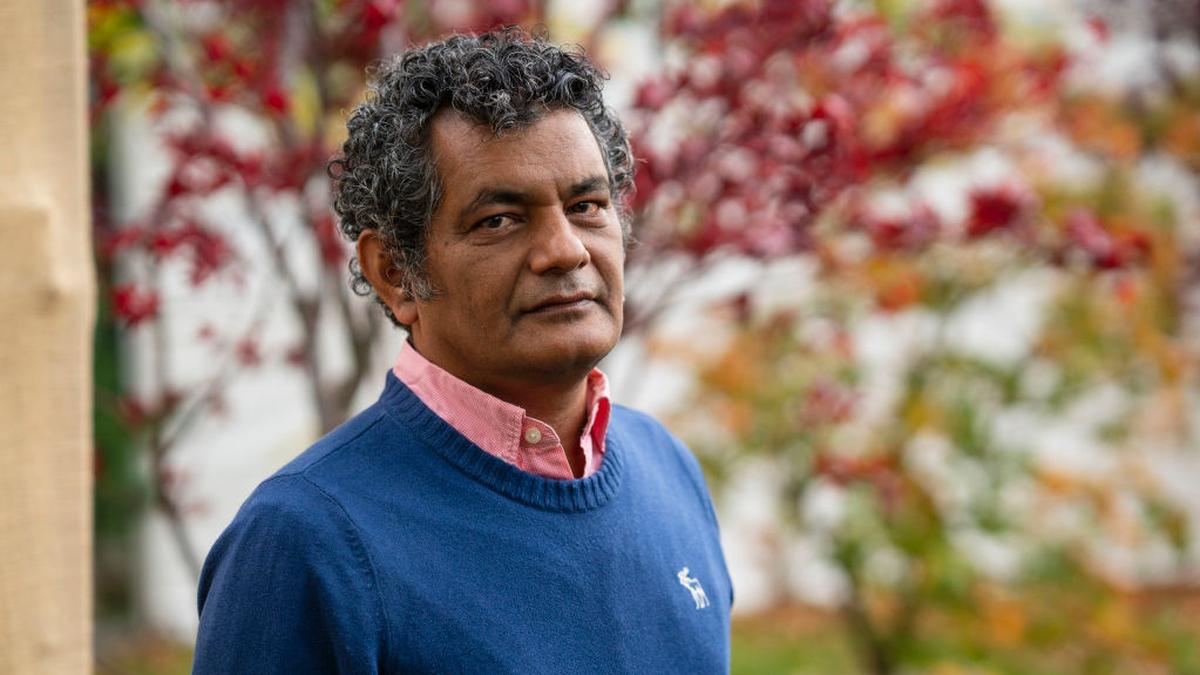
Review | Mohammed Hanif’s unrelenting gaze in new novel, Rebel English Academy
The Hindu
Explore Mohammed Hanif's "Rebel English Academy," a satirical take on Pakistan's turmoil, blending humor with political critique.
Terrible events occur in Pakistan; its landscapes, volatile, its people, nervy. British-Pakistani journalist and author Mohammed Hanif’s novels tell of these political uncertainties, and tragedies, with subversive mirth.
His gaze is unrelenting in exposing the foibles of a republic that malfunctions, persistently, leaving a stupefied citizenry to deal with the aftermath of sudden violence. Cataclysm, in the guise of satire, is the quintessential Hanif narrative, and his latest novel, Rebel English Academy, adheres somewhat to his style.
The opening chapter depicts the political events that underpin the novel. Zulfikar Ali Bhutto, former socialist Prime Minister, is hanged to death in a jail in Rawalpindi. Captain Gul, an intelligence officer who has fallen out of favour with his superiors, is transferred to nondescript OK Town. Hanif builds an atmosphere rife with simultaneous events that portend a complex and often hilarious narrative arc. Characters emerge from the dusty interiors, with sports bags, pistols, and tormented pasts.
In Ok Town, Sir Baghi, the founder of Rebel English Academy, a centre that teaches basic English to the locals, receives an unforeseen visitor. Young Sabiha Bano, recently widowed, has been brought to the academy by Molly or Maulvi Rafique of Gol Mosque. Baghi observes her with trepidation: “Ruin, he thinks, she is going to ruin us.”
The narrative smoulders with ruinous possibilities. Baghi’s tuition centre-cum-residence is on the second floor of the mosque’s complex, which is surrounded by bazaars. Grief-stricken jiyalas are immolating themselves in these bazaars, to protest the execution of Bhutto. It is whispered that the proprietor of Iron Syrup & Other Herbs, Hakim Wasif Ali Wasif, has set himself on fire. Baghi gleans that the hakim’s second wife, an athlete, has escaped the flames, and realises that she is none other than Sabiha, hiding out in his academy.
Through a variety of plotted manoeuvres, Hanif depicts a town peopled with idiosyncratic characters: a pedlar of Himalayan aphrodisiacs, an advocate who is also a palmist, a photographer who plans to record a video of his own immolation, with the help of an apprentice. The landscape isn’t always picturesque, and the provincial quietude is suggestive of recent unrest: “They drive past the boarded-up Satlaj Cotton Mills, a tattered red banner proclaiming ‘Mill to the Workers’ still fluttering on an adjacent electric pole.”


Explore Neha Sinha's "Wild Capital," a poignant blend of memoir and nature writing uncovering Delhi's hidden ecological treasures.

Explore Mohammed Hanif's "Rebel English Academy," a satirical take on Pakistan's turmoil, blending humor with political critique.

Delhi HC refers the 'Tridev' song dispute in 'Dhurandhar 2' to mediation, amid copyright claims by Trimurti Films.

Discover the serene simplicity and spiritual lifestyle of Kurma Gramam, an electricity-free village in Andhra Pradesh's scenic hills.

Karnataka Information Commission criticises the State Government for failing to recover penalties from officials with regard to denial of information under RTI Act, undermining accountability.

Foreign Secretary Vikram Misri and U.S. Secretary Marco Rubio discuss trade and defense ahead of Rubio's upcoming visit to India.

Explore the escalating human-wildlife conflict in Kollam's eastern regions as summer heat drives animals into towns and farms.

‘Centre trying to deny SC status to Dalit Christians’

CPI leader claims secular parties unite under DMK to counter BJP's influence in Tamil Nadu's upcoming Assembly elections.

Captained by Jimmy Moussa with a four member crew, flight J9 3417 Dammam-Mangaluru, which arrived at 4.25pm, had 181 passengers including 11 infants.

Anaicut constituency faces severe neglect, lacking essential infrastructure like roads, water, and electricity for its tribal residents.

Kozhikode achieves the highest voter turnout in the state at 81.32%, with Kunnamangalam leading at 84.45%.

Ernakulam's voter turnout surged to 80%, with Kunnathunad leading at 83.69% and Angamaly recording the lowest at 75.62%.