Registration of live-in relationships, polygamy ban: Key features of Uttarakhand’s Uniform Civil Code Bill | Explained Premium
The Hindu
With the Uniform Civil Code Bill tabled in the Uttarakhand Assembly on Tuesday, The Hindu decodes the key takeaways from the controversial legislation
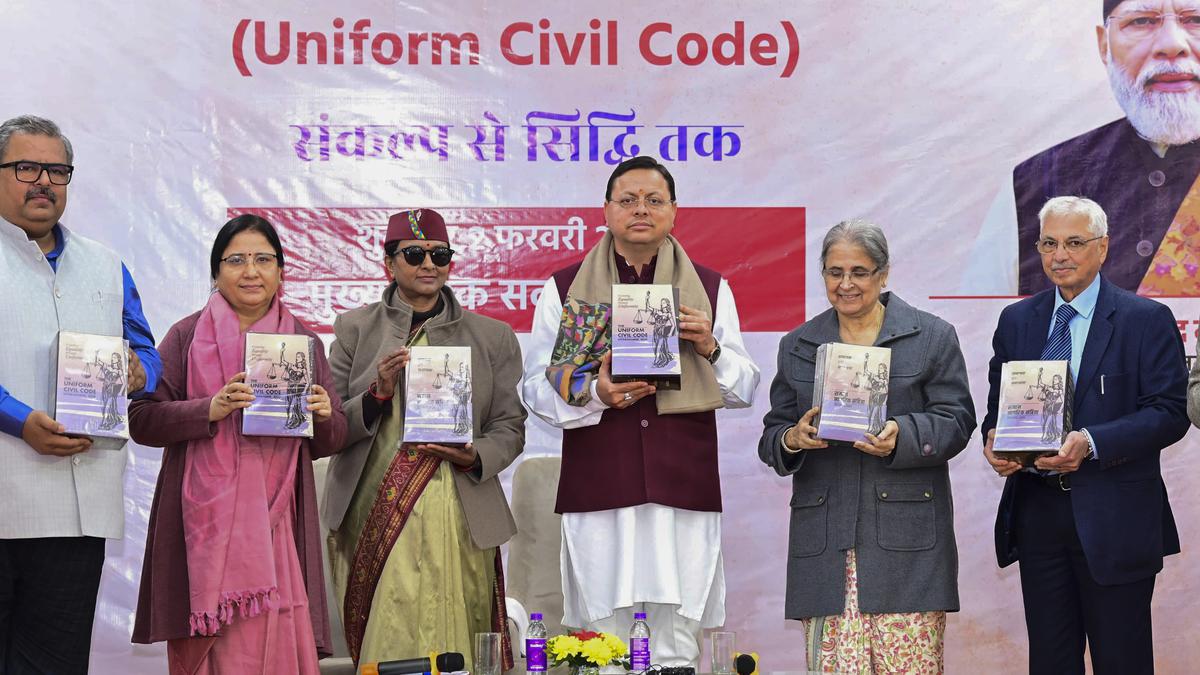
Uttarakhand Chief Minister Pushkar Singh Dhami on Tuesday tabled the Uniform Civil Code (UCC) Bill in the State Assembly three days after a state-appointed panel submitted its final report. If passed by the Assembly, Uttarakhand will be the first State in India to implement such a legislation after Independence.
The introduction of a UCC was a key poll promise of the BJP in the run-up to the 2014 general elections and was reiterated before the 2022 Legislative Assembly elections in Uttarakhand. Following the BJP’s electoral victory on May 27, 2022, the Uttarakhand government announced the constitution of a five-member committee led by former Supreme Court judge Justice Ranjana Prakash Desai to draft the legislation.
While exempting the tribal community from its purview, the Bill proposes a common law on marriage, divorce, inheritance of property, and live-in relationships for all citizens, irrespective of their religion. This stems from Article 44 of the Constitution, which mandates that the state “shall endeavour to secure for the citizens a uniform civil code throughout the territory of India.” The provision is a part of the Directive Principles of State Policy (Part IV of the Constitution), which although not enforceable, play a pivotal role in the country’s governance.
Following Uttarakhand’s footsteps, two other BJP-ruled States — Madhya Pradesh and Gujarat — have appointed committees to initiate the formulation of a UCC. Individual states are competent to undertake such an exercise since the Seventh Schedule of the Constitution empowers both the Centre as well as state legislatures to legislate on matters pertaining to family laws.
Here are some of the key features of the Bill:
Also read: Uttarakhand’s Uniform Civil Code: What it means and what lies ahead? | Explained
The tribal communities which comprise 2.9 per cent of Uttarakhand’s population have been exempted from the application of the Bill. Section 2 stipulates — “Nothing contained in this code shall apply to the members of any Scheduled Tribes within the meaning of clause (25) of Article 366 read with Article 142 of the Constitution of India and the persons and group of persons whose customary rights are protected under Part XXI of the Constitution of India.”


Decorated homes, busy temples and shared feasts mark Ugadi in Hyderabad

Housing Minister seeks ₹260 crore to develop 50 slums for Karnataka's golden jubilee, urging CSR support for infrastructure enhancement.

Congress opposes VBSA Bill, citing constitutional overreach, State power encroachment, and politicization of higher education funding.

Hyderabad Airport wins Skytrax 2026 award for Best Airport Staff in India and South Asia for the fifth time.

General and Election Expenditure Observers assumed charge in Krishnagiri to monitor election processes and expenditure across six constituencies.

A detailed analysis of Puducherry’s evolving political landscape and election trends since 2011.

CPI(M) insists on six Tamil Nadu Assembly seats, while DMK offers five, causing a stalemate in alliance talks.

Unaccounted cash, articles worth ₹13.58 lakh seized in Tirunelveli in five days

Ugadi Asthanam at Tirumala temple celebrated with rituals, Vedic recitations, floral decorations, and grand festivities honoring the Telugu new year.

Srirangam temple offers herbal buttermilk and paanakam to devotees to help them stay cool during the summer heat.

VMRDA invites global bids for the Vizag Bay City project to develop a world-class integrated waterfront hub by 2026.

Civil society urges Amit Shah to direct police vigilance against open threats of communal violence in Uttam Nagar, Delhi.

PMK leader Anbumani blames alcohol and drug abuse for rising suicides in Tamil Nadu, criticising government inaction.