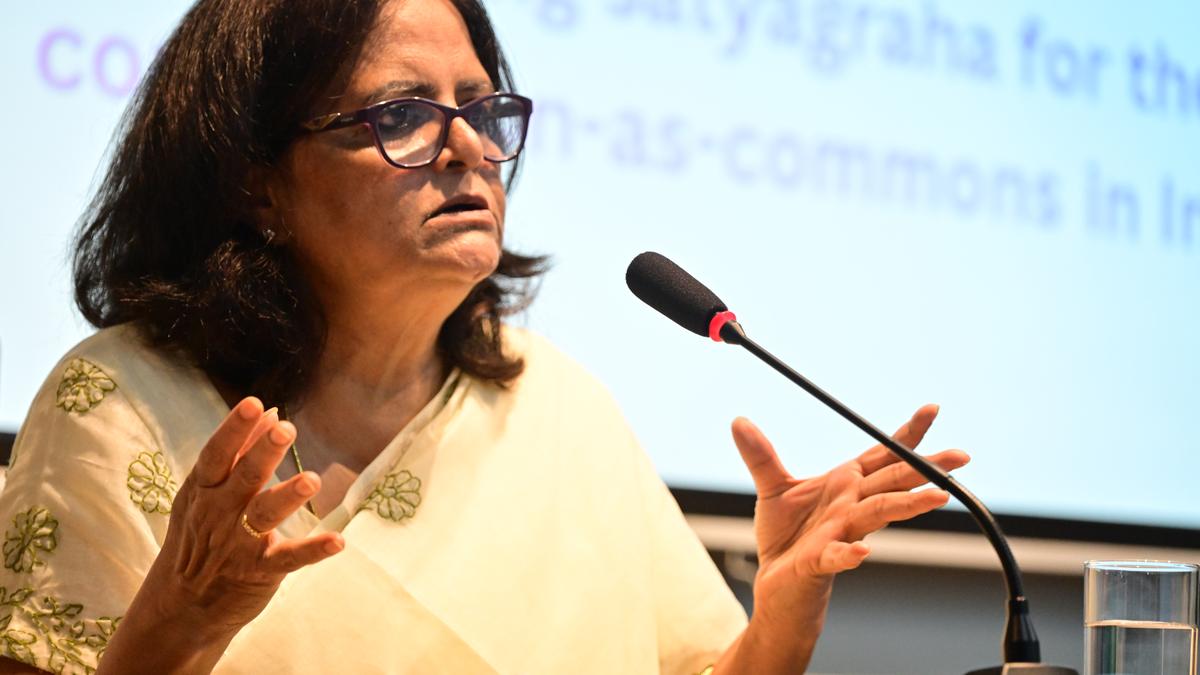
Necessary to invoke Constitution-as-commons to resist and counter the politics of maiming: Kalpana Kannabiran
The Hindu
Kalpana Kannabiran discusses the importance of the Constitution as a commons and human dignity in India's social deprivation.
Kalpana Kannabiran, Distinguished Professor, Council for Social Development, New Delhi, on Monday said her ongoing work focused on building a bridge between the intellectual history of Indian constitutionalism, histories of insurgent interpretation of the Constitution and the ideas of the scholars of the commons.
“In proposing the conceptualisation of the Constitution as a commons, I look at belonging and ownership, foregrounding collective action and civic engagement as providing the tools for constitutional interpretation,” she said, delivering the 11th ‘T. G. Narayanan Memorial Lecture on Social Deprivation’ under the auspices of the Media Development Foundation and the Asian College of Journalism.
The lecture was on the topic -- Human dignity in the time of Article 21: The long satyagraha for the Constitution-as-commons in India. “Why is it necessary for us to focus on convivialities in India today? Why do we need to think of recuperation by invoking the Constitution-as-commons? The simple answer is to resist and counter the politics of maiming,” Ms. Kannabiran said.
“The deathly coils of the politics of maiming in India articulate caste, community, conscience, ethnicity and gender as reified un-historical identities, disregardful of their dense intersections, heterogeneity and plural articulations across history,” she said. The experience of Manipur over the past year and a half -- continuing exacerbated and unresolved in the present -- is a daily reminder of the profound harm inflicted by the politics of maiming, Ms. Kannabiran said.
She stressed the aspect of how one could think of dignity as a moral and constitutional value. “My attempt is a call to memory and a critique that illuminates paths not taken, recovering ground from the shards that affirm freedom, fraternity and dignity, in a time of deep crisis. The purpose is to develop a cogent assemblage of citizenship that builds on histories of anti-colonial/anti-majoritarian struggles, assertions of the unassailability of human dignity than persist despite the rolling juggernaut of burgeoning exception,” Ms. Kannabiran said.
“In the effort to revisit our troubled pasts, we assemble insights of a moral firmament that speak to the spirit of the Constitution, reject its aberrations (using arguments of severability and non-retrogression) and provide a dignity compass for just and compassionate governance, state formation and citizen engagement,” she added.


Iran-Israel war: Follow live updates from The HIndu on the West Asia conflict on Marh 18, 2026

A kidney sale scandal in Tamil Nadu in 2007 exposed a network of illegal organ trade, prompting a CB-CID investigation and arrests.

TIMS Sanathnagar inauguration on Ugadi uncertain as construction, staffing gaps persist

Mumbai's water crisis escalates as corporators highlight irregular supply and reliance on costly private tankers amid administration neglect.

Explore the evolution of cooking fuels in Madras, from wood and coal to the rise of LPG, amid recent shortages.

Protests against the Sharavathi Pumped Storage Hydroelectric Project in the Western Ghats just got new life

51 couples take thebig plunge at Udaipur mass wedding event

A bridge collapse in Roop Nagar kills a woman; Delhi government forms a probe panel amid rising safety concerns.

Tribunal halts Colonel Purohit's retirement, pending promotion decision after his acquittal in the 2008 Malegaon blast case.

Pinarayi Vijayan launches his election campaign in Dharmadam, aiming for a third consecutive term amid tightening competition.

Delhi Speaker Vijender Gupta has written to Lieutenant-Governor Taranjit Singh Sandhu seeking directions to instal audible signals at traffic intersections across the city to ensure the safety of mobility-impaired individuals and senior citizens.

GVMC council concludes its five-year term, highlighting significant development projects and global events that enhanced Visakhapatnam's recognition.

Karnataka SC/ST Commission discusses internal reservation issues amidst confusion over reduced quotas for Scheduled Castes and Tribes.