NABARD projects ₹4.88 lakh crore priority sector credit for Rajasthan
The Hindu
NABARD projects ₹4.88 lakh crore priority sector credit for Rajasthan, aligning financial institutions with the state's development goals for 2026-27.
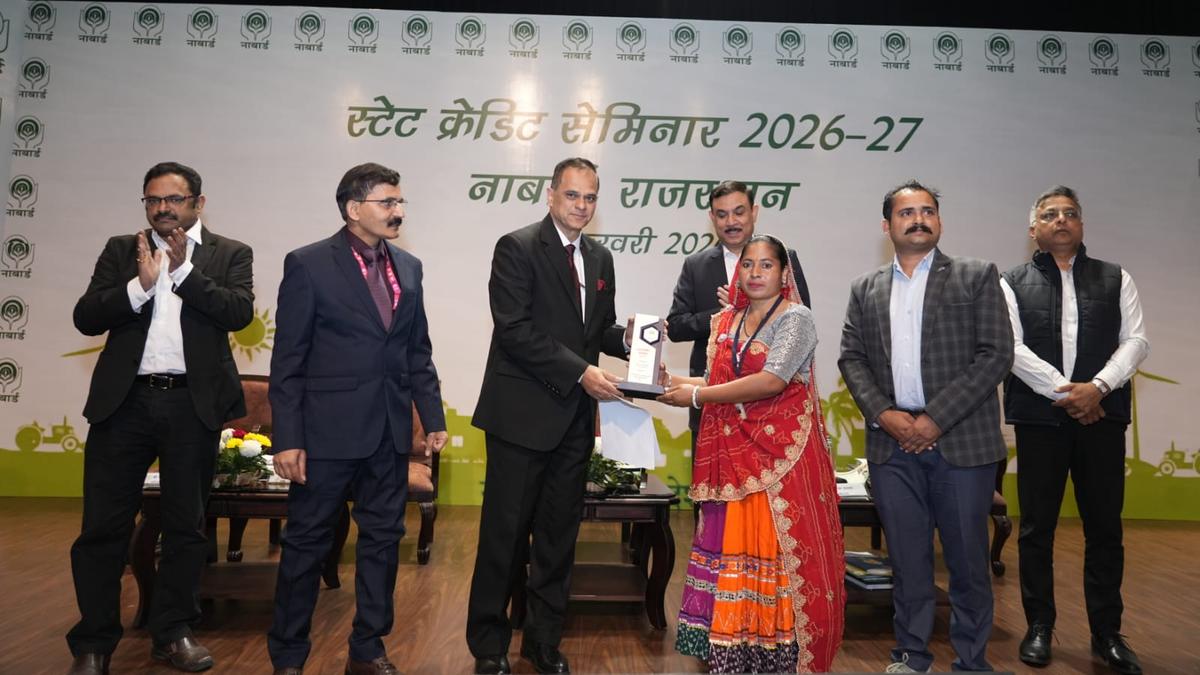
The National Bank for Agriculture and Rural Development (NABARD) has projected the priority sector credit potential of ₹4.88 lakh crore for 2026-27 in Rajasthan. The State Focus Paper (SFP), revealing the district-wise realistic potential in both physical and financial terms, was launched in Jaipur on Friday (February 13, 2026).
Chief Secretary V. Srinivas highlighted the ₹6.11 lakh crore State Budget outlay while releasing the SFP at the NABARD’s State Credit Seminar. Mr. Srinivas said the NABARD had carried out credit planning with the preparation of SFP for the next financial year to align financial institutions with the State’s development priorities.
Mr. Srinivas asked the banks and other stakeholders to work in unison to achieve the projections made in the SFP. “NABARD has played a significant role in strengthening the cooperative movement through computerisation, training programmes and financial support to cooperatives,” he said.
NABARD Chief General Manager for Rajasthan, R. Ravi Babu, said the priority sector credit potential had been calculated in line with the State government’s vision for ‘Developed Rajasthan-2047’. “The block-wise credit potentials are estimated for different sub-sectors while considering the available infrastructure and the actual ground-level credit flow,” he said.
Within the estimates, agriculture and allied activities were projected at ₹2.24 lakh crore and micro, small and medium enterprises at ₹2.27 lakh crore in an indication of the growth balance emerging between farm and non-farm sectors.
Mr. Babu said the credit potential assessed in the SFP would serve as a benchmark for the preparation of the annual credit plan. A roadmap will also be created for achieving the credit projections, improving last-mile delivery, and promoting inclusion, especially for women farmers and cooperative institutions.


7-Eleven expands its Global Solution Centre in Bengaluru, enhancing innovation and technical expertise for global operations and customer experience.

Malaysia encourages Indian airlines to expand routes beyond Kuala Lumpur to popular tourist destinations like Langkawi and Penang.

Hyderabad Metro Rail Phase II faces challenges due to legacy issues, outstanding debts, and scrutiny over project approvals.

Karnataka High Court scrutinizes a transport official's seizure of a Lamborghini from private premises without notice to the owner.

Bengaluru sees a surge in women autorickshaw drivers, growing from 100 to 2,000, empowering them economically and socially.

ECI reviews electoral preparedness in Puducherry, ensuring transparency, security, and accessibility for the upcoming Assembly polls.

BJP accuses Rahul Gandhi of undemocratic behavior in Parliament, demanding his stance on Vande Mataram singing notification.

Six lakh names may be removed from West Bengal's voter list, raising concerns over the electoral roll revision process.

Children’s rights must be prioritized, says Karnataka Commission chairman during inspection of Belagavi’s Special Police Unit for Children.

Experts emphasise early diagnosis, long-term care and policy support for people living with epilepsy
Experts advocate for early diagnosis, long-term care, and policy support to improve epilepsy management and reduce stigma.

Coimbatore increases security measures for 1998 bombings anniversary, deploying 2,000 police personnel and specialized teams across the city.

Law and Order: Panangal Road to be widened to remove bottleneck near GRH

Pawan Kalyan advocates for apolitical temple trust boards and inaugurates a new Giri Pradakshina route around Srikalahasti temple.