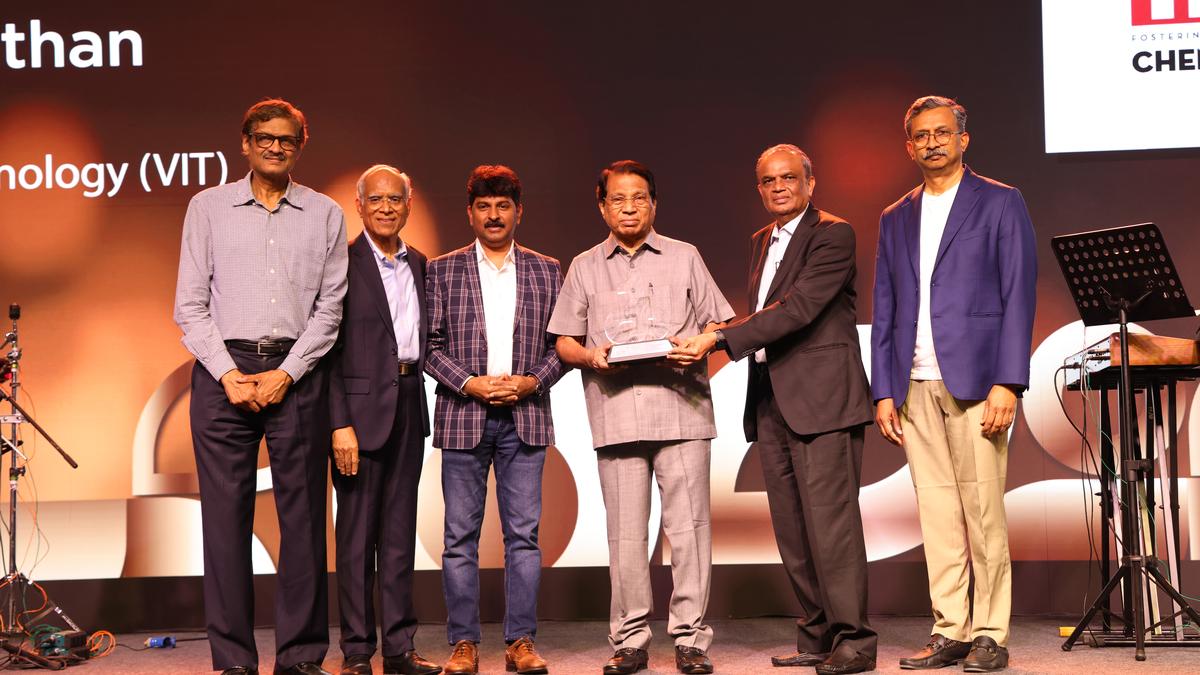
Expanding export-driven manufacturing sector helps in stabilising rupee: Chief Economic Advisor
The Hindu
Chief Economic Advisor V. Anantha Nageswaran emphasizes manufacturing's role in stabilizing India's currency amid trade uncertainties.
Stating that the present currency vulnerability has stemmed largely from trade uncertainties that have affected capital flow, Chief Economic Advisor V. Anantha Nageswaran said on Friday that a thrust on expanding the export-driven manufacturing sector should help in stabilising the rupee.
To achieve this, he suggested a three-pronged strategy: import substitution, time-bound protectionism for Indian exporters linked to production and export performance, and investment in climate adaptation before focusing on emission mitigation.
“To be able to export in a world that is increasingly becoming self-centric and to be able to attract capital when capital itself can be held back or used as a strategic weapon isn’t going to be easy. If we don’t get our exports and capital flows correct, the casualty will be the currency. We saw that in 2025,” Mr. Nageswaran said at the inauguration of Tiecon Chennai 2026.
V. Anantha Nageswaran, Chief Economic Advisor to the Government of India, Speaking at Inauguration of TiE con Chennai 2026 in Guindy on Friday. | Photo Credit: B. VELANKANNI RAJ
India’s tryst with import substitution between 1947 and the 1980s was fraught with protectionism that did not elevate capabilities or manufacturing capacity, but rather spread complacency. “So, no protection in perpetuity, but protection in return for quid pro quo obligations on productivity and export performance will have to be the mantra for the next 25 years in a world that’s going to be challenging,” he observed.
“Let us be very clear: renewable energy production requires a lot of energy in and of itself,” he said. Giving details, he said large quantities of silver, polysilicon and aluminium, and a substantial input of power were required to produce one gigawatt of solar power. Similarly, for wind power, 2,866 tonnes of copper was required for which at least 4,80,000 tonnes of ore requires handling, given that the yield of copper was only 0.6%.


7-Eleven expands its Global Solution Centre in Bengaluru, enhancing innovation and technical expertise for global operations and customer experience.

Malaysia encourages Indian airlines to expand routes beyond Kuala Lumpur to popular tourist destinations like Langkawi and Penang.

Hyderabad Metro Rail Phase II faces challenges due to legacy issues, outstanding debts, and scrutiny over project approvals.

Karnataka High Court scrutinizes a transport official's seizure of a Lamborghini from private premises without notice to the owner.

Bengaluru sees a surge in women autorickshaw drivers, growing from 100 to 2,000, empowering them economically and socially.

ECI reviews electoral preparedness in Puducherry, ensuring transparency, security, and accessibility for the upcoming Assembly polls.

BJP accuses Rahul Gandhi of undemocratic behavior in Parliament, demanding his stance on Vande Mataram singing notification.

Six lakh names may be removed from West Bengal's voter list, raising concerns over the electoral roll revision process.

Children’s rights must be prioritized, says Karnataka Commission chairman during inspection of Belagavi’s Special Police Unit for Children.

Experts emphasise early diagnosis, long-term care and policy support for people living with epilepsy
Experts advocate for early diagnosis, long-term care, and policy support to improve epilepsy management and reduce stigma.

Coimbatore increases security measures for 1998 bombings anniversary, deploying 2,000 police personnel and specialized teams across the city.

Law and Order: Panangal Road to be widened to remove bottleneck near GRH

Pawan Kalyan advocates for apolitical temple trust boards and inaugurates a new Giri Pradakshina route around Srikalahasti temple.