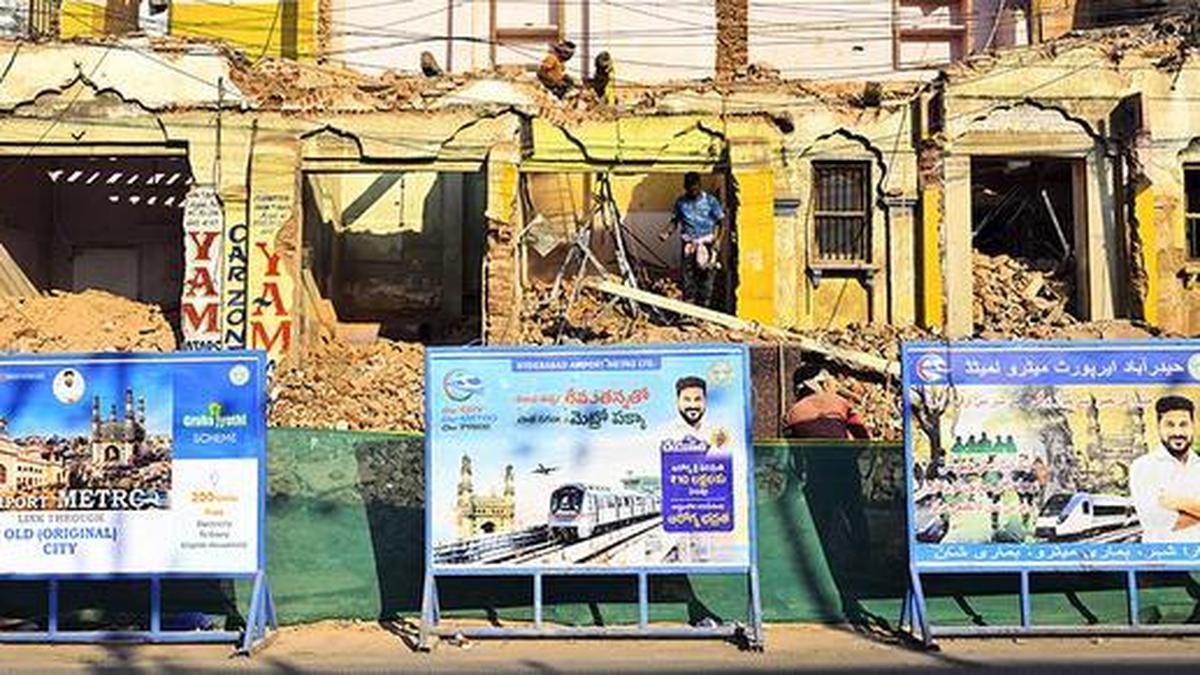
Legacy issues cast shadow on Hyderabad Metro Rail phase II plans
The Hindu
Hyderabad Metro Rail Phase II faces challenges due to legacy issues, outstanding debts, and scrutiny over project approvals.
The Congress government has been pushing for the Central government’s approval to form a Joint Venture (JV) to mobilise funding and secure mandatory clearances for the proposed Hyderabad Metro Rail (HMR) Phase II over the past few months.
During his recent visit to New Delhi, Chief Minister A. Revanth Reddy reiterated his government’s commitment to the project. He confirmed that the State administration intends to take over the project from Larsen & Toubro (L&T) next month after completing the necessary financial and legal formalities.
Government-appointed consultants — IDBI Bank and Delhi Metro Rail Corporation (DMRC) — are currently examining the financial and technical aspects of the proposed takeover from L&T, including the outstanding debt of ₹13,000 crore and an equity of ₹2,000 crore.
However, legacy issues from HMR Phase I — a 69.2-km network built across three corridors — may still pose challenges when the empowered committee comprising officials from the Centre and the State meets to examine the modalities for clearing the Detailed Project Report (DPR) for Phase II-A and II-B. These phases cover 162 km across eight corridors at an estimated cost of ₹42,000 crore, according to official sources, who requested anonymity.
A key concern is the 7.5-km corridor between Mahatma Gandhi Bus Station (MGBS) and Chandrayangutta in the Old City, which is expected to face closer scrutiny. Road widening along this alignment has progressed over the past year without major resistance, with nearly 500 structures cleared after payment of enhanced compensation, totalling more than ₹400 crore.
However, the process was recently challenged in court, and officials acknowledge that the empowered committee is likely to take a critical view of construction plans along this stretch. The corridor forms part of Phase II-A, with Chandrayangutta planned as an interchange station for the 36.6-km Nagole–Rajiv Gandhi International Airport (RGIA) line.


7-Eleven expands its Global Solution Centre in Bengaluru, enhancing innovation and technical expertise for global operations and customer experience.

Malaysia encourages Indian airlines to expand routes beyond Kuala Lumpur to popular tourist destinations like Langkawi and Penang.

Hyderabad Metro Rail Phase II faces challenges due to legacy issues, outstanding debts, and scrutiny over project approvals.

Karnataka High Court scrutinizes a transport official's seizure of a Lamborghini from private premises without notice to the owner.

Bengaluru sees a surge in women autorickshaw drivers, growing from 100 to 2,000, empowering them economically and socially.

ECI reviews electoral preparedness in Puducherry, ensuring transparency, security, and accessibility for the upcoming Assembly polls.

BJP accuses Rahul Gandhi of undemocratic behavior in Parliament, demanding his stance on Vande Mataram singing notification.

Six lakh names may be removed from West Bengal's voter list, raising concerns over the electoral roll revision process.

Children’s rights must be prioritized, says Karnataka Commission chairman during inspection of Belagavi’s Special Police Unit for Children.

Experts emphasise early diagnosis, long-term care and policy support for people living with epilepsy
Experts advocate for early diagnosis, long-term care, and policy support to improve epilepsy management and reduce stigma.

Coimbatore increases security measures for 1998 bombings anniversary, deploying 2,000 police personnel and specialized teams across the city.

Law and Order: Panangal Road to be widened to remove bottleneck near GRH

Pawan Kalyan advocates for apolitical temple trust boards and inaugurates a new Giri Pradakshina route around Srikalahasti temple.