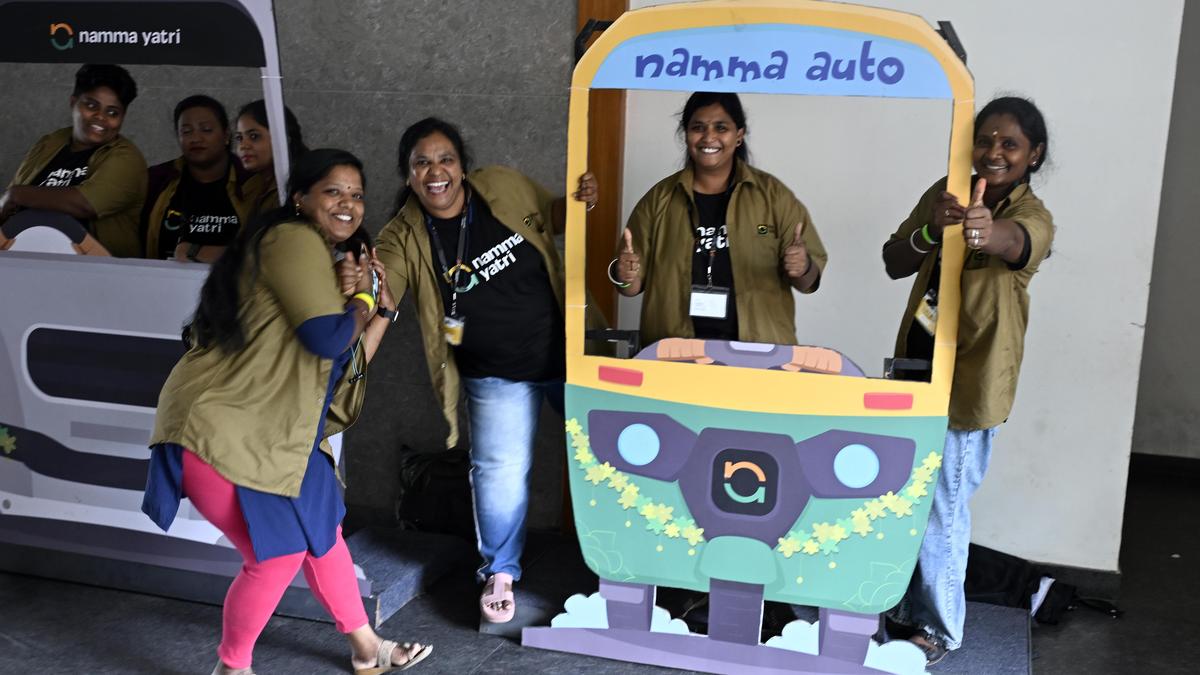
From 100 to 2,000: Women take the driver’s seat in Bengaluru’s autorickshaws
The Hindu
Bengaluru sees a surge in women autorickshaw drivers, growing from 100 to 2,000, empowering them economically and socially.
When Mumtaz Afreen pulls up in her blue electric auto for a pick-up, she says the first reaction is almost always one of surprise. “There’s a small shock at first. But most passengers, especially women, are very happy. They start conversations and ask me how I learnt riding and what it feels like to be on the road,” she said.
Ms. Afreen, who has been riding for the past six months, is among 2,000 women autorickshaw drivers now working across Bengaluru.
The number of women auto drivers has risen sharply from just 100 in 2021 to 2,000 at present, according to data compiled by the Bengaluru City Police from the Regional Transport Office (RTO) and various transport aggregators.
Like many other women drivers, Ms. Afreen entered the male-dominated field following personal hardship. She lost her husband two years ago and is raising two children on her own. “As a single mother, I was constantly thinking about how to provide for my children,” she said.
Before this, she had signed up with food delivery aggregators, but her daily earnings rarely crossed ₹500. The work, she said, was unpredictable and physically demanding — waiting outside restaurants for orders, riding a two-wheeler for long hours — and still earning less than expected. “Now I earn between ₹1,000 and ₹3,000 a day,” she said.
Another driver, Prema Nagaraju, left a violent marriage at 26 and walked out with her three children. Today, she too is part of the growing pool of women auto drivers earning independently in the city. “When passengers first get in, they ask if we are confident enough. Later they say we ride well and that it’s inspiring,” she said.


7-Eleven expands its Global Solution Centre in Bengaluru, enhancing innovation and technical expertise for global operations and customer experience.

Malaysia encourages Indian airlines to expand routes beyond Kuala Lumpur to popular tourist destinations like Langkawi and Penang.

Hyderabad Metro Rail Phase II faces challenges due to legacy issues, outstanding debts, and scrutiny over project approvals.

Karnataka High Court scrutinizes a transport official's seizure of a Lamborghini from private premises without notice to the owner.

Bengaluru sees a surge in women autorickshaw drivers, growing from 100 to 2,000, empowering them economically and socially.

ECI reviews electoral preparedness in Puducherry, ensuring transparency, security, and accessibility for the upcoming Assembly polls.

BJP accuses Rahul Gandhi of undemocratic behavior in Parliament, demanding his stance on Vande Mataram singing notification.

Six lakh names may be removed from West Bengal's voter list, raising concerns over the electoral roll revision process.

Children’s rights must be prioritized, says Karnataka Commission chairman during inspection of Belagavi’s Special Police Unit for Children.

Experts emphasise early diagnosis, long-term care and policy support for people living with epilepsy
Experts advocate for early diagnosis, long-term care, and policy support to improve epilepsy management and reduce stigma.

Coimbatore increases security measures for 1998 bombings anniversary, deploying 2,000 police personnel and specialized teams across the city.

Law and Order: Panangal Road to be widened to remove bottleneck near GRH

Pawan Kalyan advocates for apolitical temple trust boards and inaugurates a new Giri Pradakshina route around Srikalahasti temple.