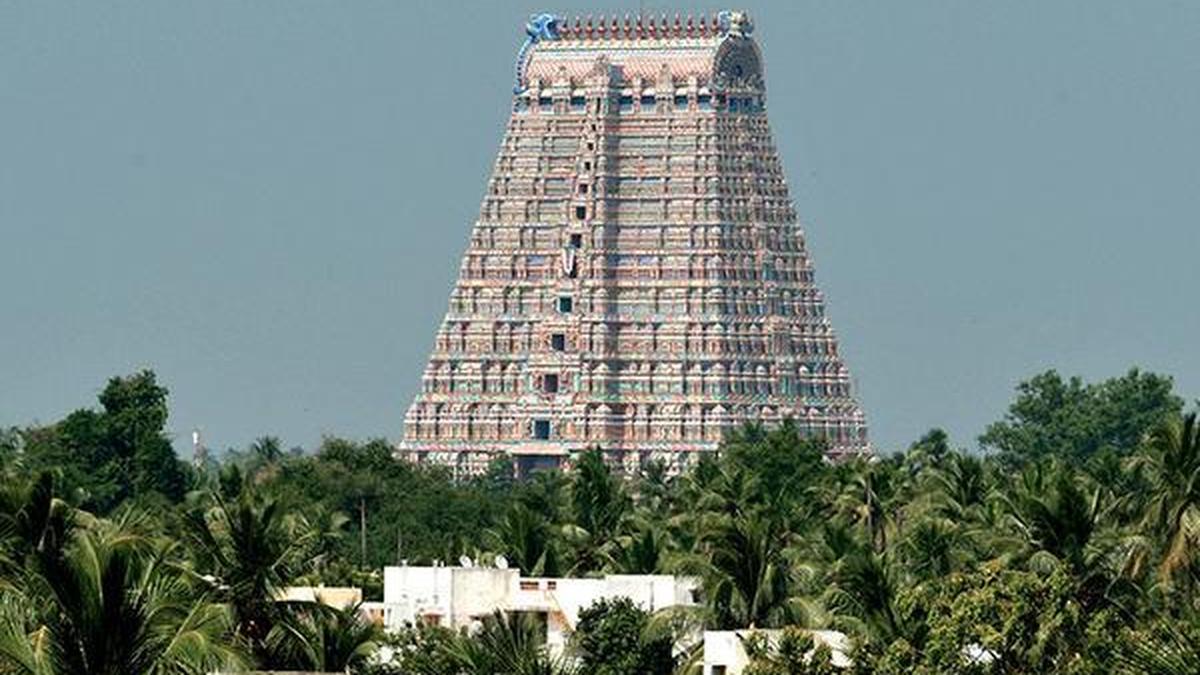
Meet Bharadwajan, a trained pilot, who performs the traditional Araiyar sevai in Srirangam
The Hindu
The enduring legacy of Araiyar Sevai
At a recent lecture organised by the Department of Vaishnavism, University of Madras, Bharadwajan Araiyar spoke about the rich heritage of Araiyar sevai, performed in temples, which seamlessly blends all three aspects of Muthamizh — iyal (literature), isai (music) and natakam (theatre). drama).
The practice of reciting pasurams in front of Lord Ranganatha of Srirangam was begun by Thirumangai Azhwar. However, over time, the Divya Prabandham verses were lost. It was the Vaishnava acharya Nathamunigal (mid ninth to mid 10th century CE) who retrieved them and arranged for them to be presented with music, abhinaya and theatrical elements. Bharadwajan said that the music that Nathamunigal created for the pasurams is reverentially referred to as deva gaanam (divine music).
Araiyar Sevai forms an integral part of the Adhyayana Utsavam. | Photo Credit: Special Arrangement
To illustrate the musical acumen of Nathamunigal, Bharadwajan highlighted an episode. Once, when Nathamuni was asked to establish the superiority of this deva gaanam over ordinary forms of music, he requested the king to arrange for the playing of 4,000 cymbals all at once. Just by listening to their tonal quality, Nathamuni was able to identify the metals used to make the cymbals, the proportion and the exact weight of each cymbal. The king acknowledged Nathamunigal’s knowledge of music and the superiority of his deva gaanam.
According to Bharadwajan, Nathamunigal drew from many ragas of Sama Veda to come up with the music for the Divya Prabandham. Demonstrating the min uruvai verse of Thiruneduntandagam, Bharadwajan highlighted the similarity between Nathamuni’s music composition and the melodic structure of the Sama Veda. “Nathamuni’s music captures the emotions and the philosophy underlying each verse in the Divya Prabandham,” he said.
While talking about the Tiruppavai renditions, he explained how the verses are presented in different ways by the araiyars. When Ranganatha is visualised as a king presiding over his court, the verses are sung only in arohanam. When he is imagined as a child, it is rendered in a coaxing tone.


First randomization of EVMs/VVPATs in Tiruvarur and Thanjavur districts set for March 23, involving political party representatives.

Learn if you can vote in Tamil Nadu's 2026 Assembly elections with spelling mistakes on your voter ID card.

Bengaluru Metro penalises 14 passengers for disrupting services with loud singing, following a viral clip of their antics.

NICE opens a 1.5-km link road, enhancing traffic flow and connectivity from Deepanjali Nagar to NICE Road in Bengaluru.

LPG shortage halts Nagapattinam boatyards, leaving hundreds of workers jobless and delaying crucial fishing vessel repairs.

The enduring legacy of Araiyar Sevai

BJP considers fielding a candidate in Sibsagar to challenge Akhil Gogoi after Congress-Raijor Dal alliance strengthens opposition.

The government has banned 300 illegal gambling platforms, raising the total to nearly 8,400 to protect citizens from online risks.

Telangana's 2026-27 budget allocates ₹3,769 crore for Minorities Welfare, marking a 5% increase from the previous year.

Discover Olympe Ramakrishna's exhibition celebrating Malayali women's strength and identity through art at Alliance Française de Trivandrum.

Mehbooba Mufti urges PM Modi to intervene in Uttam Nagar to prevent escalating communal violence ahead of Eid celebrations.

Madras High Court mandates eradication of prosopis juliflora with new directives to protect Tamil Nadu's environment and ecology.

Puducherry CM N. Rangasamy files nominations for two constituencies as several ministers and MLAs join the electoral race.