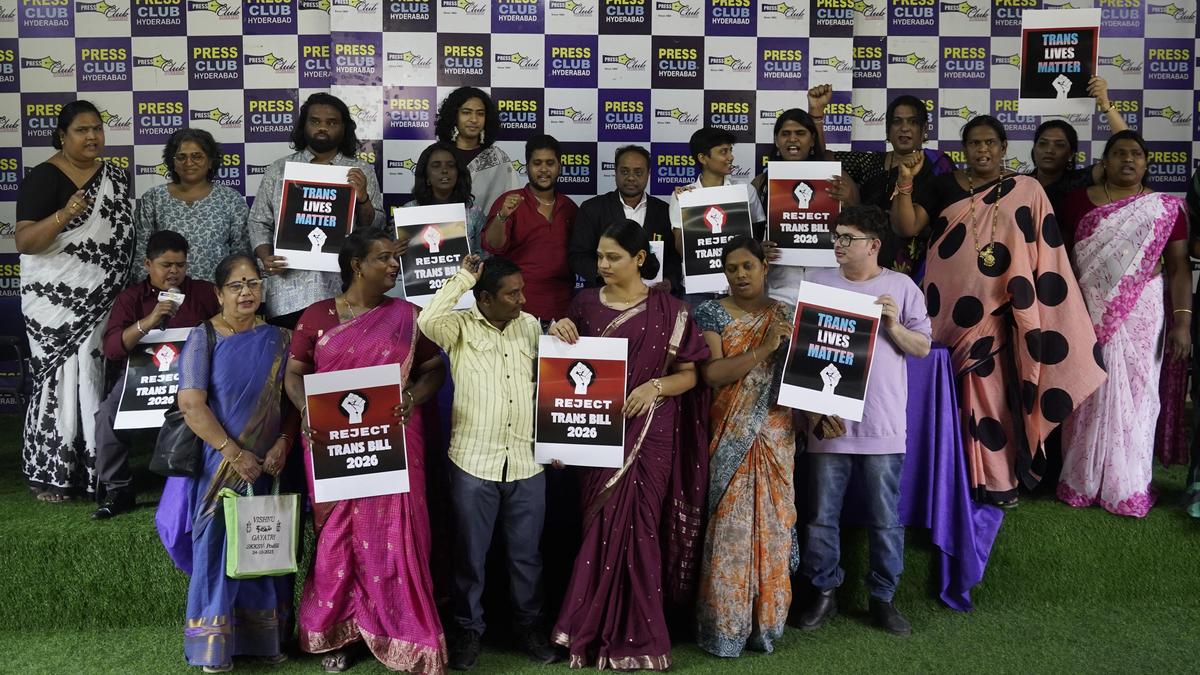
Law must recognise dignity, not verify identity: Hyderabad’s LGBTQIA+ community opposes Transgender Amendment Bill
The Hindu
Hyderabad's LGBTQIA+ community opposes the Transgender Amendment Bill, stressing dignity over identity verification and highlighting economic and medical concerns.
“Transgender people do not come into existence because of the law. They exist in our society. The question before us is, does the law recognise their dignity or will it subject their identity to verification?” said Aarathi Selvan, founder of Pause for Perspective and a clinical psychologist, setting the tone for a press conference organised by members of the LGBTQIA+ community and activists at the Press Club in Hyderabad on Tuesday, March 17.
The gathering brought together transgender persons, genderqueer individuals, healthcare professionals and activists, all of whom voiced strong opposition to the proposed Transgender Persons (Protection of Rights) Amendment Bill, 2026. Speakers argued that the amendments mark a shift away from the principle of self-identification recognised by the Supreme Court in the 2014 NALSA judgment and risk reversing the limited gains achieved under the 2019 Act.
Under the proposed amendments, individuals may be required to obtain certification from district medical authorities, and in certain cases undergo medical procedures, to be legally recognised.
Economic barriers to medical transition also emerged as a key issue. Swetcha, a queer activist pointed out that testosterone injections can cost between ₹7,000 and ₹15,000, making them unaffordable for many, especially those in rural areas. “Linking legal recognition to medical transition would exclude large sections of the community who either cannot afford or do not wish to undergo such procedures,” they said.
Rachana, a transgender activist, traced the trajectory of legal protections from the Supreme Court’s directives to the 2019 Act, noting that despite recognition as a backward community, transgender persons have not been granted reservations or protection comparable to other marginalised groups.
A.M.V. Monalisa, a transgender person, spoke about the lived experiences of discrimination and the long struggle for dignity. Recalling a time when many feared expressing their identities openly, she said that legal recognition and activism had brought change, but the proposed amendments risk undoing that progress.


Supreme Court questions why heirs can't access unclaimed funds of deceased depositors, urging government to develop a disclosure policy.

Karnataka High Court demands LPG supply details amid state restrictions, threatening Bengaluru's restaurants and livelihoods.

Shorts News:UN body investigating deadly strike on Iranian girls school

Moodbidri police inspector suspended pending inquiry over allegations of misbehaviour and inappropriate conduct towards women.

The State currently hosts more than 880 GCCs, up from around 500 GCCs in 2021.

Transgender and intersex activists march to Lok Bhavan, protesting the regressive Transgender Persons Bill and demanding its withdrawal.

Hyderabad's LGBTQIA+ community opposes the Transgender Amendment Bill, stressing dignity over identity verification and highlighting economic and medical concerns.

MDMK's manifesto demands total prohibition, life imprisonment for sexual offenders, and measures to protect youth and improve public transport in Tamil Nadu.

Telangana CM Revanth Reddy and TPCC chief Mahesh Goud meet AICC leaders Kharge and Venugopal to discuss political developments.

NMC fines Devanahalli medical college ₹1 Crore for stipend non-disclosure, part of broader regulatory actions against seven institutions.

Centre reports no evidence of increased efficiency from sewer cleaning mechanisation; highlights deaths, complaints, and caste issues in sanitation work.

NDA protests in Tamil Nadu condemn DMK for worsening law and order, citing rising violence and drug issues.

Major General Ajay Misra meets dignitaries in Amaravati to enhance military-civil synergy and discuss community development initiatives.