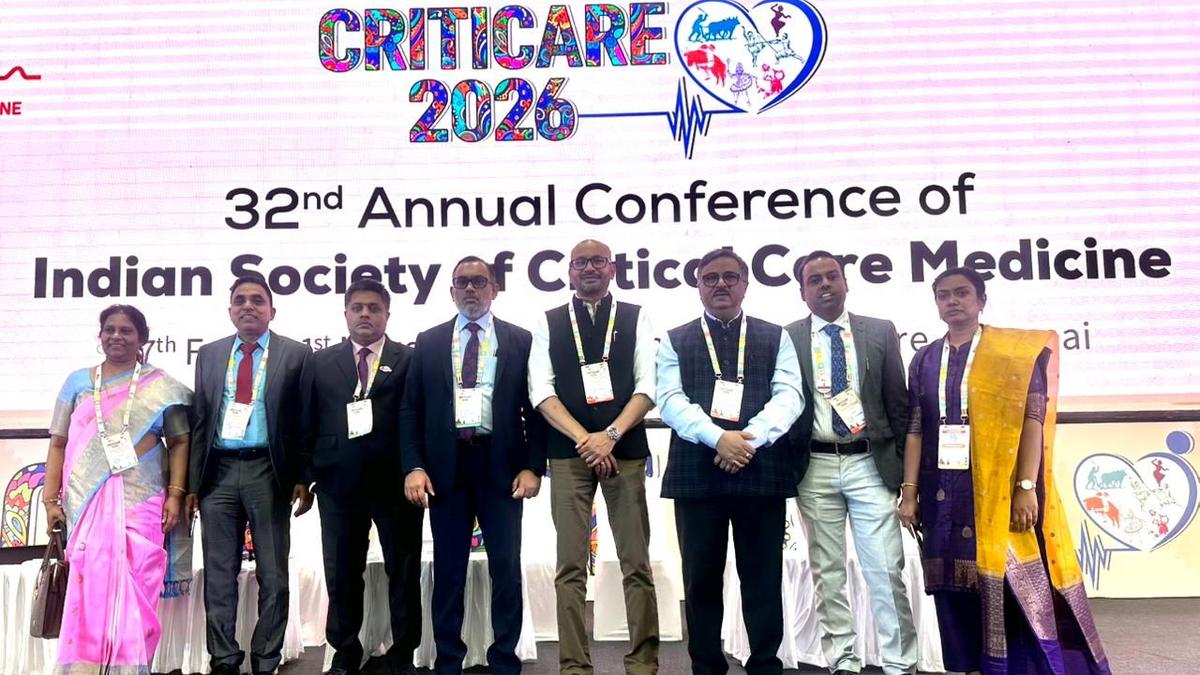
ISCCM urges stronger ICU infection control and antimicrobial stewardship at Criticare 2026
The Hindu
ISCCM calls for enhanced ICU infection control and antimicrobial stewardship at Criticare 2026 to combat rising antimicrobial resistance.
Antimicrobial resistance (AMR) is emerging as a serious threat to critical care, and in response, experts at Criticare 2026 called for stronger infection prevention practices, rational antibiotic use, and coordinated national action across all levels of healthcare.
The annual conference of the Indian Society of Critical Care Medicine (ISCCM), attended by over 3,000 delegates and 300 national and international faculty, focused on improving ICU infection management.
The press conference was addressed by Srinivas Samavedam, president, ISCCM; Sachin Gupta, general secretary; Pradip Kumar Bhattacharya, immediate past president; Ranvir Singh Tyagi, president-elect;. Ganshyam Jagathkar, general secretary-elect; Kalavathy Swarna, secretary, ISCCM Chennai Branch; Susovan Mitra, critical care physician; and Sathya AC, senior critical care specialist from Chennai.
Dr. Gupta emphasised that every fever in the ICU does not warrant antibiotic therapy. He spoke against fear-driven and indiscriminate prescribing, stressing careful clinical assessment, identification of infection source, appropriate diagnostics and targeted anti-infectives for a defined duration as central to antimicrobial stewardship.
Dr. Samavedam highlighted that stronger prevention at hospitals in all levels, could significantly reduce the burden on tertiary ICUs. He also underlined the importance of empathy in critical care and said data science and Artificial Intelligence could help personalise treatment, provided they complement sound clinical judgement.
Experts stressed that improving infection control understanding among doctors, adhering to scientifically validated data rather than social media trends, and ensuring robust diagnostic practices are crucial to combating AMR. They called for shared responsibility across the medical fraternity and the public, supported by stronger governmental policy frameworks.


International athlete Swapna Barman joins Trinamool Congress ahead of West Bengal Assembly elections, inspired by Chief Minister Mamata Banerjee.

Tamil Nadu unveils its first Dark Sky Park in Kolli Hills, offering stargazing opportunities and promoting astronomical awareness.

Southern Railway launches shuttle and bus services to alleviate commuter woes amid reduced suburban train operations in Chennai.

CEC Gyanesh Kumar announces strict enforcement of the Model Code of Conduct in Tamil Nadu to combat election inducements.

Commuters on Srinivagilu Road face dust, congestion, and unpleasant odors as delayed white-topping works create ongoing challenges.

Jain archaeological sites across 37 Tamil Nadu districts require urgent protection, highlights a recent seminar on Jainism’s heritage.

India and the U.K. will enhance cooperation on cybercrime, call centre scams, and security concerns for Indian dignitaries.

Deputy Chief Minister D.K. Shivakumar orders maintenance and restoration of ornamental plants along Bengaluru's roads and dividers.

AIDWA backs Anganwadi workers' strike in Ongole, demanding higher salaries and better support for the Integrated Child Development Services.

Explore the transformative changes in Formula One’s 2026 season, featuring innovative engines, eco-friendly designs, and unanswered racing dynamics.

Security is heightened for Prime Minister Modi's visit to Puducherry ahead of crucial Assembly polls, with significant announcements expected.

Telangana sweepers earn between ₹19,000 and ₹58,500 monthly, debunking myths of ₹2 lakh salaries.

Three workers faint due to inhaling toxic gas at a tannery in Tirupattur; police launch investigation.