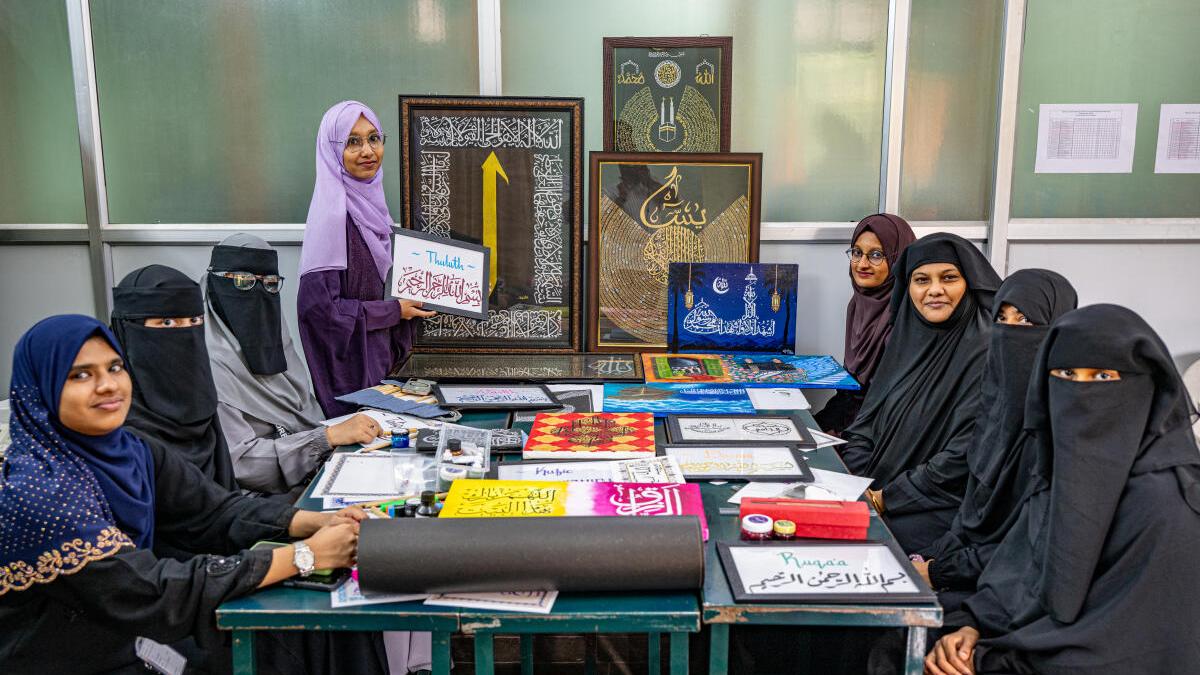
Ink beyond scripture: The revival of Arabic calligraphy in South India
The Hindu
Steered by women and social media, Arabic calligraphy is seeing a resurgence in South India as an art form, beyond religious texts like the Quran
Achyut Palav, 66, the Mumbai-based Marathi master calligrapher who was honoured with the Padma Shri in 2025, recalls the day when his Class VIII teacher assigned him the task of writing ‘Thought for the day’ on the blackboard. Little did he know that it would lead him to a career in typography and letters.
Palav is credited with the creation of ‘Mukta Lipi’, an amalgamation of Modi and Devanagari scripts. His ‘Calligraphy Roadways’ project in 2024 introduced young students from more than 20 Indian colleges, such as National Institute of Design and Indian Institutes of Technology, to calligraphy as an art form. “Calligraphy teaches patience and concentration. One has to be very aware of one’s stance and space when writing. And the beauty of calligraphy is that it makes even a simple word or phrase look like a masterpiece,” says the founder of Navi Mumbai’s Achyut Palav School of Calligraphy.
Padma Shri Achyut Palav with his artwork, a combination of Om and Shri Ganesha using Arabic calligraphy. | Photo Credit: Special Arrangement
Mumbai-based Marathi master calligrapher Achyut Palav’s artworks. | Photo Credit: Special Arrangement
Said to have been seen in ancient scripts such as Brahmi and Kharosthi, Indian calligraphy today encompasses the vast linguistic heritage of the nation. Regional scripts like Bengali, Tamil and Telugu used calligraphy from 6th-16th centuries, while from the 8th-12th centuries, Arabic and Persian calligraphy blended with Indian styles to create a vast ocean of literary and artistic works.
There was a time when India’s popular culture and artistic sensibilities were shaped by multilingual calligraphy — for instance, in Urdu, which adapted from the Arabic script. Indian film posters (Alam Ara, 1931; Mughal-e-Azam, 1960; Pakeezah, 1972), wedding cards, shop hoardings and even legal documents were handwritten/hand-painted in Urdu, as were a number of magazines (Shama; Din Dunia) and newspapers (The Musalman) that set the foundation of a booming publishing industry. Until 2020, The Musalman, published from Chennai, was known to be among the few handwritten publications in India. “We went for online production since the pandemic, and now print 15,000 copies every day. Our readers are spread across the nation,” says editor Syed Arifullah.


BRS leader Harish Rao questions Congress's commitment to the Constitution amid allegations of defections in Telangana

Justice Lisa Gill officially takes charge as Andhra Pradesh High Court Judge, poised to become the first woman Chief Justice.

Discover how cooks at Thiruvananthapuram mosques prepare nombu kanji for devotees during Ramzan, blending tradition and community spirit

T.N. CM Stalin commissions first unit of Udangudi Thermal Power Plant, inaugurates various projects

Telangana's Chief Secretary directs officials to ensure smooth LPG cylinder supply and prevent black marketing for consumers.

Shorts News:Watch: Emotional V.K. Sasikala announces name of her new political party

Explore Usha Balakrishnan's 'Silver & Gold' to uncover India's rich folk and tribal jewellery traditions in stunning detail.

Protests erupt in Shia-majority Kashmir against US-Israel actions in Iran, amid imposed curbs and calls for Palestinian solidarity.

Tamil Nadu Assembly election: KMDK to contest two seats on ‘Rising Sun’ symbol

Karnataka prioritises LPG supply for hospitals and schools amid crisis; hotels must wait a week for deliveries.

BJD and Congress urge MLAs to stay in Bhubaneswar until March 16 amid concerns over Rajya Sabha election cross-voting.

LPG shortage leads to the closure of over 100 hotels in Kochi, with remaining eateries limiting menu options amid the crisis.

Sasikala announces her new party, All India Puratchi Thaliavar Makkal Munnetra Kazhagam