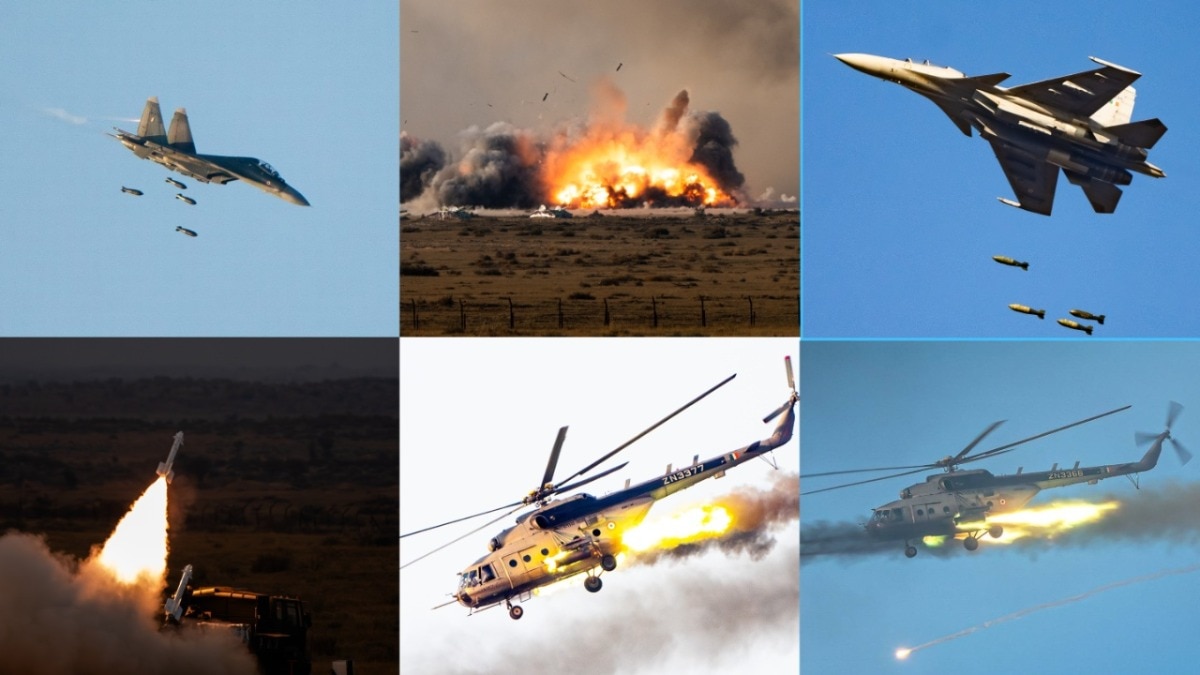
IAF to fire 12,000 Kg of explosives in first mega 'Vayu Shakti' after Op Sindoor
India Today
The exercise will prominently feature indigenous and smart weapons systems. It is designed to showcase the Air Force's ability to dominate long-range targeting, maintain control of airspace and highlight operational lessons from Operation Sindoor.
In its first major combat demonstration after Operation Sindoor, the Indian Air Force (IAF) will unleash 12,000 kilograms of explosives during Exercise Vayu Shakti at the Pokharan firing range near the India-Pakistan border on February 27.
Briefing the media, Vice Chief of Air Staff Air Marshal Nagesh Kapoor said the large-scale exercise will showcase the IAF’s precision strike capability and send a clear message that terrorism will not be tolerated.
A total of 277 weapons will be deployed during the nearly two-and-a-half-hour event, which will feature day, dusk and night operations. The full dress rehearsal is scheduled for February 24, while February 28 has been kept as a standby date.
The February 27 event marks the IAF’s first large-scale firepower demonstration since Operation Sindoor, during which the Air Force carried out precision strikes targeting terror infrastructure and military assets.
Responding to a question on future inductions, Air Marshal Kapoor said Rafale was “definitely the hero of Operation Sindoor, among many other heroes.” Calling Rafale the current “buzzword”, he added that the IAF is looking to induct more advanced multirole fighter aircraft (MRFA), though the process remains under deliberation.
“Yes, the IAF is looking forward to inducting new-generation aircraft. But since it is under deliberations, I cannot say which type,” he said.


India on Monday said it has not held bilateral talks with the United States on deploying naval vessels to secure merchant shipping in the Strait of Hormuz. The clarification came after US President Donald Trump urged countries to send warships to keep the strategic waterway open amid tensions with Iran.

After attacking his wife, Nafees attempted suicide by inflicting injuries on himself with the same scissors. Neighbours intervened after hearing the commotion and stopped him from taking his own life.

The victim, identified as Naitik Kumar, allegedly rammed his speeding Bullet motorcycle into a scooter near Janeshwar Mishra Park in Lucknow, triggering a crash that left him dead and two others injured.

RJD MLA who skipped Bihar Rajya Sabha poll voting cites mother's illness

West Bengal Chief Minister Mamata Banerjee led a protest march in Kolkata against the alleged LPG shortage, accusing the PM Narendra Modi-led Centre of failing to ensure adequate supply.

Himayani Puri, daughter of Union Minister Hardeep Singh Puri, has moved the Delhi High Court over "false and malicious" reports linking her to convicted sex offender Jeffrey Epstein.

The family, a resident of Thyagaraju Street in Punganur town, had recently repaired the engine of their two-wheeler vehicle. A local mechanic advised the family to keep the engine running overnight to "set" the newly installed parts. However, this turned out to be fatal for the family.

The Supreme Court closed criminal proceedings against Ashoka University professor Ali Khan Mahmudabad after the Haryana government said it would not grant sanction to prosecute him over social media posts related to Operation Sindoor.

Three Congress MLAs in Bihar are reportedly out of contact as voting for five Rajya Sabha seats is underway, with the INDIA bloc and the BJP-led NDA locked in a tight contest for the fifth seat that could hinge on cross-voting.

Bunty Solanki stabbed his wife to death following a quarrel at their residence in Vadodara's Bakrawadi area. Rita died on the spot.

The girl's family members were angered over the friendship, and as a result, they called Jadhav last Saturday evening and allegedly beat him.

External Affairs Minister S Jaishankar has said that direct talks with Iran to restore shipping through the war-hit Strait of Hormuz have yielded results, stressing that direct engagement with Tehran is the most effective way to address the disruption.

This moment comes days after the Supreme Court allowed Harish Rana to die with dignity – a historic first court-ordered case of passive euthanasia in India. The court acknowledged the medical opinion that Rana will never recover and that the tubes that feed him and keep him alive are only prolonging his pain.