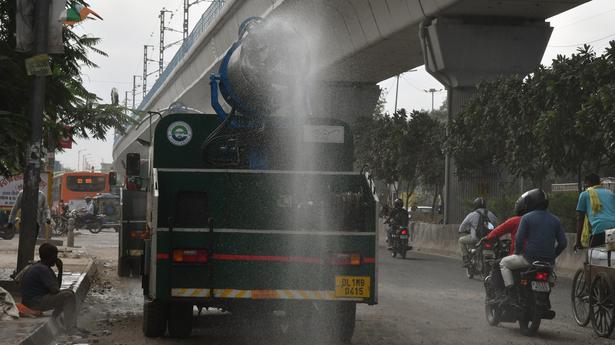
‘Hyperlocal emissions’ behind spike in pollution in Delhi on Dasara
The Hindu
The possible sources of these emissions could be the large number of effigies burnt on the occasion of Dasara and during a political protest, said Indian Institute of Tropical Meteorology officials
Delhi's air quality turned poor on Dasara, though the early warning system of the Indian Institute of Tropical Meteorology had predicted moderate to satisfactory air quality in the capital.
IITM officials said that they did not record any substantial changes in parameters like temperature, wind speed and emissions from farm fires on October 5 and "hyperlocal emissions" could have impacted the air quality.
The possible sources of these emissions could be the large number of effigies burnt on the occasion of Dussehra and during a political protest, they said.
With the air quality in Delhi dropping to the 'poor' category on Wednesday, authorities in the National Capital Region (NCR) have been asked to strictly implement measures under Stage 1 of the Graded Response Action Plan (GRAP) which include penal and legal action against polluting industrial units.
The Centre's sub-committee on GRAP noted in a meeting that there has been a "sudden dip" in air quality parameters in the region which pushed Delhi's Air Quality Index (AQI) into the 'poor' category.
"While this is likely due to a localised influence and the forecasts do not predict any further deterioration, in an effort to maintain the AQI in the moderate category, as a precautionary measure, the sub-committee decided that all actions as envisaged under Stage I of the GRAP - 'Poor' air quality (AQI 201-300) be implemented in right earnest by all the agencies concerned with immediate effect in the NCR," the Commission for Air Quality Management (CAQM) said in an order.
The GRAP has four different stages of adverse air quality: Stage I - 'Poor' (AQI 201-300), Stage II - 'Very Poor' (AQI 301-400), Stage III - 'Severe' (AQI 401-450) and Stage IV - 'Severe Plus' (AQI >450).


A Tamil Nadu State Planning Commission study reveals the ground reality of gig workers across platforms like Uber, Swiggy, and Zomato. Long hours, mounting debt, and lack of basic facilities expose the gap between “flexibility” and survival. Is the gig economy truly empowering workers—or trapping them?

Posing as Border Security Force (BSF) officials, conmen duped a Bengaluru-based firm of over ₹26 lakh by issuing a fake purchase order.

Sniffer dog wing welcomes puppy ‘Brownie’

The High Court of Karnataka on Thursday ordered the issue of notice to Chief Minister Siddaramaiah, his wife Parvathi B.M. and others on a petition challenging a special court’s order of accepting a clean chit given to them by the Lokayukta police on the allegation of illegalities and corruption in the allotment of 14 alternative sites worth ₹56 crore to Ms. Parvathi by the Mysuru Urban Development Authority (MUDA).

Parliamentary panel proposes a National Highway Safety Patrol to enhance accident response, enforce traffic discipline, and protect infrastructure.

Nara Bhuvaneswari announces a comprehensive development plan for Kuppam, focusing on industrial growth, welfare, and infrastructure.

Political tensions rise in Vattiyurkavu as UDF candidate alleges secret CPI(M)-BJP deals ahead of Kerala Assembly polls 2026.

Cashier in Hassan accused of refusing service and making derogatory religious remarks; police investigate after viral video.

Mangaluru City Corporation (MCC) in its Budget for 2026-27 proposed three initiatives for women.

A Nirmal police Sub-Inspector was arrested for accepting a ₹20,000 bribe, as confirmed by the Anti-Corruption Bureau.

Shorts News:“Give 4 tickets to each MLA for IPL matches in Bengaluru” Congress MLA Vijayananda Kashappanavar

Delhi government bans reels and short videos in schools during class hours to maintain focus on education and discipline.

Telangana CM reviews MMTS services, directing studies to enhance ridership, amenities, and last-mile connectivity in Hyderabad.