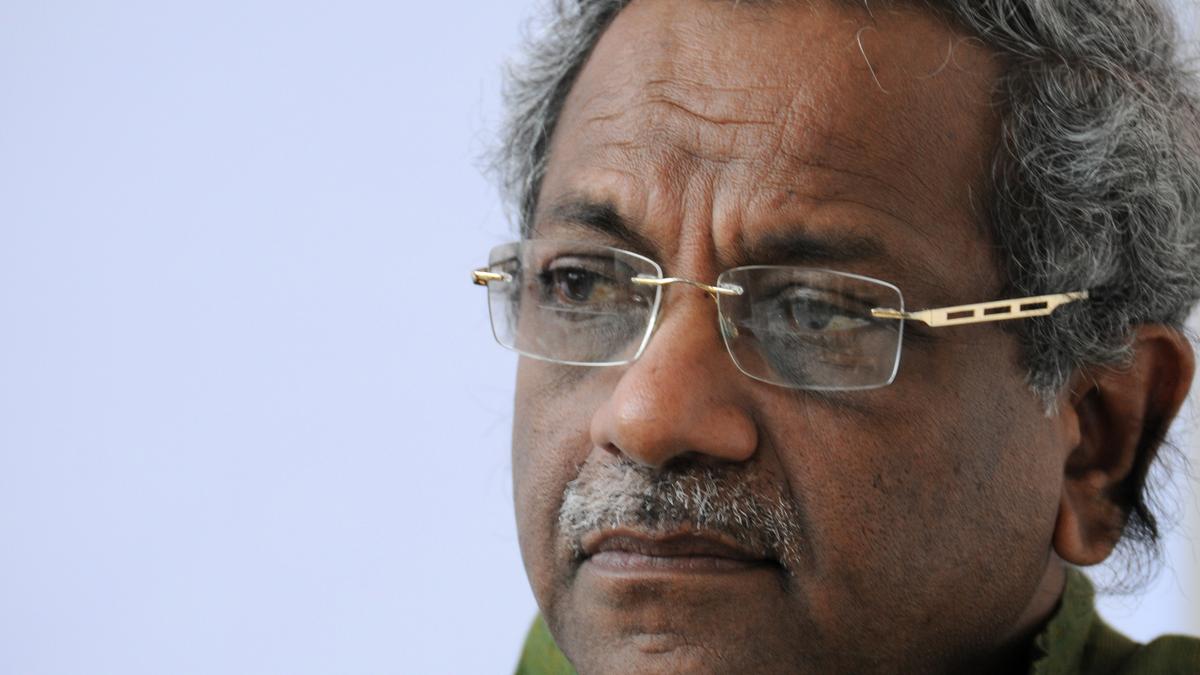
How Shaji N Karun captured the realities of life through his lens
The Hindu
Shaji N Karun's legacy as a celebrated filmmaker and cinematographer lives on.
A pall of gloom hangs over ‘Piravi’, Shaji N Karun’s residence in Thiruvananthapuram. This was where the auteur and ace cinematographer met admirers from all walks of life. This is where he had conceptualised all his works, including documentaries and short films. This is where I met Shaji more than three decades ago as a student of journalism as part of my course. He had shared that it was his wife Anusuya Warrier’s idea to name their house ‘Piravi’.
Shaji spent considerable time speaking to a rookie reporter, discussing his maiden film Piravi (1988), his second film Swaham (1994) and his student days in Pune. Piravi , a huge success, was about the story of a father’s futile search for his son, who has been picked up by the police. The film brought alive the excesses during the Emergency, in a poignant way. It won Shaji the Camera d’Or at the Cannes Film Festival in 1989 and the National award for best director along with several other honours from across the world. Swaham (1994) was also screened at Cannes.
It was Shaji’s fascination for the images painted by light that made him take to cinematography. After his graduating in Physics from University College, he chose to join the Film and Television Institute of India in Pune. He passed out with a gold medal in cinematography.
Shaji always spoke passionately about the magic and moods of the tropical sun. He would excitedly capture its constantly changing hues and direction. His attention to detail was amazing.
His simplicity was in stark contrast to the world he saw through the lens. Since he lived in the neighbourhood of my mother’s house, I have often seen him walk quietly along the road. He was then the chairman of the Kerala State Chalachitra Academy. He was also the executive chairman of the International Film Festival of Kerala (IFFK). He was able to get the best of filmmakers and technicians to these festivals because of his personal equation with them.
Over the years, I have had the opportunity to speak to him several times. Each time, I was left with a sense of wonder at the filmmaker’s ability to delve into varied themes set in different periods of times. Shaji was not a prolific director. He took time to shape a story or a theme and then spent some more time visualising it in a language and idiom that was all his.
Among the many awards that Shaji had won, he particularly treasured the Sir Charlie Chaplin Award instituted to commemorate the birth centenary of the legendary comic actor (1989) at the Edinburgh Film Festival. “After I boarded my flight to India, the flight attendants announced that I had won this prestigious award and the passengers gave me a standing ovation,” he had recounted during an interview to The Hindu.


Khalid Rahman is reuniting with Malayalam superstar Mammootty after Unda (2019). The Thallumaala director has teamed up with the veteran for Mattancherry Mafia.

Bollywood actor Akshay Kumar paid tribute to the martial arts grandmaster and Hollywood’s action star, Chuck Norris, who passed away on Thursday, March 19, 2026.

Renowned Odissi dancer Madhumita Raut, aged 59, dies of cardiac arrest, leaving behind a legacy of artistic achievements.

Chuck Norris, iconic martial arts master and actor, dies at 86, leaving behind a legendary legacy and internet memes.

South African naturalist Steve Boyes speaks on ghost elephants, ancestral tracking, and Werner Herzog’s documentary exploring Angola’s elusive highland giants

Actor-director Amol Palekar will receive META's Lifetime Achievement award for 2026 on March 25 in New Delhi.

India's artists unite against rising censorship, advocating for creative freedom and support for marginalized voices in the arts.

Written and directed by Kunal, the film also stars Sparsh Shrivastava and Vanshika Dhir

This year, Bharatnatyam artistes will present the Tyagaraja Aradhane as a dance performance

This year, Bharatnatyam artistes will present the Tyagaraja Aradhane as a dance performance

The actor, along with director Sushant Shah, speak about their upcoming series ‘Chiraiya’, Divya’s process of working on the dialect, Sushant’s approach to telling a story about women, and more

An independent video, ‘Feel the Spark’ by Raleigh Rajan with vocals by Ciera Dumas that celebrates Tamil literary giants, garnered 1.4 million views in less than 36 hours.

In ‘Jack Ryan: Ghost War’, John Krasinski is back as the savvy CIA analyst, diving headfirst into a high-stakes mission that unravels a deadly conspiracy and pits him against a rogue black-ops unit