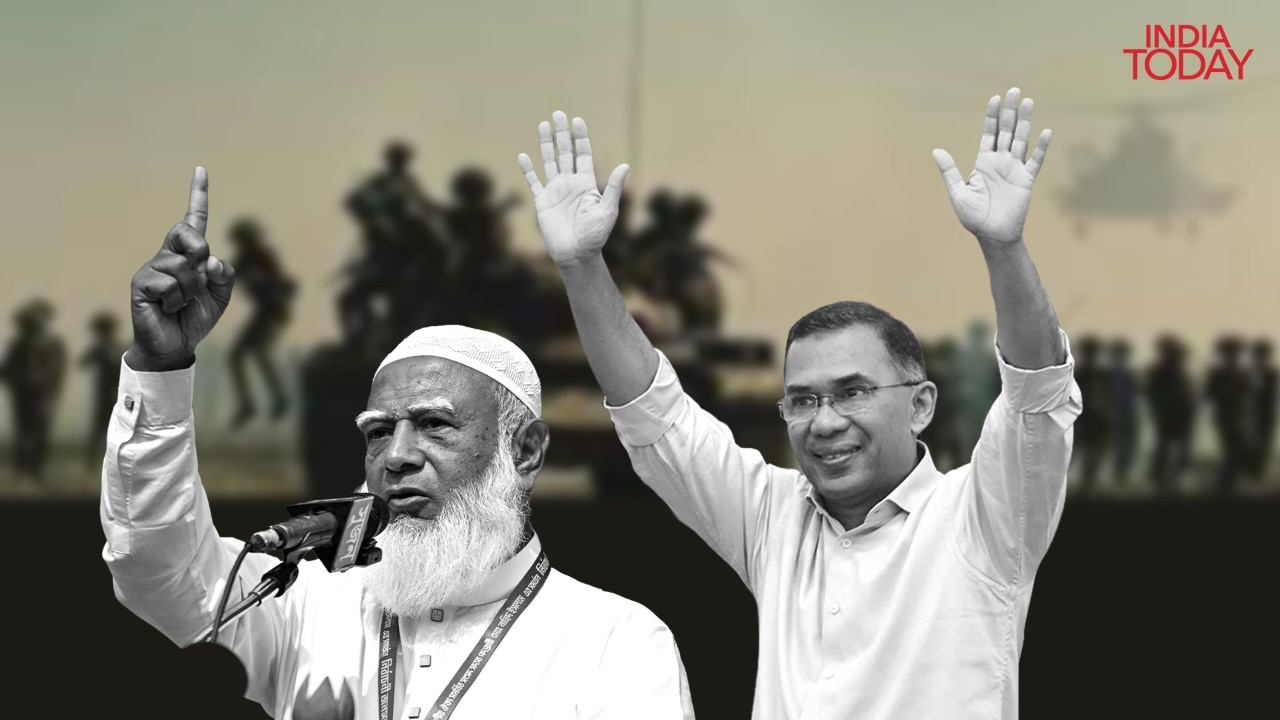
Following Bangladesh's first post-Hasina election? Key points here
India Today
Bangladesh's 127 million people are voting in its first election without Sheikh Hasina or the Awami League on the ballot in over 15 years. Here's a detailed look at what is at stake, who is in the fray, and why the BNP-Jamaat contest could redefine Bangladesh.
Today, February 12, is a big day for Bangladesh. That's because 127 million people of Bangladesh are electing their first government after an anti-quota agitation supported by Islamists dethroned PM Sheikh Hasina in August 2024. People of Bangladesh, now seeking a "notun byabostha" (a new system)" are voting for the next government and also for a simultaneous referendum for the implementation of the July Charter.
With nearly 44% of the 127 million voters aged between 18 and 37, and about five million casting their vote for the first time, this post-Hasina election carries a major significance. After youth-led protests helped trigger the political unrest in Bangladesh, young voters are now positioned to shape the outcome through the ballot.
The two main alliances contesting the polls are led by the Bangladesh Nationalist Party (BNP) and the Jamaat-e-Islami (JeI).
The BNP's chief is Tarique Rahman, the son of former PM Khaleda Zia who died in December 2025. The Jamaat-e-Islami is led by Shafiqur Rahman and is at the head of an 11-party alliance, which includes the National Citizen Party (NCP) formed by anti-Hasina leaders. Shafiqur Rahman, during the Hasina rule, was booked for terrorism and sabotage. He was locked up, and the Islamist Jamaat was banned until the Muhammad Yunus administration lifted the ban.
The polls in Bangladesh are being held under the shadow of alleged fraud, violence, a shortage of police personnel, and a deteriorating law-and-order situation.
Earlier, the BNP's Tarique Rahman, concerned over security of polling booths, had asked his supporters to be present even before the Fajr namaz (dawn prayers). On Monday, miscreants set fire to four polling booths in the Netrokona district. A day ago, the Bangladesh Army arrested a terrorist in the capital Dhaka with three foreign pistols, 13 locally made weapons, and various types of ammunition. Later on Monday night, a Hindu businessman was stabbed to death inside his shop in Bangladesh's Mymensingh district.


The profiles of at least three of China's leading nuclear, missile and radar experts were scrubbed from the website of the Chinese Academy of Engineering, the country's most prestigious academic body. This comes as a series of purges under Premier Xi Jinping's anti-corruption campaign have decimated the upper echelons of China's military and scientific community.

The aircraft had also been used by senior Iranian officials and military figures for both domestic and international travel, and for coordinating with allied countries, the Israeli military said. Meanwhile, Dubai International Airport has resumed flight operations after a temporary suspension of about seven hours caused by a drone strike near a fuel tank facility.

A government school teacher's gesture of buying a new uniform for an orphaned student has received widespread attention after a video of the act was shared on Instagram.

A father travelling with his toddler addressed fellow passengers ahead of a flight, asking for patience and understanding if his child became unsettled.

The lottery system for a segment of Green Cards, known as the Diversity Immigrant Visa programme, has been restarted. However, the stricter rules being enforced by the US won't impact Indian Green Card aspirants. Here's why.

Instead of putting an end to rumours, the video has triggered another wave of speculation about Netanyahu's fate. Several users on 'X' (formerly Twitter) have claimed that the video posted on 'X' was an AI-generated deepfake.

US jets strike military facilities near Iran's Chabahar free trade zone

The video, recorded inside the train coach, shows the compartment littered with snack packets, water bottles, soiled spoons and bedsheets scattered on the floor.

The US is planning to deploy a third aircraft carrier in the Middle East amid the war with Iran. Aircraft carriers, one of the most expensive defence systems, are floating military bases that project power. Here's how aircraft carriers are used and where India stands.

Donald Trump warned that Nato could face a 'very bad' future if member states fail to help reopen the Strait of Hormuz, and to support Washington's efforts amid the ongoing US-Israeli war with Iran.

When we look at Iran through the prism of religion and see a Shia Islamic country, we negate its thousands of years of rich pre-Islamic Persian culture. A dive into the world of Zoroastrianism and Vedas shows us how Indians and Iranians have been sharing languages, Gods, sciences and a sacred fire for thousands of years.

Israeli Prime Minister Benjamin Netanyahu responded directly to his death rumours by releasing a new video intended to show he was alive and continuing his duties.

A couple and two children were killed when Israeli fire hit their car in the West Bank. Two injured boys survived, their story reveals the terrifying final moments inside the vehicle.