Female right whales may never breed after entanglement in fishing gear: study Premium
The Hindu
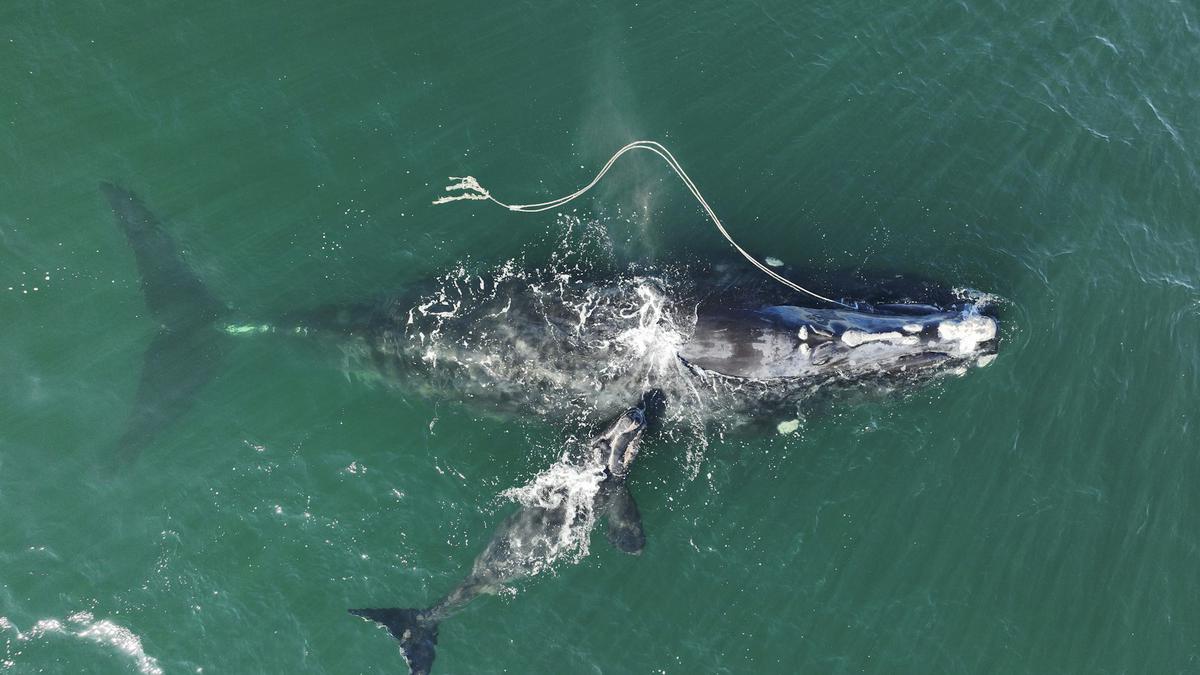
Female right whales may never breed after entanglement in fishing gear, a new study has found.
It sounds like a crime show episode at sea: In late January 2024, federal regulators learned that a dead female North Atlantic right whale had been sighted near Martha’s Vineyard, Massachusetts. The whale was towed to shore, where more than 20 U.S. and Canadian scientists converged to perform a necropsy, or animal autopsy.
On Feb. 14, the U.S. National Oceanic and Atmospheric Administration announced that the whale was #5120 in a catalogue that tracks individual right whales. Further, the agency said, rope that had been deeply embedded in the whale’s tail had likely come from lobster fishing gear in Maine.
Entanglement in fishing gear is a deadly threat to these critically endangered animals. Scientists estimate that before commercial whaling scaled up in the 18th and 19th centuries, there may have been as many as 10,000 North Atlantic right whales. Today, fewer than 360 individuals remain. Almost 90% of them have been entangled at least once.
When whales become entangled in fishing gear, they use extra energy dragging it as they swim. If the rope is caught around their mouths, they may struggle to feed and slowly starve. Ropes wrapped around whales’ bodies, flippers or tails can cut into the animals’ skin and become deeply embedded in their flesh, as happened to whale #5120. This can cause infections, chronic emaciation and damage to whales’ blubber, muscle, bone and baleen – the bristly structures in their mouths that they use to filter prey from the water.
North Atlantic right whales are legally protected, both internationally and in U.S. waters, including policies that seek to reduce deaths or serious injuries resulting from entanglements. However, even when entanglement does not kill a whale, it can affect individuals’ ability to reproduce, which is critically important for a species with such low numbers.
In a newly published study, we show that even entanglements scientists classify as “minor” have devastating impacts on female right whales and that, surprisingly, potential mothers who suffer “minor” entanglements have the lowest chance of starting to breed. As researchers with expertise in marine biology, ecology and statistics, we believe our findings underline the urgent need for ropeless fishing gear that can reduce threats to the survival of this species.
Understanding reproductive patterns is essential for supporting species that are critically endangered. North Atlantic right whales historically started breeding by around 9 years of age and gave birth to a single calf every three to four years thereafter for several decades.


The BMW X3 30 xDrive M Sport Pro blends sporty performance with everyday luxury, powered by a 258 hp 2.0-litre TwinPower Turbo engine and BMW’s xDrive all-wheel-drive system. With bold M Sport styling, a high-tech Curved Display running Operating System 9, advanced driver assistance features, and genuine off-road capability, the latest X3 delivers a versatile premium SUV experience that excels on city roads, highways, and beyond.

Explore the concept of 'snowball earth' and recent findings on climate variability during this ancient icy period.

A riot of capes, corsets, and carefully crafted armour took centrestage as Chennai Comic Con wrapped up at the Chennai Trade Centre, with cosplay emerging as the undisputed showstopper. From anime icons and gaming legends to beloved Indian comic characters, over 500 fans transformed the venue into a living, breathing multiverse, showcasing how Chennai’s fandom culture has evolved, placing the city on India’s pop culture map.

Warmer oceans and depleting food have affected the ubiquitous loggerhead turtle’s reproductive and migratory patterns — and even its size.

Toyota Urban Cruiser Ebella review: Explore design, range, features, ride comfort and safety of Toyota’s new electric SUV for India. Expected price ₹14–18 lakh, with up to 500 km claimed range and practical urban usability.

Explore India's potential in bio-based chemicals and enzymes, highlighting industry leaders and challenges in sustainable manufacturing.

Astronomers discover an unusual planetary system with a rocky planet formed outside its gaseous neighbors, challenging existing formation theories.

Four new astronauts arrive at the ISS to replace a crew evacuated due to a serious health issue.

Neurobehavioural therapy can transform brain connectivity in functional neurological disorders, highlighting the link between cognition, emotion, and behavior.

The centuries-long quest for synthetic diamonds, also known as lab-grown diamonds or human-made diamonds, came to an end in 1954-55. On February 15, 1955, the creation of the first synthetic diamonds were announced, and it was quickly picked-up by newspapers around the world. A.S.Ganesh tells you more about these diamonds and the man who first made it happen…

Kadhambari S. Viswanathan highlights online education's evolution and its coexistence with traditional methods at The Hindu Tech Summit 2026.

The Hindu science quiz on Charles Darwin on February 13 2026

Explore the immersive art exhibit "A Story in Red" in Fort Kochi, featuring 13 installations celebrating memory, culture, and emotion.