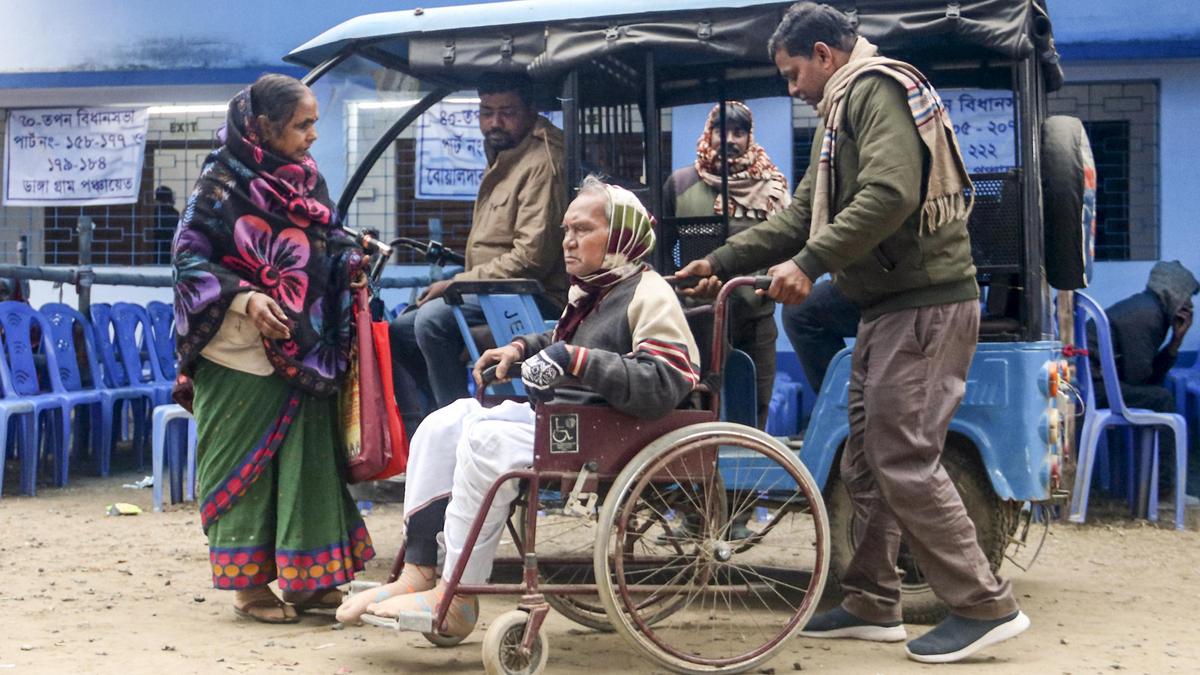
Disabled voters need to queue up for SIR hearings in West Bengal despite ECI directives
The Hindu
Disabled voters in West Bengal face long waits and inadequate facilities for SIR hearings, despite Election Commission exemptions.
Thirty-nine-year-old Arpita Banerjee, a resident of Baranagar in West Bengal’s North 24 Parganas district, has been battling multiple health problems since childhood, exacerbated by neurological disorders.
Born in November 1987, Ms. Banerjee had been on the earlier 2025 voter list and was included in the post-Special Intensive Revision (SIR) draft electoral rolls published in December last year. Soon after, however, she received a notice to attend a hearing over a “logical discrepancy” arising from a mismatch in the spelling of the surname “Banerjee” in her and her father’s records.
Her 76-year-old father, a small-time businessman, accompanied her to the hearing, where they had to wait for a good three hours before officials clicked her photograph and accepted her disability certificate as documentary evidence, as mandated under SIR rules. The experience, however, has left her traumatised.
Similar difficulties have been reported by other voters with disabilities. Lokman Sheikh, a person with visual disability from Raghunathganj Assembly Constituency under Murshidabad district, had to wait in the queue during his hearing, with no separate facility for people like him, despite being called over a “logical discrepancy” in his name.
The parent of a non-verbal autistic boy from Kolkata, who did not wish to be identified, said they had to wait for nearly five hours in a queue with their son for the SIR hearing, triggering severe anxiety in the child.
According to the Election Commission of India data, West Bengal had 5,07,089 registered voters with disabilities in the 2024 electoral rolls used for the Lok Sabha elections. The ECI provides a home voting facility for voters with disabilities.


KPCC chief Sunny Joseph emphasizes UDF's focus on Sabarimala and corruption while expressing confidence in winning Kerala's upcoming Assembly elections.

A military plane crash in Colombia leaves 125 aboard, with at least 48 survivors rescued amid ongoing recovery efforts.

‘Symposium’, a new platform to promote lifelong learning and counter misinformation among youth, was launched in Hyderabad.

By using TB as an entry point, integrated healthcare delivery can optimise and improve public health efficiency

Residents of Chettichavadi express concerns over deteriorating groundwater quality due to long-standing garbage dumping issues in Salem West.

Community Health Officers in Vijayawada protest for reduced workload and continued incentives amid growing dissatisfaction over salary changes.

Telangana faces 13,929 healthcare vacancies, primarily in doctors and nurses, as recruitment efforts aim to address the shortage.

For most patients with TB who are severely underweight, nutritional support is an essential and not optional part of treatment

Family of custodial death victims demands harsh punishment for nine convicted policemen to prevent future abuses of power.

Rajinikanth refutes TVK leader's claims about DMK threats preventing his political entry, expressing gratitude to supportive political figures.

CM announces Cabinet Sub-Committee on Musi rejuvenation; rehabilitation for all displaced

Ramanathapuram identifies 145 polling stations as sensitive, ensuring security with paramilitary forces ahead of assembly elections, says DEO.

BJP Puducherry president V. P Ramalingam files nomination for Raj Bhavan, joined by Union Minister Mandaviya and Khushbu Sundar.