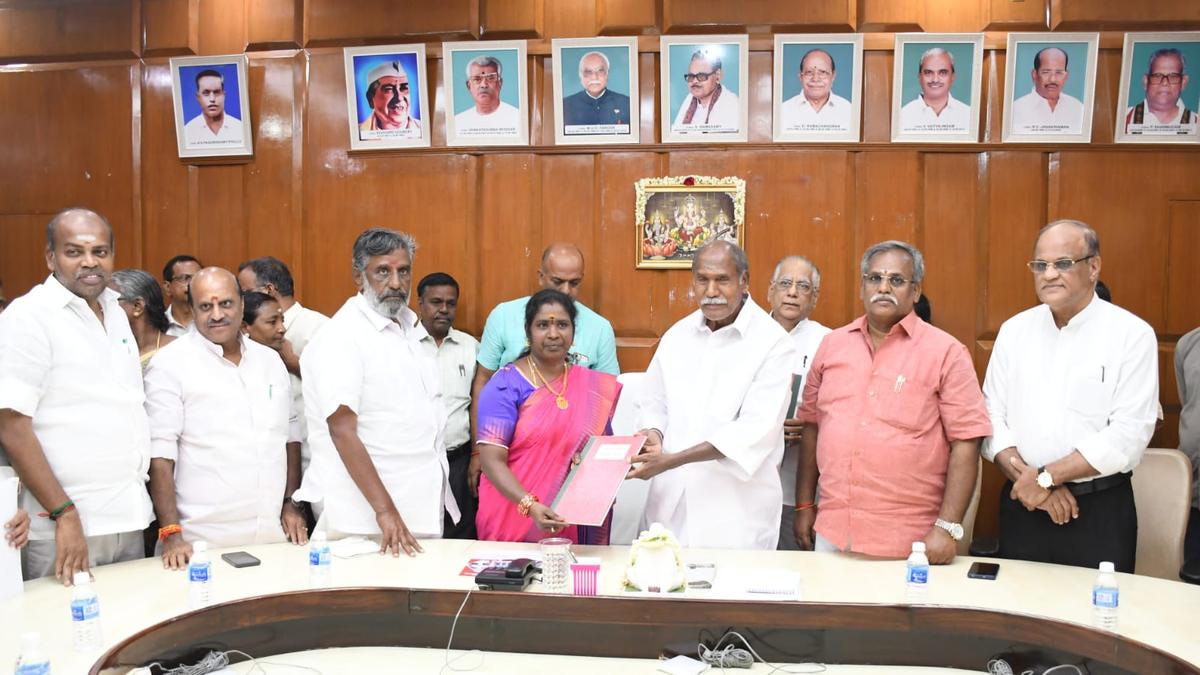
Committed to submitting authentic, verifiable data for OBC reservation in local body polls despite constraints: Justice Sasidharan Commission
The Hindu
Committed to submitting authentic, verifiable data for OBC reservation in local body polls despite constraints: Justice Sasidharan Commission
Responding to criticism over delays in completing its mandated task of identifying Other Backward Classes (OBC) ward-wise before the local body polls in Puducherry, the Justice K.K. Sasidharan Commission clarified that the extended timeline was due to the comprehensive nature of the survey and the limited resources available to it.
“The Commission’s work is characterised by meticulous data collection and scientific analyses under significant resource constraints. The extended timeline is primarily due to the comprehensive nature of the survey and the limited manpower and funding, unlike other States with large-scale financial support for a similar exercise,” Officer on Special Duty to the Commission and District Judge (Retired) D. Ramabathiran said in an interaction with The Hindu.
The one-man commission, with Justice Sasidharan, a former Judge of the Madras High Court, as Chairperson, was appointed by the Puducherry government on December 17, 2021, following a direction of the Madras High Court to conduct the local body polls after reserving seats for OBCs. The commission was asked to submit a report recommending appropriate reservation for OBCs within six months of its constitution. However, the commission was given another extension last year after it commenced the survey on August 9, 2023.
“The commission remains committed to maintaining authentic, verifiable records and producing a report that withstands scrutiny regarding voter distribution by ward, religion, and community. Constructive engagement is welcome from anyone interested in reviewing the extensive work completed by the Commission to date,” he said.
Recently, former Member of Parliament and president of the Puducherry Maanila Makkal Munnetra Kazhagam M. Ramadass had criticised the delay in submitting the report by the commission, stating that Telangana government had completed a similar study within three months of setting up a panel.
“It is crucial to shed light on the commission’s diligent efforts and the limitations and constraints it has encountered in executing its mandate. The last available census (2011) does not provide separate statistics for the OBC population in the UT, necessitating alternative approaches. Efforts were made to gather date from educational institutions across the UT. However, response was limited. Then, the commission adopted a door-to-door enumeration as the primary tool to collect accurate, area-specific demographic data on OBC voters,” Mr. Ramabathiran said.
Unlike larger States such as Telangana, Bihar, Karnataka, and Maharashtra, which allocated substantial funds ranging from ₹160 crore to ₹500 crore, the Puducherry government had made no specific budgetary allocation for the enumeration activities. The Telangana government had spend a sum of ₹160 crore for conducting the survey by employing 94,261 enumerators, he said.


Special prayers mark Eid-ul-Fitr celebrations in Madurai

India’s gem and jewellery industry continues to demonstrate remarkable resilience and a spirit of innovation, said Kirit Bhansali, chairman of the Gem and Jewellery Export Promotion Council (GJEPC), at the inauguration of the 4th edition of IIJS Bharat-Tritiya 2026 at Bengaluru International Exhibition Centre (BIEC) here on Saturday, March 21.

HYDGEN dispatches eight modular green hydrogen systems to Surat, enhancing on-site industrial hydrogen generation and operational efficiency.

Fight is between AIADMK and DMK, says Rajan Chellappa

Two habitual offenders arrested in Miyapur for wine shop burglary; police recover stolen cash and bike.

Tiruchi's Smart City projects face underutilisation despite completion, raising concerns about planning, execution, and revenue generation.

Election Observer Anubha Shrivatsava inspects polling booths in Western Ghats, ensuring smooth arrangements amid challenging conditions.

A.P. Minister announces ₹9.8 crore development of Barashaheed Dargah and ₹20 crore international school for minorities in Nellore.

Vice-President Radhakrishnan advocates for modern university syllabi to enhance employability and skill development in today's evolving job market.

A poignant protest at Palakkad Medical College highlights ongoing developmental challenges, initiated by a symbolic wreath-laying by a young girl.

A three-year-old girl was tragically killed by a truck while walking with her mother near Bengaluru.

Iran's President calls for U.S.-Israeli aggression cessation and urges BRICS to ensure regional peace and security.

Harish Rao accuses govt. of cancelling ₹1,070 cr. work sanctioned to Siddipet