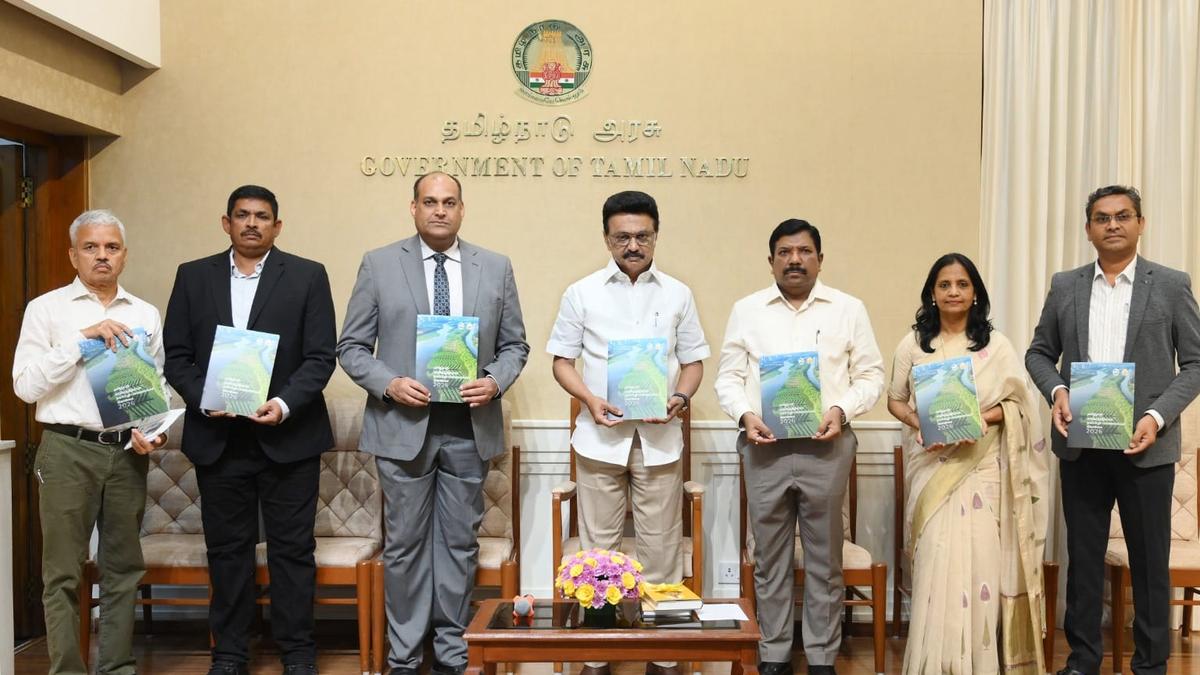
CM Stalin releases Tamil Nadu Urban Greening Policy 2026
The Hindu
Tamil Nadu CM Stalin unveils the Urban Greening Policy 2026, promoting sustainable urban development and enhanced green spaces statewide.
Chief Minister M.K. Stalin on Friday (February 6, 2026) released the Tamil Nadu Urban Greening Policy 2026, aiming to build climate-resilient, liveable, and sustainable cities.
According to an official release, the State government has been pursuing a mission-mode, Statewide greening effort through the Green Tamil Nadu Mission, with the objective of progressively enhancing forest and tree cover towards 33%, improving climate resilience, and strengthening ecological security.
Some of the greening efforts by the State government include the planting of over 12.05 crore seedlings, expansion of agroforestry over more than 2.24 lakh acres, mangrove plantation and restoration, palmyrah dibbling at scale, establishment of 100 village woodlots (Maragathapooncholai) across 38 districts, creation of 1,000 micro forests (Kurunkadugal) within industry premises, and notification of 100 new reserve forests, integrating greening with livelihoods, climate action, and sustainable development.
The policy provides a comprehensive and forward-looking framework for integrating trees, urban forests, parks, wetlands, and blue-green infrastructure into urban planning and development across the State. It addresses challenges arising from rapid urbanisation, urban heat island effects, declining air quality, loss of urban biodiversity, and shrinking green spaces, while aligning with the State’s climate change vision, climate action plans, and ongoing greening initiatives.
According to the policy, a State-level coordination committee will be formed to ensure effective convergence across departments. The Municipal Administration and Water Supply (MAWS) Department will set up a dedicated urban forest wing to promote greening initiatives in urban areas.
City-level urban biodiversity plans and urban greening micro-plans will be prepared, geospatial mapping and carbon accounting will be undertaken, and monitoring dashboards will be set up for urban greening initiatives. All departments and agencies will allocate a proportionate share of projects towards greening and landscape restoration. Urban Local Bodies (ULBs) shall explore the possibility of levying a green fee for urban greening activities.


KPCC chief Sunny Joseph emphasizes UDF's focus on Sabarimala and corruption while expressing confidence in winning Kerala's upcoming Assembly elections.

A military plane crash in Colombia leaves 125 aboard, with at least 48 survivors rescued amid ongoing recovery efforts.

‘Symposium’, a new platform to promote lifelong learning and counter misinformation among youth, was launched in Hyderabad.

By using TB as an entry point, integrated healthcare delivery can optimise and improve public health efficiency

Residents of Chettichavadi express concerns over deteriorating groundwater quality due to long-standing garbage dumping issues in Salem West.

Community Health Officers in Vijayawada protest for reduced workload and continued incentives amid growing dissatisfaction over salary changes.

Telangana faces 13,929 healthcare vacancies, primarily in doctors and nurses, as recruitment efforts aim to address the shortage.

For most patients with TB who are severely underweight, nutritional support is an essential and not optional part of treatment

Family of custodial death victims demands harsh punishment for nine convicted policemen to prevent future abuses of power.

Rajinikanth refutes TVK leader's claims about DMK threats preventing his political entry, expressing gratitude to supportive political figures.

CM announces Cabinet Sub-Committee on Musi rejuvenation; rehabilitation for all displaced

Ramanathapuram identifies 145 polling stations as sensitive, ensuring security with paramilitary forces ahead of assembly elections, says DEO.

BJP Puducherry president V. P Ramalingam files nomination for Raj Bhavan, joined by Union Minister Mandaviya and Khushbu Sundar.