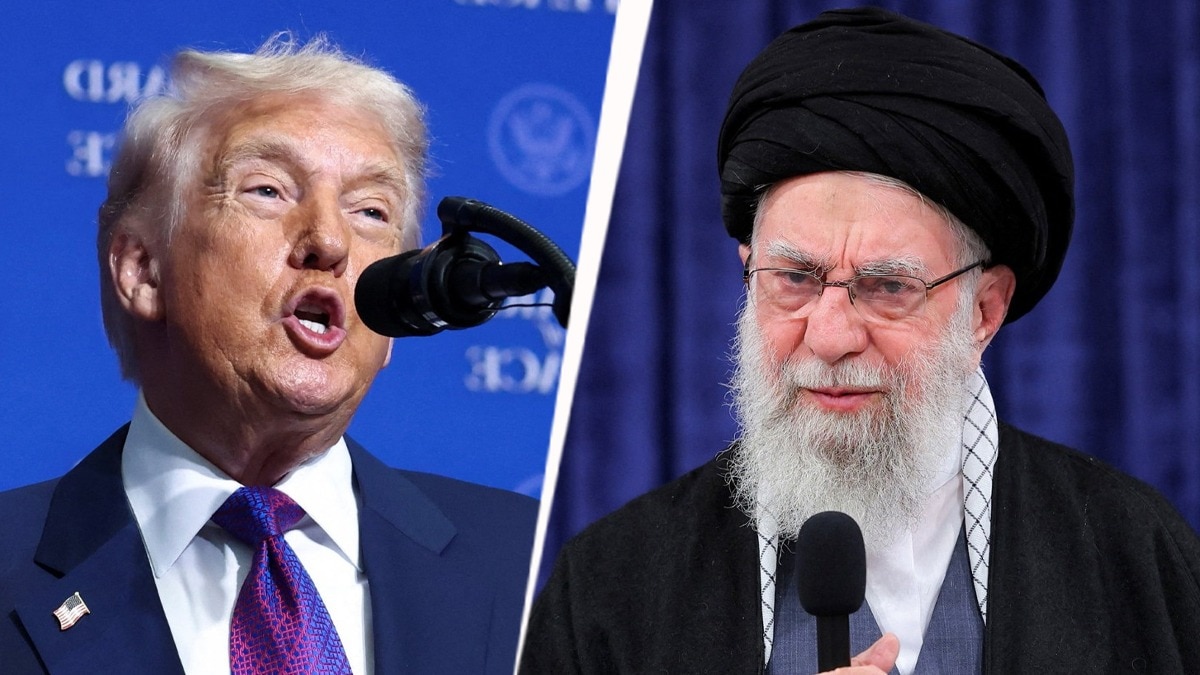
Can America really afford the catastrophic price of going to war with Iran right now?
India Today
Iran's foreign minister has told India Today Global that Tehran is fully prepared for war. As Trump's armada circles the Persian Gulf, Geeta Mohan asks whether Washington truly understands the cost of what it is threatening.
The Persian Gulf has seen standoffs before. It has seen gunboat diplomacy, sanctions regimes, proxy conflicts and nuclear brinkmanship. But what is unfolding right now between Washington and Tehran carries a different weight. This time, both sides are speaking with uncommon clarity. Trump says he is locked and loaded. Iran says it is ready for the worst. The question is no longer whether the rhetoric is serious. The question is whether anyone in Washington has properly calculated what serious actually means.
Iran's Foreign Minister Abbas Araghchi sat down with India Today Global for an exclusive interview and delivered a message that was steady, deliberate and chilling in equal measure. Iran is fully prepared for both options, he said. War, God forbid, and peace. That framing matters. It is not bluster. It is doctrine. Tehran has spent decades building a defence posture rooted in one core principle: make any attack so costly that no rational adversary would attempt it. Whether that principle holds against an adversary as unpredictable as Donald Trump is the central question of this moment.
Trump has deployed aircraft carriers, warships, fighter jets and tens of thousands of troops to the Gulf. He has posted warnings on social media urging Iranian patriots to seize institutions. He has promised rescue to protesters and floated the idea of new leadership in Tehran. Each statement lands in Iran not as diplomacy but as evidence of a regime change script. Araghchi says intercepted communications showed rioters being urged to shoot police, or civilians if police were unavailable, to inflate casualty figures and bait American intervention. Washington has produced no public dossier. No named agents. No declassified intercepts. Iran says the evidence exists. It has not released it either.
The protests themselves are not manufactured from nothing. Years of sanctions hollowed out Iran's economy. The rial collapsed. Inflation climbed. After the 2018 US withdrawal from the nuclear deal, purchasing power eroded steadily. The brief but intense conflict of mid 2025 accelerated the slide. Food costs rose. Energy bills deepened. Subsidies were cut. Real grievance exists on Iranian streets. Araghchi does not deny the economic pain. He insists that the armed turn the protests took was not organic. Whether that distinction satisfies the protesters themselves is another matter entirely.
On missiles, Iran's position is precise. Araghchi says Tehran has intentionally kept its missile range below 2,000 kilometres. Iran does not seek to be seen as a global threat. The missiles exist to defend, not to strike across oceans. The logic is straightforward and rather effective. When US bases in Qatar, Bahrain, Saudi Arabia and the United Arab Emirates sit within 1,000 kilometres of Iran's borders, intercontinental range is simply unnecessary. Geography has already done the targeting. Iranian drones, rockets and saturation strike capabilities are built for exactly this theatre. The aim is not conquest. The aim is prevention through the credible promise of enormous pain.


The newspaper, citing officials familiar with the conversations, said the Saudi leader has been in frequent contact with Trump during the conflict and encouraged him to "keep hitting the Iranians hard" as the fighting intensifies across the region.

A video showing a woman holding a child near a moving train window for him to urinate has gone viral, stirring public outrage over safety risks.

Amid the widening US, Israel–Iran war, the cyber front intensifies as the Handala hacker group claims attacks on US companies and Israeli intelligence-linked figures.

A post about a software developer's salary in Bengaluru and savings amount has started a conversation among X users about how to save wisely.

The profiles of at least three of China's leading nuclear, missile and radar experts were scrubbed from the website of the Chinese Academy of Engineering, the country's most prestigious academic body. This comes as a series of purges under Premier Xi Jinping's anti-corruption campaign have decimated the upper echelons of China's military and scientific community.

The aircraft had also been used by senior Iranian officials and military figures for both domestic and international travel, and for coordinating with allied countries, the Israeli military said. Meanwhile, Dubai International Airport has resumed flight operations after a temporary suspension of about seven hours caused by a drone strike near a fuel tank facility.

A government school teacher's gesture of buying a new uniform for an orphaned student has received widespread attention after a video of the act was shared on Instagram.

A father travelling with his toddler addressed fellow passengers ahead of a flight, asking for patience and understanding if his child became unsettled.

The lottery system for a segment of Green Cards, known as the Diversity Immigrant Visa programme, has been restarted. However, the stricter rules being enforced by the US won't impact Indian Green Card aspirants. Here's why.

Instead of putting an end to rumours, the video has triggered another wave of speculation about Netanyahu's fate. Several users on 'X' (formerly Twitter) have claimed that the video posted on 'X' was an AI-generated deepfake.

US jets strike military facilities near Iran's Chabahar free trade zone

The video, recorded inside the train coach, shows the compartment littered with snack packets, water bottles, soiled spoons and bedsheets scattered on the floor.

The US is planning to deploy a third aircraft carrier in the Middle East amid the war with Iran. Aircraft carriers, one of the most expensive defence systems, are floating military bases that project power. Here's how aircraft carriers are used and where India stands.