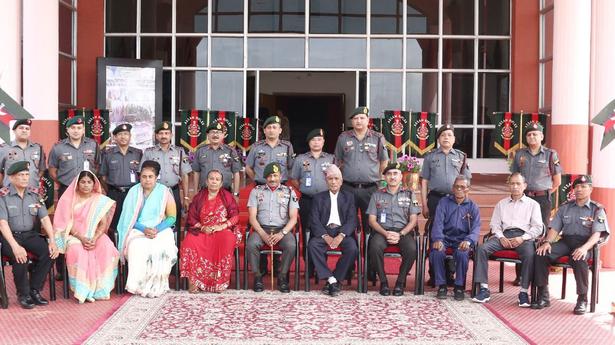
Assam Rifles honours surviving soldiers of India’s most successful counter-insurgency operation
The Hindu
Naib Subedar Padam Bahadur Chhetri and 14 others killed 72 extremists, captured 13 others at 14,000 ft in J&K on May 5, 1991
GUWAHATI
The paramilitary Assam Rifles on Monday felicitated the surviving soldiers of Operation Dudhi, marked in the country’s defence history as India’s most successful counter-insurgency operation more than 30 years ago.
A team of 15 soldiers of the Assam Rifles’ 7th Battalion led by Naib Subedar Padam Bahadur Chhetri had on May 5, 1991, gunned down 72 Pakistan-trained extremists and captured 13 others at 14,000 ft in Jammu & Kashmir.
Two Assam Rifles soldiers — riflemen Kameshwar Prasad and Ram Kumar Arya — died during the six-hour gun battle, while rifleman R.K. Yadav sustained injuries.
“Our Director-General, Lt. Gen. P.C. Nair had met some of the heroes of Op Dudhi during a recent trip to Nepal and thought of felicitating them for their outstanding feat that is yet to be matched. They were honoured in Shillong today [Monday] on the 31st anniversary of Operation Dudhi,” an Assam Rifles spokesperson said.
Meghalaya’s capital Shillong is the headquarters of Assam Rifles, India’s oldest paramilitary force, whose operational control is with the Defence Ministry and administrative control with the Home Ministry.
Since its establishment in 1835, the Assam Rifles has been engaged in countless counter-insurgency operations across the northeast and elsewhere in India. But none has been as “daring and exemplary” as Operation Dudhi undertaken by the 7th Battalion that was posted in Jammu & Kashmir from 1989-1992.


KPCC chief Sunny Joseph emphasizes UDF's focus on Sabarimala and corruption while expressing confidence in winning Kerala's upcoming Assembly elections.

A military plane crash in Colombia leaves 125 aboard, with at least 48 survivors rescued amid ongoing recovery efforts.

‘Symposium’, a new platform to promote lifelong learning and counter misinformation among youth, was launched in Hyderabad.

By using TB as an entry point, integrated healthcare delivery can optimise and improve public health efficiency

Residents of Chettichavadi express concerns over deteriorating groundwater quality due to long-standing garbage dumping issues in Salem West.

Community Health Officers in Vijayawada protest for reduced workload and continued incentives amid growing dissatisfaction over salary changes.

Telangana faces 13,929 healthcare vacancies, primarily in doctors and nurses, as recruitment efforts aim to address the shortage.

For most patients with TB who are severely underweight, nutritional support is an essential and not optional part of treatment

Family of custodial death victims demands harsh punishment for nine convicted policemen to prevent future abuses of power.

Rajinikanth refutes TVK leader's claims about DMK threats preventing his political entry, expressing gratitude to supportive political figures.

CM announces Cabinet Sub-Committee on Musi rejuvenation; rehabilitation for all displaced

Ramanathapuram identifies 145 polling stations as sensitive, ensuring security with paramilitary forces ahead of assembly elections, says DEO.

BJP Puducherry president V. P Ramalingam files nomination for Raj Bhavan, joined by Union Minister Mandaviya and Khushbu Sundar.