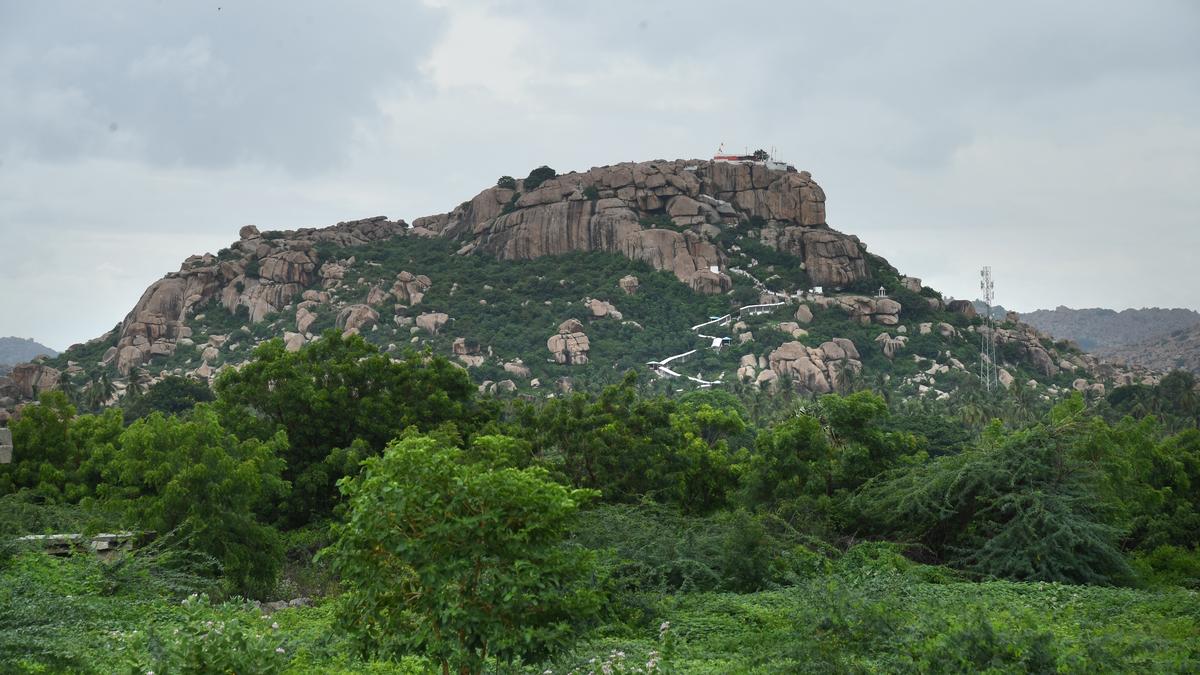
Anjanadri Betta: The scenic abode of Hanuman Premium
The Hindu
It is 6 a.m. and Anjanadri Betta is stirring to life. Vendors open shops, invite devotees to buy fruits, flowers, and garlands to adorn the temple idol at the top of the hill. Wearing saffron robes, hundreds of barefoot devotees slowly begin climbing the narrow steps, unmindful of the cold and strong breeze.
It is 6 a.m. and Anjanadri Betta is stirring to life. Vendors open shops, invite devotees to buy fruits, flowers, and garlands to adorn the temple idol at the top of the hill. Wearing saffron robes, hundreds of barefoot devotees slowly begin climbing the narrow steps, unmindful of the cold and strong breeze.
Atop the hill, in the sanctum sanctorum, a priest performs aarati and chants mantras to the presiding deity Hanuman, as sandalwood incense sticks spread fragrance and oil lamps glow bright.
This is the early morning scene at Anjanadri Betta (hill). There is no hustle-bustle at the foot of the hill or at the top, but the flow of people is unrelenting and prayers continue all day till closing time at 8 p.m.. Devotees from different parts of India line up for darshan of Hanuman and his mother Anjana Devi in the same temple.
With the increased flow of pilgrims and law and order issues in 2018, The HinduReligious and Charitable Endowments Department of the Karnataka government took over the administration of the temple in 2018.
Chanting “Jai Hanuman” and “Jai Shri Ram”, devotees trek close to 600 steps to reach the temple site. Handrails are provided at some locations for climbing steps without much difficulty. Steps up to the temple are for most part easy and at some places shade has been provided for some respite from the sun on hot days. Aged persons would find it difficult at a couple of locations, but it is not too hard a climb for others.
Close to the hill, there is an overhanging rock, and one has to bend very low to go under it and move to the next step. There are plenty of monkeys running around on the way.
The Anjanadri Betta/temple is located on the banks of the Tungabhadra River in Koppal district in north Karnataka, about 350 km from Bengaluru. The hill is believed to be the mythical birthplace of Lord Hanuman. Anjanadri Betta is one of the seven hillocks around the region and they are believed to be connected with the epic Ramayana. At a distance of four km from the temple, Anegundi, a small hamlet, is also called Kishkinda and this name finds a reference in Valmiki’s Ramayana. The name of Kishkinda is also found in inscriptions belonging to 11th century, said Dr. S.Y. Somashekar, Professor, Department of Ancient History and Archaeology, Kannada University, Hampi.


TIMS Sanathnagar inauguration on Ugadi uncertain as construction, staffing gaps persist

Mumbai's water crisis escalates as corporators highlight irregular supply and reliance on costly private tankers amid administration neglect.

Explore the evolution of cooking fuels in Madras, from wood and coal to the rise of LPG, amid recent shortages.

Protests against the Sharavathi Pumped Storage Hydroelectric Project in the Western Ghats just got new life

51 couples take thebig plunge at Udaipur mass wedding event

A bridge collapse in Roop Nagar kills a woman; Delhi government forms a probe panel amid rising safety concerns.

Tribunal halts Colonel Purohit's retirement, pending promotion decision after his acquittal in the 2008 Malegaon blast case.

Pinarayi Vijayan launches his election campaign in Dharmadam, aiming for a third consecutive term amid tightening competition.

Delhi Speaker Vijender Gupta has written to Lieutenant-Governor Taranjit Singh Sandhu seeking directions to instal audible signals at traffic intersections across the city to ensure the safety of mobility-impaired individuals and senior citizens.

GVMC council concludes its five-year term, highlighting significant development projects and global events that enhanced Visakhapatnam's recognition.

Karnataka SC/ST Commission discusses internal reservation issues amidst confusion over reduced quotas for Scheduled Castes and Tribes.

President Droupadi Murmu serves Akshaya Patra’s 5 billionth meal, highlighting child nutrition and education at Rashtrapati Bhavan.

PM Modi and UAE President agree on ensuring safe navigation through the Strait of Hormuz amid regional tensions.