Ancient grain storage tradition fading fast in Srikakulam district Premium
The Hindu
The ancient grain storage tradition of Paathara in Srikakulam district is rapidly fading due to modernization and space constraints.
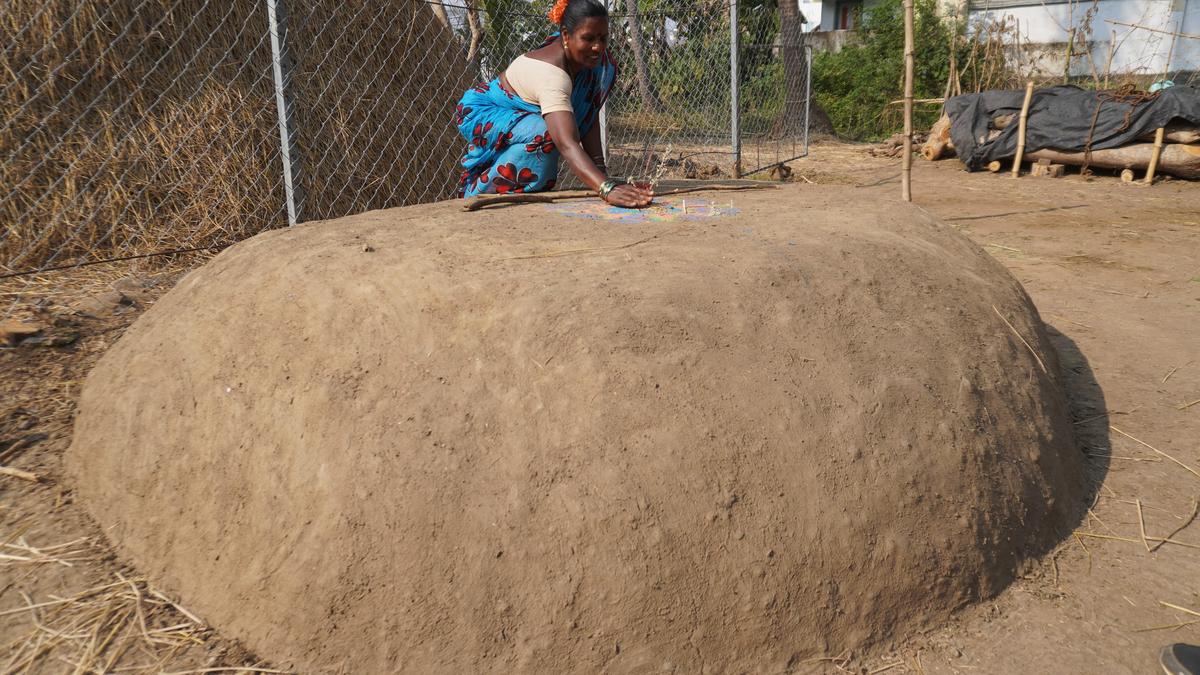
On a foggy morning, a week before Sankranti, a 52-year-old woman gathered clay, wildflowers, and paddy grains from her freshly harvested field. Marla Dillemma was preparing the traditional offering for Paathara—an ancestral practice of grain storage observed by farmers along the banks of the Mahendratanaya River in the Uddanam region of Srikakulam district, near the Andhra Pradesh–Odisha border.
As part of the ritual, Ms. Dillemma drew a bindi—similar to a forehead mark—on the Paathara and placed wildflowers and paddy grains on top while offering prayers. “This year, nearly 30 bags of paddy have been stored in our Paathara. Stored until the monsoon, it is meant entirely for our household consumption and rituals,” said Ms. Dillemma of Jalantara Saasanam village in Kanchili Mandal.
Ms. Dillemma’s family owns five acres of land, including four-and-a-half acres under tenancy, all located in the command area of a canal of the Mahendratanaya river. The river originates in the Mahendragiri hill range of Odisha and meets the sea at Baruva Mandal in the Uddanam region of Srikakulam district.
A traditional Paathara—an ancestral practice of grain storage observed by farmers— at Poorna Saasanam village of Kanchili Mandal in Srikakulam district. | Photo Credit: T. APPALA NAIDU
In Odia, the Paathara tradition is known as Khoni—a storage pit in which freshly harvested grains, mostly paddy, are stored. The pit is dug in a rectangular shape, plastered with straw and clay, and sealed with a layer of cow dung on top. Earlier, the Paathara was built in front of thatched houses and was an integral part of rural architecture, symbolising a thriving joint family system. Every paddy-growing family stored enough grain for its annual needs.
However, in Jalantara Saasanam, a village of nearly 200 households, only two Paatharas were constructed this year—one belonging to Ms. Dillemma near the canal and another built by Juttu Moinamma in the heart of the village.


The government plans to amend the FCRA, introducing new regulations for NGO asset management and accountability for key functionaries.

The draft policy for “Responsible Digital Use Among Students”, released on Monday by the Department of Health and Family Welfare, has recommended that parents set structured routines with clear screen-time rules and prioritise privacy, safety, and open conversation with children on digital well-being.

Police Observer Sushant Kumar Saxena conducts surprise inspection at Shencottai police station, reviewing warrants and security arrangements ahead of elections.

Andhra Pradesh government to launch key projects in April, focusing on industrial growth and infrastructure development, says Nara Lokesh.

Lok Sabha refers the Corporate Laws (Amendment) Bill to a JPC amid opposition concerns over CSR provisions dilution.

SHG members in Kanniyakumari use snakes and ladders to raise election awareness and boost voter turnout.

Government accelerates consultations for early implementation of the Women’s Reservation Act to ensure women’s representation in 2029 elections.

CM A. Revanth Reddy distributes ₹1 crore insurance cheques to families of deceased Electricity department employees, enhancing financial security for workers.

The Bengaluru Traffic Police (BTP) registered 634 cases of drunk driving during a week-long special enforcement drive conducted across the city between March 16 and March 22.

GHMC intensifies action against property tax defaulters, seizing properties and offering a One Time Settlement scheme for payments.

CCB arrests three drug peddlers in Mangaluru, seizing ₹2.5 lakh worth of MDMA and other valuables.

TVK's 28 candidates in Puducherry include former BJP MLAs, a sitting Independent, and a retired police IG.

BRS submits notice on private member bill to Speaker