Colleges within schools Premium
The Hindu
Haryana's rapid college growth faces challenges of inadequate infrastructure and teacher shortages, impacting students' educational quality and access.
When Himanshi, 20, finished school, her heart was set on pursuing a degree in the sciences. But her parents were hesitant to let her go to a college in Haryana’s Gohana, around 15 km from their village, Bhainswal, in Sonipat district. The commute, they felt, was a concern. Himanshi was forced to enrol in Bhainswal Kalan Government College. It offered only a BA programme.
Her classmate Ritu, 21, had hoped for a BA degree with Geography as one of her subjects, but, to her dismay, the college didn’t offer it. Her parents, too, were uncomfortable with the idea of her travelling beyond a few kilometres to study.
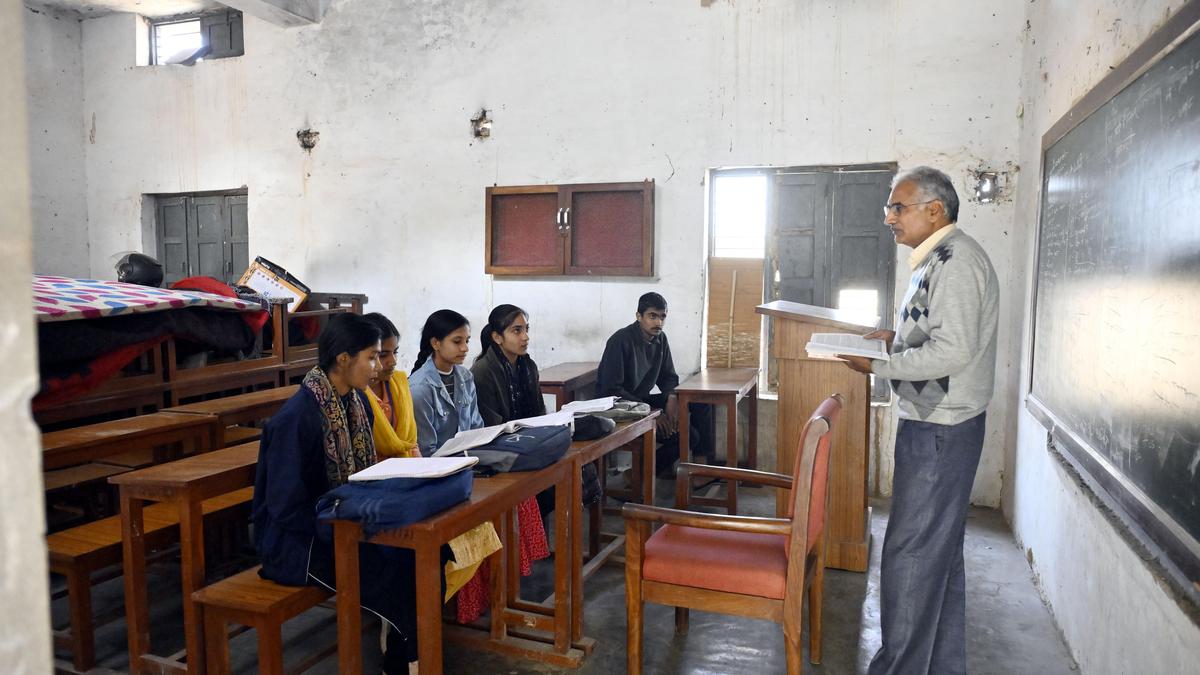
When they joined, Himanshi and Ritu found themselves back in a school building. The co-educational college in Bhainswal village, just about 50 km from Delhi, has been running from four rooms on the premises of the Government Senior Secondary School in the village for the past six years.
It has a total strength of 81 — 49 girls and 32 boys — and offers BA programmes in Hindi, English, History and Political Science. All students opted for a degree in History, but the college does not have a History teacher.
When Haryana was carved out of Punjab on November 1, 1966, the State had just one university and two government colleges. Now, Haryana has 38 universities, including 10 State and 24 private universities, 186 government colleges, 97 government-aided colleges, and 94 self-financing colleges. These have helped students, especially women, access education, but the lack of infrastructure and an acute teacher shortage have impacted the quality of higher education.
After the National Education Policy 2020 was unveiled, the Haryana Government, in a press release, stated that the gross enrolment of girls in higher education in the State was 32%. To meet the national goal of 50% by 2030, they aim to have a college within a 20-km radius of each home, so access is easier, especially for women. itself caters to just around six villages.


CM announces Cabinet Sub-Committee on Musi rejuvenation; rehabilitation for all displaced

Ramanathapuram identifies 145 polling stations as sensitive, ensuring security with paramilitary forces ahead of assembly elections, says DEO.

BJP Puducherry president V. P Ramalingam files nomination for Raj Bhavan, joined by Union Minister Mandaviya and Khushbu Sundar.

History-sheeter 'Thoppai' Ganesh shot dead by police in Chennai after attacking officers during attempted escape.

The government plans to amend the FCRA, introducing new regulations for NGO asset management and accountability for key functionaries.

The draft policy for “Responsible Digital Use Among Students”, released on Monday by the Department of Health and Family Welfare, has recommended that parents set structured routines with clear screen-time rules and prioritise privacy, safety, and open conversation with children on digital well-being.

Police Observer Sushant Kumar Saxena conducts surprise inspection at Shencottai police station, reviewing warrants and security arrangements ahead of elections.

Andhra Pradesh government to launch key projects in April, focusing on industrial growth and infrastructure development, says Nara Lokesh.

Lok Sabha refers the Corporate Laws (Amendment) Bill to a JPC amid opposition concerns over CSR provisions dilution.

SHG members in Kanniyakumari use snakes and ladders to raise election awareness and boost voter turnout.

Government accelerates consultations for early implementation of the Women’s Reservation Act to ensure women’s representation in 2029 elections.

CM A. Revanth Reddy distributes ₹1 crore insurance cheques to families of deceased Electricity department employees, enhancing financial security for workers.

The Bengaluru Traffic Police (BTP) registered 634 cases of drunk driving during a week-long special enforcement drive conducted across the city between March 16 and March 22.