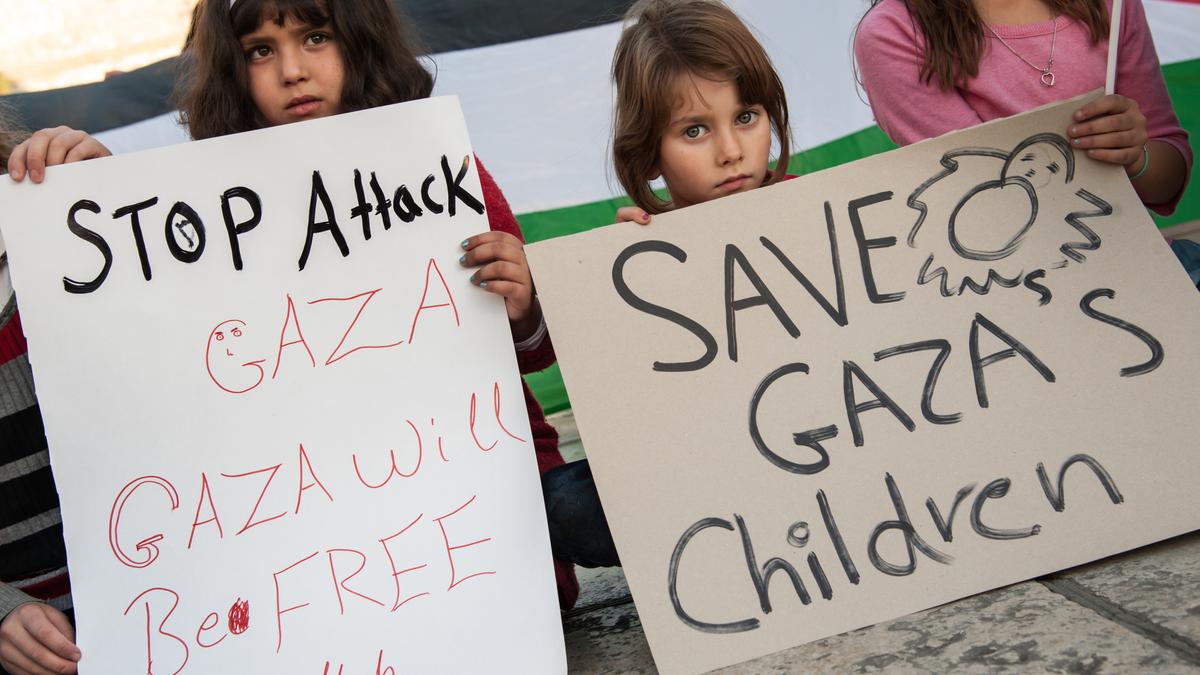
An excerpt from Soumyabrata Choudhury’s Thoughts of Gaza Far from Gaza: Deafening silence
The Hindu
An excerpt from Soumyabrata Choudhury’s Thoughts of Gaza Far from Gaza. A philosopher dwells on the imprisoned population of Gaza and why protests against a wrong are muted in India
In his latest book, Thoughts of Gaza Far from Gaza, Soumyabrata Choudhury, who teaches at Jawaharlal Nehru University, speculates and reflects on an urgent but distant reality. An edited excerpt:
As I write this, the television screen in my room continued to transmit reports on the latest Gaza situation. I heard a health worker on the BBC say that she couldn’t speak about Gaza from a bird’s eye view even though she had just returned from there. Between the northern and the southern part of the Strip, wherever she went, it was a disaster. It was worse than anything she had seen before. And I thought to myself that if she, with first-hand experience of the reality, couldn’t speak of Gaza as a total situation or scenario, then what chance would I have, so far removed from that reality?
When I try to look for voices speaking up in my own surroundings about any of this, I mostly hear a deafening silence. At the most, there are some faint murmurs. At a time when there are widespread protests across the globe, why is there so little happening in India? I can think of a few possible reasons.
First, even though the government has continued to uphold the position India has taken historically, that it supports Palestinian self-determination, this stand is more or less a formality today. The Indian state’s relation with Israel is so visibly fraternal that this attachment has a far greater effective presence than any formal support for a so-called two-state solution.
This in itself is not surprising. Since India’s entry into the neoliberal regime of global capitalism in 1992, its aim to belong to and to be normalised by the hegemonic system of states, that one only indicatively calls the West, was inevitable. What is striking is that under the present regime the people of India seem mostly led by the government’s agenda. If the Indian government has little role to play in the present conflict, and shows little interest or initiative in any meaningful terms, then the people too seem to lose interest in what is happening in West Asia, despite its reality and intensity.
The second level of reasoning to explain this kind of ‘loss of reality’ can come from the recognition that one of the older forms of popular resistance beyond governmental and state agendas to anti-capitalist or anti-colonial policies came from the left tradition. That tradition is substantially weakened in India now; even the popular resistance to global policies and anti-colonial support for Palestinian struggle becomes a little bit of a formal exercise than a mass movement. In fact, to speak of an anti-colonial internationalism, based on the role of different postcolonial states in the global order today, turns out to be quite hollow. It’s shown on the ground by the fact that while South Africa’s internationalism consists in speaking for Palestine at the International Court of Justice and comparing Israel’s apartheid state with its own past of oppression, the anti-colonial limits of the Indian government consists of rewriting the Indian Penal Code in Hindi and claiming that this is a new expression of freedom from colonial law and language.
The third dimension of the lack of popular protests in India is the general atomisation and pushing to the wall of the Muslim population in this country, such that the expected visible solidarity on the part of what is called the ‘Muslim world’ with Palestine doesn’t quite extend to Indian Muslims in any form of public association. There are of course some exceptions, like the All India Majlis-e-Ittehadul Muslimeen party, but the absence of any news about such protests in Kashmir is notable.


TIMS Sanathnagar inauguration on Ugadi uncertain as construction, staffing gaps persist

Mumbai's water crisis escalates as corporators highlight irregular supply and reliance on costly private tankers amid administration neglect.

Explore the evolution of cooking fuels in Madras, from wood and coal to the rise of LPG, amid recent shortages.

Protests against the Sharavathi Pumped Storage Hydroelectric Project in the Western Ghats just got new life

51 couples take thebig plunge at Udaipur mass wedding event

A bridge collapse in Roop Nagar kills a woman; Delhi government forms a probe panel amid rising safety concerns.

Tribunal halts Colonel Purohit's retirement, pending promotion decision after his acquittal in the 2008 Malegaon blast case.

Pinarayi Vijayan launches his election campaign in Dharmadam, aiming for a third consecutive term amid tightening competition.

Delhi Speaker Vijender Gupta has written to Lieutenant-Governor Taranjit Singh Sandhu seeking directions to instal audible signals at traffic intersections across the city to ensure the safety of mobility-impaired individuals and senior citizens.

GVMC council concludes its five-year term, highlighting significant development projects and global events that enhanced Visakhapatnam's recognition.

Karnataka SC/ST Commission discusses internal reservation issues amidst confusion over reduced quotas for Scheduled Castes and Tribes.

President Droupadi Murmu serves Akshaya Patra’s 5 billionth meal, highlighting child nutrition and education at Rashtrapati Bhavan.

PM Modi and UAE President agree on ensuring safe navigation through the Strait of Hormuz amid regional tensions.