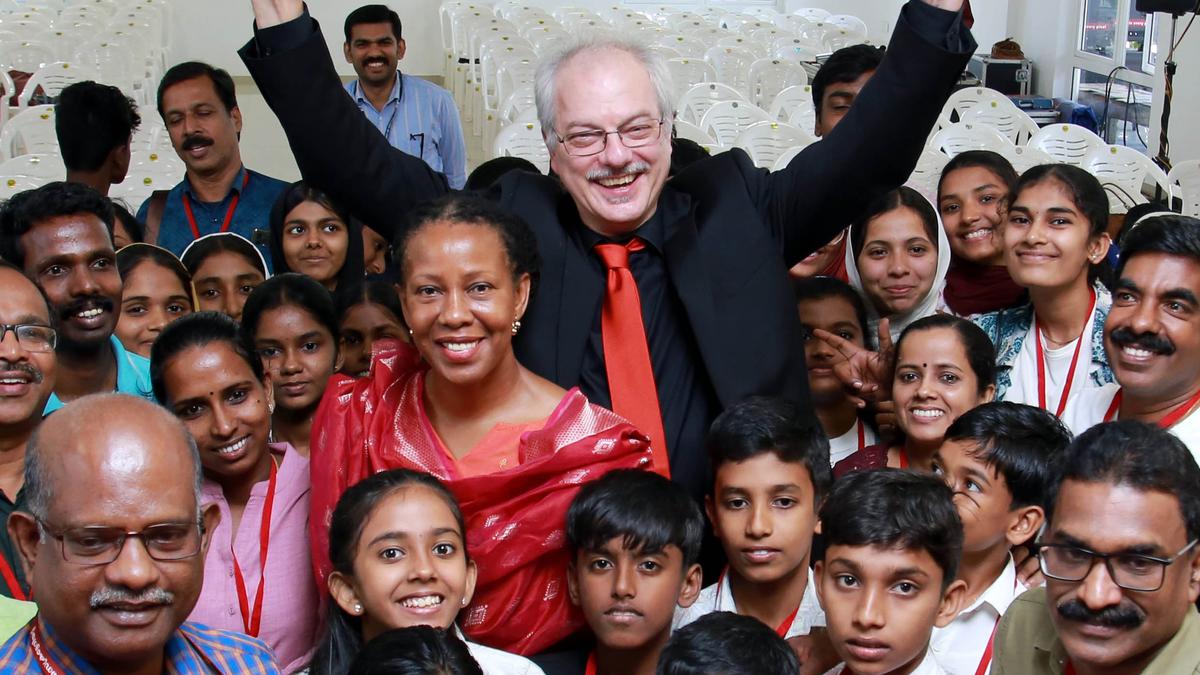
Allow researchers to do research without constraints, says Nobel laureate
The Hindu
Danish Nobel laureate Morten P. Meldal emphasizes the importance of unrestricted research and the distinction between fundamental and applied research.
Danish chemist and Nobel laureate Morten P. Meldal on Wednesday underscored the need to allow researchers to do their research “without constraints.” Danish chemist and Nobel laureate Morten P. Meldal on Wednesday underscored the need to allow researchers to do their research “without constraints.”
“A lot of the research tends to go into the applied region. But the real disruptive inventions where the Nobel prizes of the future lie are in the serendipitous discoveries, the things that we cannot predict. That’s where all the novelty is,” Prof. Meldal said, delivering a public lecture at the Global Science Festival Kerala (GSFK) at the Bio 360 Life Sciences Park, Thonnakkal.
Prof. Meldal, who is a professor at the University of Copenhagen, shared the 2022 Nobel Prize in Chemistry with K. Barry Sharpless and Carolyn Bertozzi “for the development of click chemistry and bioorthogonal chemistry.”
The distinction between fundamental research and applied research should be understood, according to him. “It’s important that we have fundamental research that can give us disruptive discoveries of the future. But we also need applied research that can develop the research that we already have done into applicable items for the good of the society. Those two things are completely independent, and no politician seems to understand this. These are two entirely different functions,” he said.
In his lecture, Prof. Meldal elaborated on four ‘mantras:’ chemistry is everything (“as everything is keyed into chemical reactions”), youth for chemistry, research without restraints, and funding by performance.
He said that children should be exposed to the concepts of chemistry from a young age. But this should be done with a child-friendly approach rather than through “hard formulas.” Young people should be taught chemistry not as something that they learn when they go to high school, but as a fundamental learning just like writing and reading, he said.
He recalled how he became interested in science as a young boy, playing around in his grandfather’s farm. One thing that puzzled him then was how everything appeared so beautiful. “How is it that nature is able to create this absolute harmony between things that really work together and create a living environment? And why is it that we humans cannot fit very well into that? That I explained with chemistry, actually. Chemistry is the cause of all communication in nature and the reason that nature looks like it does,” he said.


Decorated homes, busy temples and shared feasts mark Ugadi in Hyderabad

Housing Minister seeks ₹260 crore to develop 50 slums for Karnataka's golden jubilee, urging CSR support for infrastructure enhancement.

Congress opposes VBSA Bill, citing constitutional overreach, State power encroachment, and politicization of higher education funding.

Hyderabad Airport wins Skytrax 2026 award for Best Airport Staff in India and South Asia for the fifth time.

General and Election Expenditure Observers assumed charge in Krishnagiri to monitor election processes and expenditure across six constituencies.

A detailed analysis of Puducherry’s evolving political landscape and election trends since 2011.

CPI(M) insists on six Tamil Nadu Assembly seats, while DMK offers five, causing a stalemate in alliance talks.

Unaccounted cash, articles worth ₹13.58 lakh seized in Tirunelveli in five days

Ugadi Asthanam at Tirumala temple celebrated with rituals, Vedic recitations, floral decorations, and grand festivities honoring the Telugu new year.

Srirangam temple offers herbal buttermilk and paanakam to devotees to help them stay cool during the summer heat.

VMRDA invites global bids for the Vizag Bay City project to develop a world-class integrated waterfront hub by 2026.

Civil society urges Amit Shah to direct police vigilance against open threats of communal violence in Uttam Nagar, Delhi.

PMK leader Anbumani blames alcohol and drug abuse for rising suicides in Tamil Nadu, criticising government inaction.