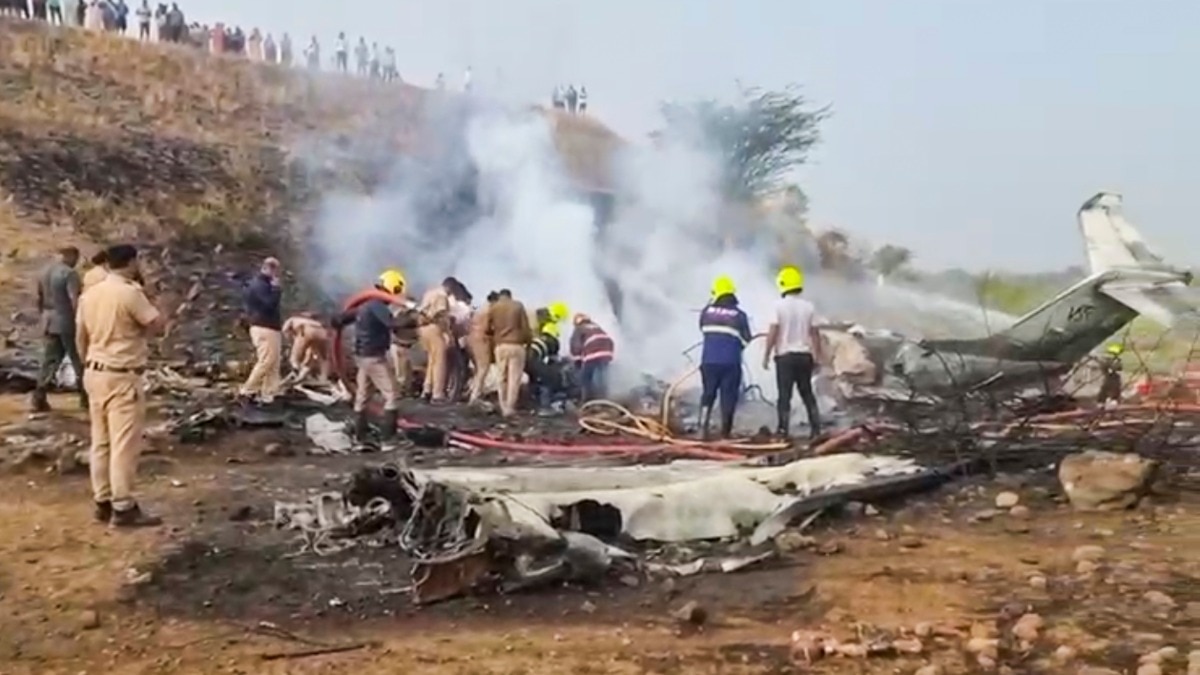
All possible scenarios behind the crash of Ajit Pawar's jet
India Today
How weather, human judgement and a VFR-only airfield converged in the final seconds before Ajit Pawar's jet crashed.
Even as the dust began to settle in Baramati on Thursday morning, questions mounted after the Learjet 45 XR crash killed Maharashtra’s Deputy Chief Minister Ajit Pawar and four others. Investigators are yet to issue an official account, even as competing theories crowd the headlines.
Drawing on publicly available data and expert analysis, India Today’s OSINT team evaluated multiple scenarios that could explain the aircraft’s final moments, assessing the relative strength of each theory.
Taken together, the trail from the aborted first landing to the tilted trajectory recorded on CCTV helps piece together the pilot’s final decisions, showing how several risk factors may have aligned to a fatal outcome.
The crew reported two times that the runway was not in sight during the approach, indicating degraded visual conditions close to the ground. A go-around on the first attempt suggests that the pilots did not have the required visual contact with the runway to continue a safe landing initially.
Indian Air Force Wing Commander Dinesh K Nair(Retired) put it succinctly: “If the pilot attempted landing despite being below visual minima, that becomes a question of judgement, not weather. Low visibility may be a contributing factor, but the primary factor there would be human error.”
The Ministry of Civil Aviation confirmed the visibility at around 3,000 meters in a statement released on Wednesday evening. However, patchy fog, ground haze, or localised mist near the runway can obscure the runway during final approach.


India Today's OSINT team identified at least 22 Indian-flagged vessels operating in the Gulf region, including seven LPG carriers, seven oil tankers, four container ships, two bulk carriers, one tug and one dredger.

India on Monday said it has not held bilateral talks with the United States on deploying naval vessels to secure merchant shipping in the Strait of Hormuz. The clarification came after US President Donald Trump urged countries to send warships to keep the strategic waterway open amid tensions with Iran.

After attacking his wife, Nafees attempted suicide by inflicting injuries on himself with the same scissors. Neighbours intervened after hearing the commotion and stopped him from taking his own life.

The victim, identified as Naitik Kumar, allegedly rammed his speeding Bullet motorcycle into a scooter near Janeshwar Mishra Park in Lucknow, triggering a crash that left him dead and two others injured.

RJD MLA who skipped Bihar Rajya Sabha poll voting cites mother's illness

West Bengal Chief Minister Mamata Banerjee led a protest march in Kolkata against the alleged LPG shortage, accusing the PM Narendra Modi-led Centre of failing to ensure adequate supply.

Himayani Puri, daughter of Union Minister Hardeep Singh Puri, has moved the Delhi High Court over "false and malicious" reports linking her to convicted sex offender Jeffrey Epstein.

The family, a resident of Thyagaraju Street in Punganur town, had recently repaired the engine of their two-wheeler vehicle. A local mechanic advised the family to keep the engine running overnight to "set" the newly installed parts. However, this turned out to be fatal for the family.

The Supreme Court closed criminal proceedings against Ashoka University professor Ali Khan Mahmudabad after the Haryana government said it would not grant sanction to prosecute him over social media posts related to Operation Sindoor.

Three Congress MLAs in Bihar are reportedly out of contact as voting for five Rajya Sabha seats is underway, with the INDIA bloc and the BJP-led NDA locked in a tight contest for the fifth seat that could hinge on cross-voting.

Bunty Solanki stabbed his wife to death following a quarrel at their residence in Vadodara's Bakrawadi area. Rita died on the spot.

The girl's family members were angered over the friendship, and as a result, they called Jadhav last Saturday evening and allegedly beat him.

External Affairs Minister S Jaishankar has said that direct talks with Iran to restore shipping through the war-hit Strait of Hormuz have yielded results, stressing that direct engagement with Tehran is the most effective way to address the disruption.