Yoga mats from Killimangalam
The Hindu
When the Killimangalam Pulpaya challenge, aimed at finding customers for traditionally woven grass mats, began trending on social media, it fuelled a movement to save the heritage craft
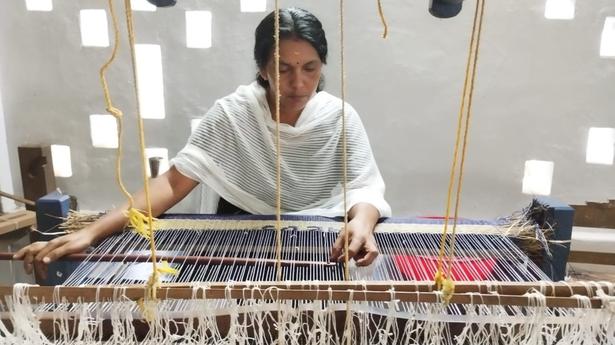
In the first week of June, 2022, the Killimangalam Pulpaya, a traditional straw mat indigenous to Killimangalam in Thrissur district in Kerala, began trending on social media. People from Kerala and beyond began placing orders. A ‘pulpaya challenge’, which urged people to buy at least one straw mat through various social media platforms, has sparked a brisk sale of mats that were lying unsold at the Killimangalam Pulpaya Neythu Cooperative Society, one of the only centres weaving grass mats in Kerala. Two weeks since the challenge was announced, the women making the mats have their hands full. Mats worth ₹4 lakh have already been sold.
A little away from the banks of the Bharathapuzha, where the society has its office, the weavers (four women) led by the secretary of the society Sudhakran N C, are happy that their efforts are now bearing fruit. The society had been selling its mats mainly through exhibitions and a few handicraft collectives, but since the 2018 Kerala flood, sales nosedived. The COVID-19 outbreak worsened the situation, and they had unsold mats worth about ₹5 lakh.
The straw mat weaving was traditionally practised by the Kurava community, who inhabited the banks of the Bharathapuzha. Over the years, as the younger members of the community drifted towards more lucrative jobs, and plastic mats became an accepted alternative, the weaving tradition was pushed to the brink of extinction. However, the co-operative society, registered in 1953, has been striving to keep the heritage craft alive.
In order to help the weavers regain the market, Vayali, a folklore collective based in Thrissur along with the Alternative Learning School of Moozhikulam Sala, an organic campus that follows a traditional lifestyle based in Chalakkudy, launched the Pulpaya challenge, which will run through June.
“The banks of the Nila (Bharathapuzha) had two such societies engaged in kora grass mat weaving — Vaniyamkulam and Killimangalam. Today, the Killimangalam Society is the only unit that makes these mats, functioning with five active members,” says Vinod Nambiar, executive director of Vayali. The mats won a UNESCO recognition, the ‘Seal of Excellence’ in 2006. In 2016, Vayali produced a documentary film on P Prabhavathi, a weaver, who worked with the society for 41 years, single-handedly leading it when it almost closed down. Prabhavati stopped weaving following a brief illness in 2018.
“The idea is to preserve the essence of folk art and help the artisans get what is due to them. We are exploring the possibilities of applying for a Geographical Indications (GI) tag and are in talks with the Directorate of Handicrafts, Thrissur, to include this craft in the ‘Vanishing Traditions’ category,” says Vinod. “We are also considering inviting designers and other agencies who work in this space to document the unique designs of Killimangalam and the processing method they follow,” he adds.
Though the designs of the mats remain the same, the processes have undergone certain changes, says Sudhakaran. While fresh Kora grass (called muthanga pullu in Malayalam) was collected from the banks of the Bharathapuzha in the earlier days, it is now bought in straw form from Chittoor, Palakkad district, for ₹ 350 a kilo. “A relatively simple mat in standard size (34 inches x 72 inches) can take up to one week. If the design is complex, it could take a weaver up to 15 days,” says Sudhakaran. The weavers are paid ₹ 150 a day.


76-year-old Kurian Jacob from Kerala triumphs with seven medals, including five golds, at the Open Masters Games in Abu Dhabi.

Can nations unite to protect the endangered Hudsonian godwit and address the challenges of climate change and habitat loss?

Discover the Minor Planet Centre, the key hub for tracking and verifying observations of small solar system bodies.

Discover the Minor Planet Centre, the key hub for tracking and verifying observations of small solar system bodies.

In this week's Science for All newsletter, XX explains

Test your knowledge with the quiz on Science films at the Oscars through history

Set between the Siwalik hills and the plains, Butwal offers travellers a mix of regional cuisine, pilgrimage trails to Lumbini and the comfort of Hyatt’s new hospitality landmark

Explore 2026's wallpaper trends in India, highlighting botanicals and handmade designs that enhance modern homes with nature-inspired aesthetics.

Mercedes-Benz CLA 250+ with EQ Technology review: design, performance, range and features explained. Discover how the new electric CLA combines advanced AI, long range, fast charging and futuristic styling for the next generation of luxury EVs.

AI tool for sparrow conservation

BTS’s comeback with ‘Arirang’ marks a major global music event. When does the album release, and where can you watch their concert live stream? We have all the details

The 2026 U.S. cholesterol guidelines urge starting screening and treatment at 30 to prevent cardiovascular disease effectively.

Olam Festival 2026 in Thiruvananthapuram returns March 27-29 with 120+ vendors, music, art, and cultural zones.