With a banjo on my wall Premium
The Hindu
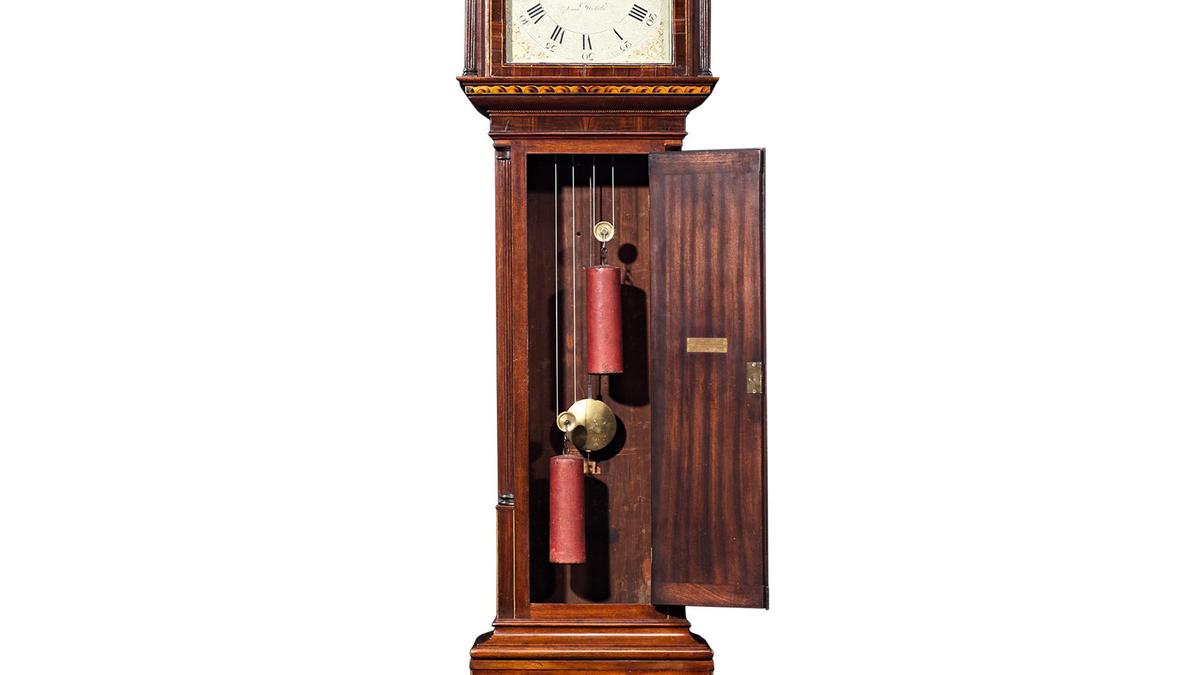
On February 8, 1802, horologist Simon Willard received a patent for what is popularly known as a banjo clock. A clockmaker of repute in the U.S., Willard worked his hands on the hands of many a clock. A.S.Ganesh tells you what made him and his clocks tick…
A fifth generation Willard in the U.S., Simon Willard was a famous American clockmaker. We mention fifth generation because the Willard of the first generation was among the founders of Concord, Massachusetts. Massachusetts was where Simon was born and died, the former in Grafton on April 3, 1753 and the latter, when time finally stood still for the clockmaker, in Roxbury on August 30, 1848.
Simon shifted from his place of birth, where he also picked up the basics of horology when he apprenticed to a clock maker, to his place of death in 1780. Simon settled in Roxbury once and for all thereafter, working there until his retirement in 1839.
Simon wasn’t the only Willard of the generation who took to clock making. Two of his elder brothers — Benjamin and Ephraim — were also clock makers, and so was his younger brother Aaron. In fact, it was with Benjamin that Simon continued his learning in the field after his move from Grafton to Roxbury, eventually superseding his brother and becoming a horologist of repute.
The fact that he was a pre-eminent clock maker of his time meant that his clients were some of the wealthiest of the era.
Portrait of Simon Willard by American painter Gilbert Stuart. | Photo Credit: Wikimedia Commons
Willard was able to move away from the traditional ways of clockmaking, turning it in the process into a successful business venture. Traditionally, a clockmaker made every part such as the weights, hands, case, etc. Willard, however, decided to put parts sourced from others together and stamping his name on the product. This meant that while other clockmakers made a handful of clocks each year, Willard’s overall count went into the thousands.


The DMK and Congress finalize a crucial seat-sharing deal thanks to key negotiations by Kharge, Chidambaram, Kanimozhi, and Karti.

Justice Swaminathan allows time for the Thirupparankundram temple trustees to respond to his suggestion regarding Karthigai Deepam prayers.

New Zealand secures a dominant T20 World Cup final spot, led by Finn Allen's explosive century against South Africa.

Central government allocates ₹64 crore for PM Ekta Mall project in Puducherry, promoting local artisans and crafts.

Farmers demand NAFED procurement of maize to secure Minimum Support Price amid declining market rates.

Four workers fainted from toxic gas exposure at a Ranipet effluent treatment plant; all are now stable after treatment.

Textiles Minister inaugurates ₹35 crore Bypass Road in Ranipet, enhancing traffic flow and connecting key highways for efficient travel.

P. Sibin takes charge as the new Superintendent of Police for Ranipet, succeeding Ayman Jamal.

Jagriti Theatre brings the sixth edition of their annual Morning Raag concert series back to the city this weekend

Karur inaugurates a new ₹2.4 crore swimming pool at Government Higher Secondary School, enhancing local sports infrastructure for aspiring swimmers.

Protests in West Bengal escalate over electoral roll issues, prompting Chief Minister Mamata Banerjee to plan a dharna against the SIR.

Palestinian envoy criticizes military dominance in Iran-U.S. conflict, calling it "jungle law" that undermines future for vulnerable nations.

AIADMK renominates veteran Thambi Durai for Rajya Sabha; PMK receives an additional Upper House seat allocation.