Why MGR’s election from Andipatti was challenged in the court?
The Hindu
Explore the court challenge to MGR's Andipatti election, focusing on the legality of his oath-taking process.
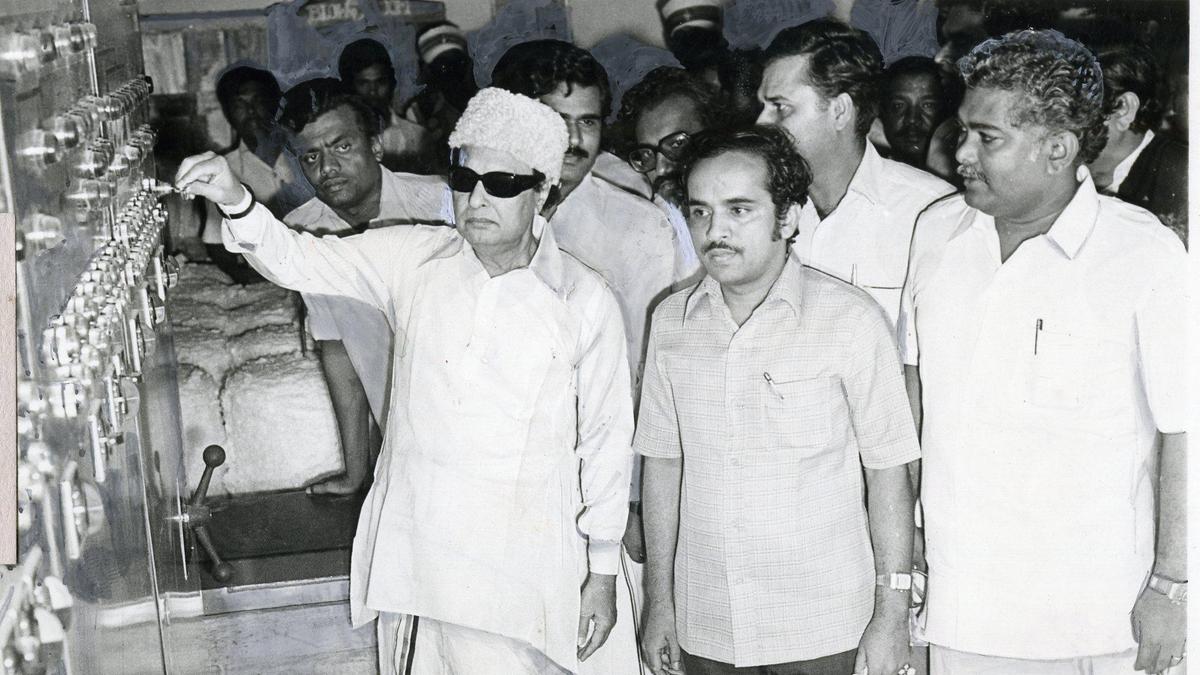
In 1980, Tamil Nadu was facing snap polls following the dismissal of the M.G. Ramachandran (MGR) Government earlier that year. The charismatic actor-turned-politician filed his nomination papers from two constituencies in south Tamil Nadu – Andipatti and Madurai West. Eventually, he contested only from the latter seat.
Four years later, sometime in July 1984, MGR, as Chief Minister, went to Andipatti for a government function. He turned sentimental while recalling that people of the constituency had shed tears when he had decided to withdraw his nomination from Andipatti. “From that time, Andipatti has always been in mind,” he told them, according to The Hindu Archives. “I have special affection for Andipatti in view of its backward needs,” he said pointing out he appointed an IAS officer, V.S. Chandralekha, to develop the constituency and “she rose to the occasion.” With that, MGR hinted he would be entering the fray from Andipatti in the next Assembly polls.
However, on the night of October 5, 1984, MGR suddenly took ill and was rushed to a private hospital in Madras (now Chennai). Days later, he was airlifted to America where he was treated at the Brooklyn Hospital. While he was in hospital, Assembly elections were notified in Tamil Nadu. From his hospital bed, MGR filed his nomination papers to contest from Andipatti constituency and emerged victorious.
Later, a defeated candidate and a voter from the constituency filed two election petitions in the Madras High Court challenging MGR’s nomination itself.
The petitions did not question the polling or counting process. Instead, they raised a legal issue: whether MGR was constitutionally qualified to contest at all, in view of how and before whom he had made and subscribed the oath or affirmation mandated under Article 173 (a) of the Constitution.
Article 173 (a) of the Constitution states that a person shall not be qualified to be chosen as a member of a State Legislature unless, among other things, he “makes and subscribes before some person authorised in that behalf by the Election Commission an oath or affirmation” in the prescribed form. To operationalise this requirement, the Election Commission had issued a notification in 1968, listing categories of officers before whom candidates could take the oath in different situations.


Karnataka approves 300-bed Puttur Government Medical College Hospital project, enhancing healthcare in the coastal region.

Explore the court challenge to MGR's Andipatti election, focusing on the legality of his oath-taking process.

Forest, Ecology and Environment Minister Eshwar Khandre on Wednesday instructed forest department officials to ensure maintenance of elephant trenches and hanging solar fences, which have been installed in Kodagu district to control human-elephant conflict.

Humayun Kabir's Aam Janata Unnayan Party will contest 182 seats, challenging Mamata Banerjee in Bhabanipur with a Muslim candidate.

Justice Swaminathan adjourns contempt hearing until April 9, expressing frustration over manipulation in the Thirupparankundram case.

Hyderabad's LGBTQIA+ community protests against the Transgender Persons Amendment Bill, advocating for trans rights and human dignity.

Sharmila criticizes Avinash Reddy's remarks on Viveka’s murder, calling Jagan a disgrace and questioning his leadership and support.

All the three major political fronts appear to be drowned in indecision when it comes to officially declaring their candidates for the prestigious Thiruvananthapuram Assembly constituency.

BJP protests for MCC council elections, claiming mismanagement and corruption, threatens to escalate protests if demands are unmet.

Hyderabad Collector assures no LPG shortage, urges residents to avoid panic booking and trust available supplies.

Telangana to soon set up nodal agency for flood plain zoning: Irrigation Minister

Patronage on Chennai's MRTS doubles post-extension to St. Thomas Mount, despite complaints about missing amenities at Puzhithivakkam station.

Over ₹44 lakh in cash and valuables seized in Coimbatore during election surveillance under the Model Code of Conduct.