Why India needs political change to retain women in STEM Premium
The Hindu
Explore the need for political change in India to support and retain women in STEM fields effectively.
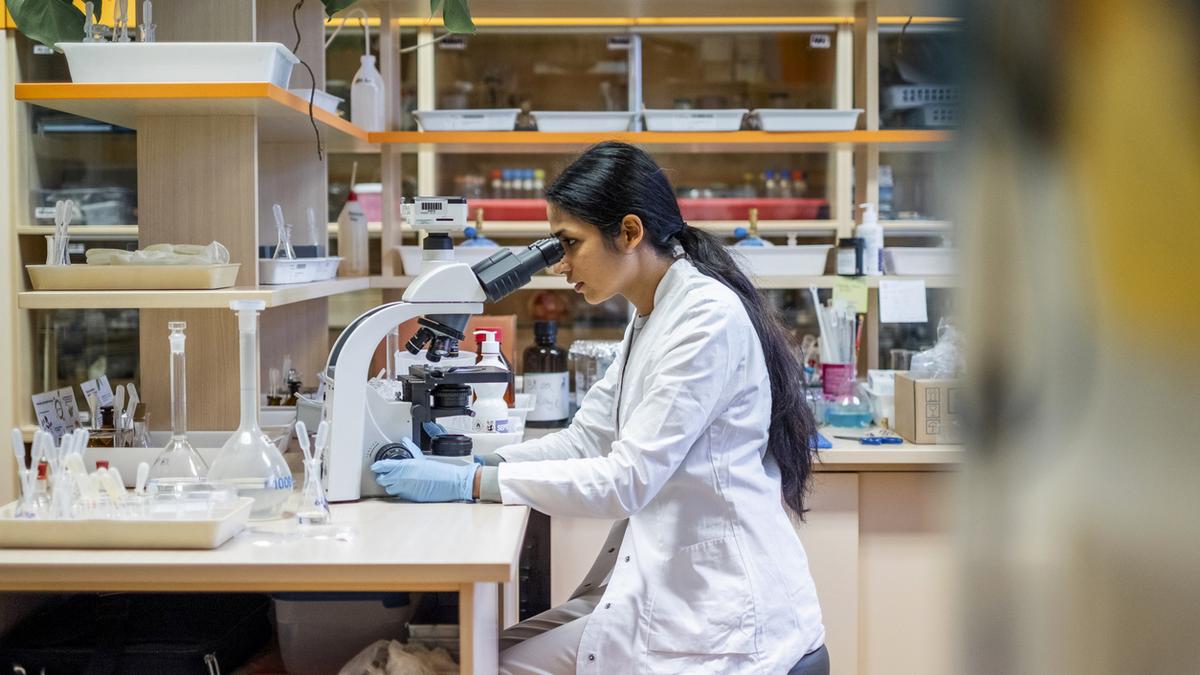
In India, the story of women and girls in science is organised around a mismatch between a widening pipeline and stubborn barriers. Put differently, the country is getting better at bringing girls and young women into STEM education but it has been much less consistent at converting those aspirations into long careers in scientific work. Why?
According to the All India Survey on Higher Education 2021-22, women constitute 43% of higher education enrolment in STEM disciplines. Recent reports from Gujarat have also indicated sharp hikes in the number of women seeking seats in mechanical and civil engineering, which are fields long coded masculine in Indian professional culture. On the other hand, a response in Parliament drawing on the Research and Development Statistics Report 2023 said women STEM researchers made up only 18.6% of the total workforce in 2021.
We know institutions are paying attention because their messages encouraging girls to choose science are increasingly accompanied by those to transform institutions so women can also stay and advance. The Department of Science and Technology’s Project GATI (‘Gender Advancement for Transforming Institutions’) positions gender equity as a reform agenda, for instance. Policy language is also becoming more explicit about allowing women to take “career breaks” and rejoin the scientific workforce. The Department of Science & Technology’s WISE-KIRAN effort has targeted women who have stepped away and want ways back into research work.
Then again, the existence of such schemes also exposes assumptions in many scientific workplaces that the better scientist is one who is continuously available, geographically mobile, and buffered from the responsibility to care for their families. Care work remains heavily feminised in India and childcare infrastructure is uneven, so these assumptions amount to a de facto sorting mechanism. And while they’re obviously exclusionary, people inside laboratories often rationalise them away as meritocracy at work.
Lived experiences
This story of metaphorical pipelines and barriers would also be incomplete if it remains only about gender in the abstract. In India, people live gender through caste, class, region, language, religion, disability, and sexuality. If the question is why a young person with scientific talent quits science, the answer is often about multiple structures selecting against them at once. A woman from a so-called “upper caste” metropolitan college and a woman from a marginalised caste in a small-town institution don’t face the same frictions even if they have the same degree. Their access to mentorship, internships, conferences, recommendations, laboratories, and patronage often differs long before they face their first interview or submit a grant application.


CID launches a manhunt for former MLA Byrathi Basavaraj after High Court denies him anticipatory bail in murder case.

Residents along Rajiv Gandhi Salai oppose road height increase, fearing flooding and accessibility issues during monsoon without cold milling.

The draft Defence Acquisition Procedure-2026 aims to modernize India's defense procurement to enhance strategic alignment and domestic manufacturing.

Court summons complainant in jewellery theft case linked to Sivaganga custodial death, with 10 police personnel accused.

Punjab Governor Gulab Chand Kataria, who on Monday began a four-day march to raise awareness against drug abuse, was joined by Shiromani Akali Dal president Sukhbir Singh Badal in Ferozepur on Tuesday. The move prompted the Congress to question whether a potential reunion of the BJP and the Akali Dal is on the cards ahead of next year’s Assembly election.

Minister for Labour V Sivankutty on Tuesday launched ‘Rakshakavacham,’ a new accident insurance scheme aimed at providing financial security to private sector workers in the state. Describing it as a “major labour welfare initiative,” Mr Sivankutty said the scheme would offer crucial protection to workers and their families during times of crisis. Inaugurating the scheme here, he said ‘Rakshakavacham’ would provide protection and assurance to lakhs of private sector workers, describing the labour force as the backbone of Kerala’s development.

Tamil Nadu is poised to become a $150 billion electronics hub by 2030, contributing significantly to India's exports and manufacturing.

Somaskanda Murthy paraded on Simha Vahanam during the vibrant Kapila Theertham festival in Tirupati, captivating devotees.

Over 6,222 applications for former Devadasi recognition remain unresolved in Karnataka, amid concerns over a significant decline in numbers.

Persons with disabilities stage protest demanding increase in monthly assistance; detained by police
Over 700 disabled protesters in Chennai demand increased monthly assistance, leading to police detentions during state-wide demonstrations.

Amit Shah emphasises urgent action against cyber fraud, linking it to national security and calling for coordinated efforts among stakeholders.

Chikkamagaluru farmer protests NHAI action by cutting sandalwood branches, claiming inadequate compensation for lost trees.

CPI-M demands 1,760 additional RTC buses in Visakhapatnam to address commuter hardships amid growing population and peak hour challenges.