A poem on St. Thomas Mount Premium
The Hindu
Explore the historical significance and beauty of St. Thomas Mount through Eyles Irwin's captivating 18th-century poem.
This is my third consecutive article for this column that features a book of some kind, and I apologise for the monotony. However, it was too tough to resist writing about this poem. H.D. Love’s Vestiges of Old Madras never ceases to amaze, and educate. Each reading throws up some nugget, as it did last week. This was a poem titled St. Thomas’s Mount. It was written around 1769 or thereabouts for it mentions the attacks on the place by Hyder Ali in 1767 and the cyclone of 1768. The poem was published anonymously in 1774 in England and ascribed to “A Gentleman from India”. The preface, anonymous, is dated Jan 1, 1773, and written at Fort St. George. The author, it says, was not yet 20 when he wrote this poem.
Love establishes that this was Eyles Irwin, born in 1750 and arrived in Madras in 1768. “Fascinated by natural beauty and historic associations of the Mount, he wrote (this) pastoral poem,” says Love. In Madras, Irwin, who was in East India Company service, was appointed Land Surveyor in 1771. Five years later, it was found that he had done nothing and so, the post was abolished. He seems to have done well enough personally, for he applied and obtained from the Company eleven acres of land in the village of “Erembore” for his residence. Irwin was evidently a man of letters for in 1777, back in England, he printed his Series of Adventures in the Course of a Voyage up the Red Sea. He also has other works of poetry and prose to his credit. His death, as per Love, was in England, in 1817.
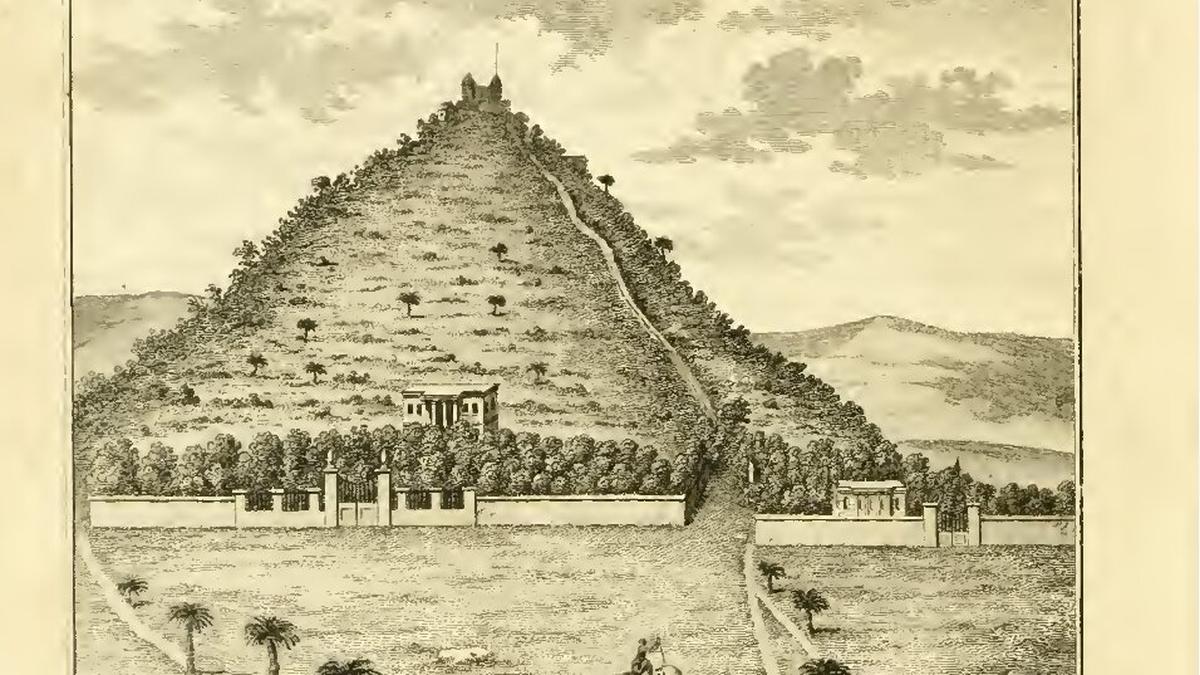
The poem is available free for download at archive.org. The frontispiece is an interesting depiction of the Mount, that Love says, is by J. Collyer. This was very likely Joseph Collyer the Younger, engraver to Queen Charlotte. He never came to India and so must have based his engraving on a sketch made by someone in Madras. If so, it depicts the hill, the steps that Petrus Uscan sponsored to the top, and a shrine at the summit. At the base, behind a compound are bungalows set amidst trees – these may be the cantonment houses for officers.
Outside the compound is barren land with a few palm trees. It reminded me of Jayshree Vencatesan, India’s first Ramsar Award winner. She has always maintained that lush and dense greenery was a colonial creation in Madras, the original vegetation being palm and scrub. A camel and an elephant, with keepers, are wandering around. A tamed cheetah, with its trainer, is hunting what seems to be an antelope on another side.
Now to the poem: it is in three cantos, the first having 220 verses, the second 175, and the third 170. Irwin seems to be one of those that rejoices in warm weather. “Th’ eternal season of our eastern years,” according to him is spring and he wonders if his compatriots back home in England, battered by winter storms and gloom, envy him his good fortune. To us, reading it after 250 years and more makes us wonder, for Meenambakkam, if anything, is always a degree or two hotter than the Nungambakkam meteorological office temperature reading. But it also reinforces the theory that during colonial times, the Mount was considered an ideal getaway from the city.
The area evidently had several mango orchards for the poem pays tribute to the “blessed shade” of the trees and the abundance of the “ambrosial fruit”. The poem then goes on to sing in praise of the elephant and the camel. Then Irwin describes a cheetah, trained to hunt, being encouraged by its keeper to go after antelopes. In his notes, Love has surmised that Collyer’s engraving predated the poem, but what is clear is that it is a faithful depiction of the poem itself. Or was Irwin inspired by the engraving and so fashioned his opening canto after it?


CID launches a manhunt for former MLA Byrathi Basavaraj after High Court denies him anticipatory bail in murder case.

Residents along Rajiv Gandhi Salai oppose road height increase, fearing flooding and accessibility issues during monsoon without cold milling.

The draft Defence Acquisition Procedure-2026 aims to modernize India's defense procurement to enhance strategic alignment and domestic manufacturing.

Court summons complainant in jewellery theft case linked to Sivaganga custodial death, with 10 police personnel accused.

Punjab Governor Gulab Chand Kataria, who on Monday began a four-day march to raise awareness against drug abuse, was joined by Shiromani Akali Dal president Sukhbir Singh Badal in Ferozepur on Tuesday. The move prompted the Congress to question whether a potential reunion of the BJP and the Akali Dal is on the cards ahead of next year’s Assembly election.

Minister for Labour V Sivankutty on Tuesday launched ‘Rakshakavacham,’ a new accident insurance scheme aimed at providing financial security to private sector workers in the state. Describing it as a “major labour welfare initiative,” Mr Sivankutty said the scheme would offer crucial protection to workers and their families during times of crisis. Inaugurating the scheme here, he said ‘Rakshakavacham’ would provide protection and assurance to lakhs of private sector workers, describing the labour force as the backbone of Kerala’s development.

Tamil Nadu is poised to become a $150 billion electronics hub by 2030, contributing significantly to India's exports and manufacturing.

Somaskanda Murthy paraded on Simha Vahanam during the vibrant Kapila Theertham festival in Tirupati, captivating devotees.

Over 6,222 applications for former Devadasi recognition remain unresolved in Karnataka, amid concerns over a significant decline in numbers.

Persons with disabilities stage protest demanding increase in monthly assistance; detained by police
Over 700 disabled protesters in Chennai demand increased monthly assistance, leading to police detentions during state-wide demonstrations.

Amit Shah emphasises urgent action against cyber fraud, linking it to national security and calling for coordinated efforts among stakeholders.

Chikkamagaluru farmer protests NHAI action by cutting sandalwood branches, claiming inadequate compensation for lost trees.

CPI-M demands 1,760 additional RTC buses in Visakhapatnam to address commuter hardships amid growing population and peak hour challenges.