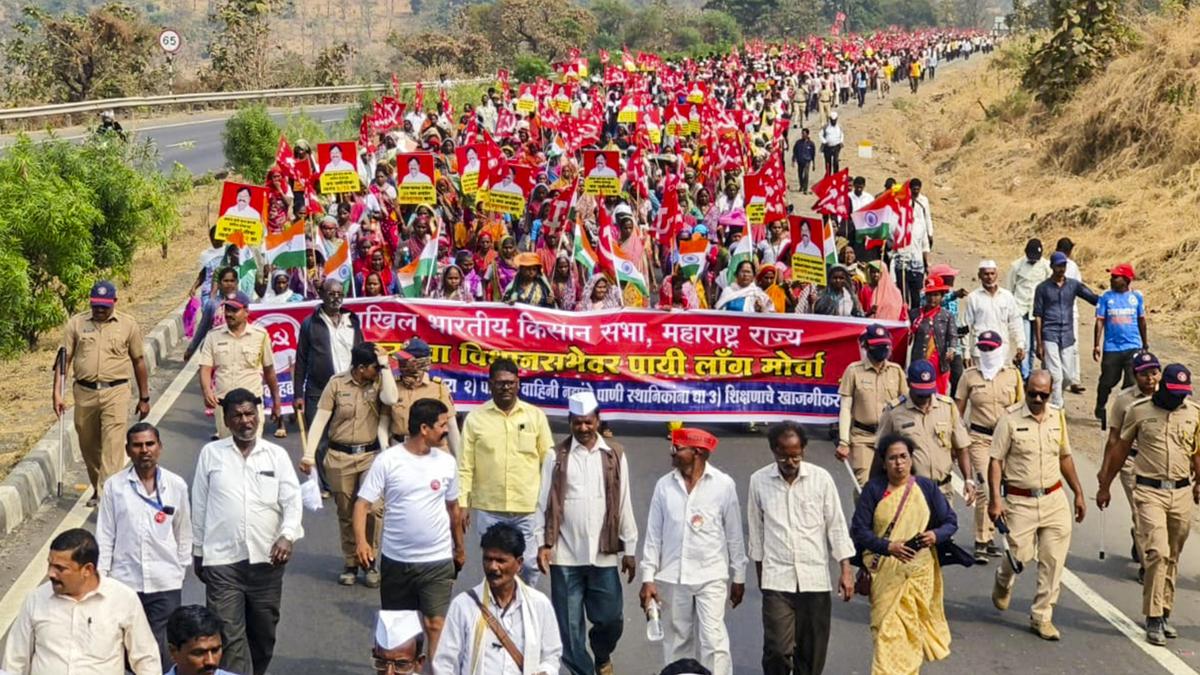
Why are tribals protesting in Maharashtra? | Explained
The Hindu
Thousands of tribals in Maharashtra protest for land rights, demanding proper implementation of the Forest Rights Act and better resources.
The story so far: Over the last few days, thousands of tribal farmers from the Palghar and Nashik districts embarked on two separate long marches in Maharashtra. The marches were organised by the All India Kisan Sabha and the Communist Party of India (M) (CPI-M) over pending land rights of the tribals. The Palghar long march started on January 19, and was partially suspended on January 22 after local demands related to administrative intervention were accepted by the district administration. But protests continued for the policy-level demands of the tribals, and on January 25, a long march started from Nashik. It was declared successful and withdrawn on January 29. Both the Nashik and Palghar districts have a dominant tribal population.
The primary demands of the tribals are about their land rights, employment, irrigation and education. They demand that as per the provisions of the Forest Rights Act, 2006, the forest land which they have been tilling for generations, should be made in their name. They have raised concerns over the current format in which land ownership titles have been issued. They claim that the current format in which the government has listed their names on the titles, excluded them from benefiting from any government schemes or institutional loans.
The other demands include the construction of small dams and river-linking projects for irrigation requirements. They state that west-flowing rivers should be arrested with small dams and be diverted to east-flowing rivers to help irrigate regions which have been facing water scarcity. This act, say the tribals, will enable them to take crops throughout the year. They currently take only one seasonal crop of paddy. Additionally, they want agricultural produce apart from paddy, which includes corn, soybean, onion, strawberry, mangoes, ragi, jowar, bajra, etc. to be sold at the Minimum Support Price (MSP).
They have also demanded the completion of pending recruitments under the Panchayats (Extension to the Scheduled Areas) Act (PESA), 1996, which will give employment opportunities to educated tribal youth. PESA empowers tribal communities in ‘Scheduled Areas’ with self-governance. The other demands include the filling up of vacant teacher posts and other staff members in Zilla Parishad schools; more education opportunities for tribal children; and 24-hour supply of electricity.
The biggest demand at the heart of all the long marches has been the proper implementation of the Forest Rights Act, 2006. Tribals have claimed that their individual claim rights are rejected; that they are allotted only a minuscule proportion of the land they actually till, thereby making them ineligible for government schemes. Tribals groups state that at present the record of land ownership is in the name of the entire village, and that their individual names are only mentioned in the village ownership document. They want the ownership record to reflect their individual names. The demands related to irrigation and the implementation of the Forest Rights Act have been constant since 2018. Government sources said that concerns about the allotment of just a fraction of land the tribals tilled were taken cognisance of. They also said that they were looking into the possibility of the digitisation of governance records leading to incongruences and denials in a few cases.
As per data accessed by The Hindu, over 45% of claims under the Forest Rights Act have been rejected so far. Recently, the Government of Maharashtra held a round of talks with a 15-member delegation of the protestors, consisting of the leaders of the All India Kisan Sabha and the CPI(M). Chief Minister Devendra Fadnavis said that the government is positive about resolving the issues. As per 2025 data about the claims under the Forest Rights Act, 2006 (presented in the Lok Sabha in July, 2025), Maharashtra has disposed off 3,80,966 of the 4,09,156 claims filed so far. Of the 3,80,966 claims, 2,08,335 titles were distributed, while, 1,72,631 claims were rejected. The pendency in the State is of 28,190 claims.


Trial begins in Coimbatore gang-rape case involving three accused, with legal counsel appointed for their defense.

Tamil Nadu CM M.K. Stalin inaugurates a ₹30 crore eco park at Navalur lake in SIPCOT Siruseri, enhancing ecological restoration.

A school van overturned on Maduravoyal flyover, but two students inside escaped unharmed; police are investigating the incident.

Tamil Nadu's marginal increase in fund devolution under the 16th Finance Commission offers little relief amid regional disparities.

A mob in Chhattisgarh's Dutkaiya village vandalized homes, prompting police to protect minority residents amid escalating violence.

PSBB School celebrates Thyagaraja Utsavam, honoring Mrs. YGP’s legacy with music, culture, and student performances in Chennai.

The Economic Survey of India (2025-26) gives significant recognition to Tamil Nadu’s performance across a range of development indicators

Student activists protest in Ongole against IIIT relocation, citing water crisis and lack of government response to their demands.

Koyira Gram Panchayat issues a notice to Foxconn for unpaid property taxes amid local discontent over job promises.

VSP displaced persons to rally on February 8, addressing land loss and job promises unmet over 35 years.

Problems aplenty in a disappointing and frustrating season for Tamil Nadu

Sarbananda Sonowal criticizes Congress for corruption, urging cooperation for India's development, highlighting Modi's governance successes since 2014.

West Bengal Government questions ED's Supreme Court plea regarding I-PAC amid ongoing Calcutta High Court case.