General relativity survives its most rigorous single-event test yet Premium
The Hindu
LIGO's GW250114 signal tests Einstein's relativity, revealing black hole properties and confirming key theorems in gravitational wave research.
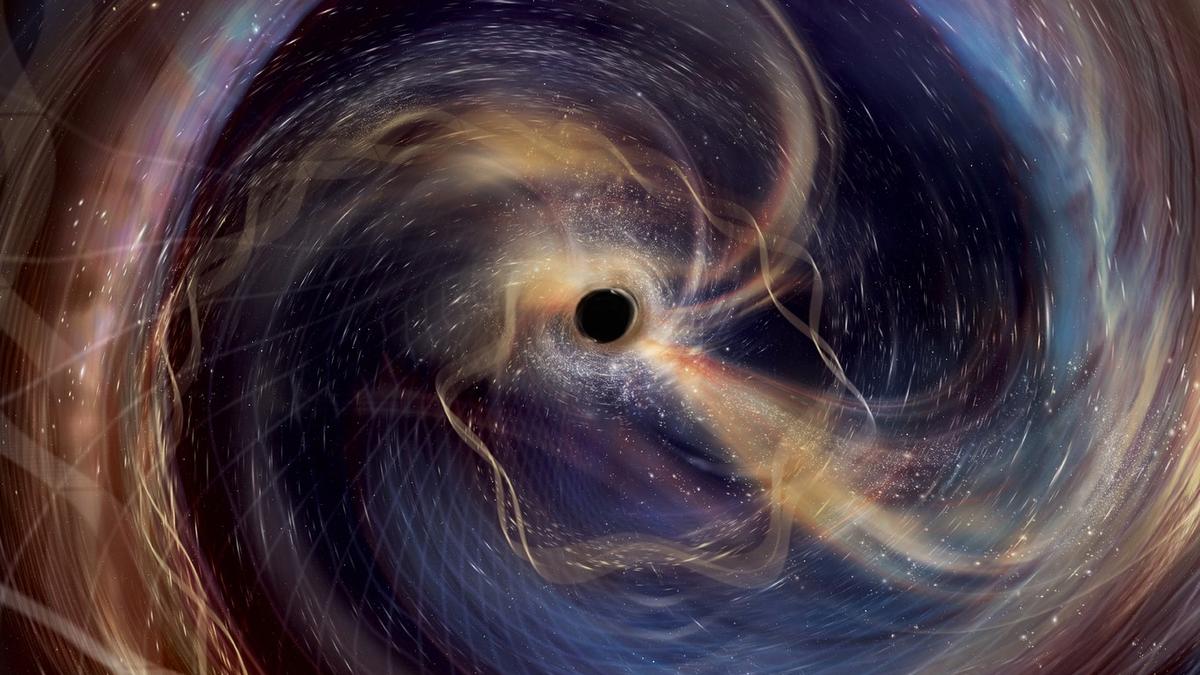
On January 14, 2025, the Laser Interferometer Gravitational-wave Observatories (LIGOs) recorded a cosmic tremor unlike any before. Named GW250114, the signal was the ‘loudest’ gravitational wave scientists had ever detected.
In a study published in Physical Review Letters on January 29, an international team of researchers reported that it had used this powerful signal to conduct the most rigorous test of Albert Einstein’s general theory of relativity and the nature of black holes to date.
For more than a century, the theory, also called general relativity, has been the gold standard for understanding gravity. It predicts that when two black holes merge, they will form a single, distorted survivor that settles down by ‘ringing’, much like a bell that has been struck, emitting gravitational waves in a process called ringdown.
According to the no-hair theorem, a black hole in vacuum can be characterised only by its mass and spin. This means its ‘ringing’ should follow a specific, predictable pattern, which is called the Kerr metric. The researchers wanted to use the exceptional clarity of GW250114 to check whether black holes truly are as simple as Einstein predicted or if they hide more complex features that might point to new physics.
To analyse the signal, the researchers used a technique called black hole spectroscopy. Just as astronomers can identify elements in stars by looking at the specific frequencies of light they emit, gravitational-wave scientists look for specific frequencies and decay times in the ‘sound’ of a black hole’s ringdown.
The team also used several advanced mathematical tools. Software packages called RINGDOWN and pyRing were used to fit specific models to the post-merger data to identify individual notes in the signal. A method called pSEOBNR analysed the entire signal to check if its beginning and end told a consistent story.


Trial begins in Coimbatore gang-rape case involving three accused, with legal counsel appointed for their defense.

Tamil Nadu CM M.K. Stalin inaugurates a ₹30 crore eco park at Navalur lake in SIPCOT Siruseri, enhancing ecological restoration.

A school van overturned on Maduravoyal flyover, but two students inside escaped unharmed; police are investigating the incident.

Tamil Nadu's marginal increase in fund devolution under the 16th Finance Commission offers little relief amid regional disparities.

A mob in Chhattisgarh's Dutkaiya village vandalized homes, prompting police to protect minority residents amid escalating violence.

PSBB School celebrates Thyagaraja Utsavam, honoring Mrs. YGP’s legacy with music, culture, and student performances in Chennai.

The Economic Survey of India (2025-26) gives significant recognition to Tamil Nadu’s performance across a range of development indicators

Student activists protest in Ongole against IIIT relocation, citing water crisis and lack of government response to their demands.

Koyira Gram Panchayat issues a notice to Foxconn for unpaid property taxes amid local discontent over job promises.

VSP displaced persons to rally on February 8, addressing land loss and job promises unmet over 35 years.

Problems aplenty in a disappointing and frustrating season for Tamil Nadu

Sarbananda Sonowal criticizes Congress for corruption, urging cooperation for India's development, highlighting Modi's governance successes since 2014.

West Bengal Government questions ED's Supreme Court plea regarding I-PAC amid ongoing Calcutta High Court case.