Where does the India-U.S. trade deal stand? | Explained Premium
The Hindu
After the U.S. Supreme Court struck down the tariffs imposed by Donald Trump on countries across the world, how did the American President react? Will reciprocal tariffs be removed? Why does a 50% tariff on aluminium and steel imports continue?
February was an eventful month for India-U.S. trade relations. The two countries announced an impending interim agreement on trade, the U.S. Supreme Court overturned President Donald Trump’s tariffs, the Indian negotiating team indefinitely postponed its visit to Washington, and Commerce Minister Piyush Goyal hosted U.S. Commerce Secretary Howard Lutnick in New Delhi. All of this has raised the question: what happens to the trade deal and U.S. tariffs?
EXPLAINED | How is U.S.-India trade deal being tweaked?
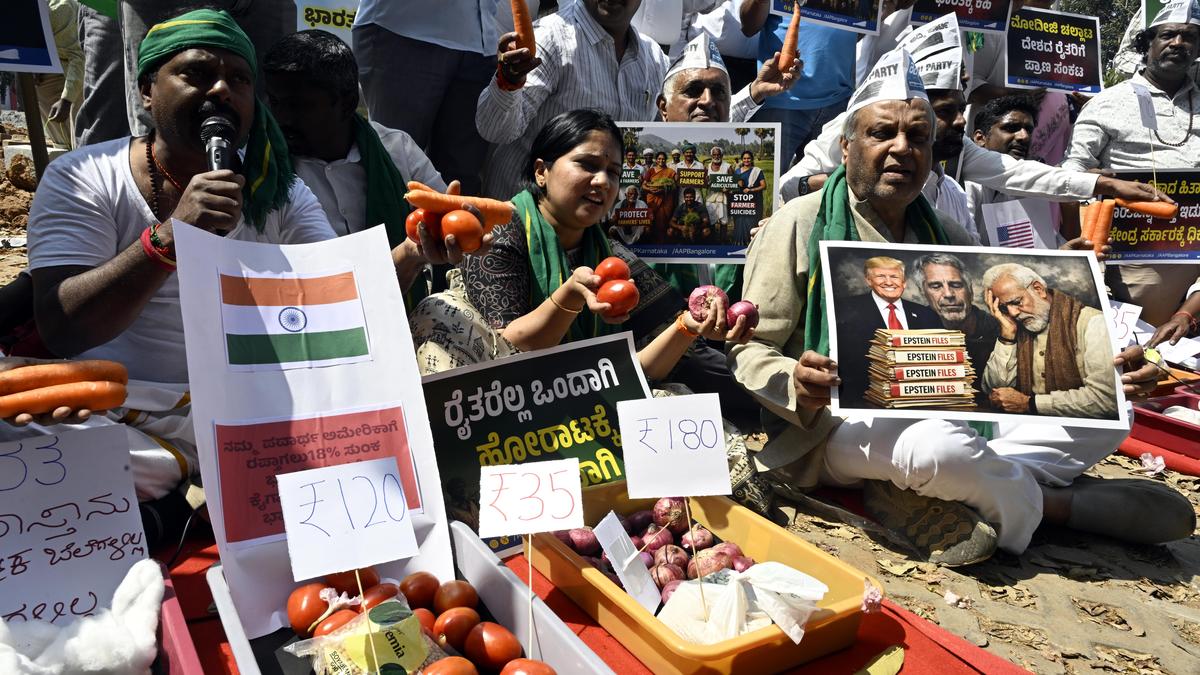
Mr. Trump implemented most of his tariffs on other countries, including on India, using the International Emergency Economic Powers Act of 1977. The U.S. Supreme Court on February 20 struck down the tariffs implemented under this law. It said that the U.S. President would need congressional approval before levying tariffs under these laws. For most countries, this involved the removal of the ‘reciprocal tariffs’ Mr. Trump had imposed on them since mid-2025. Mr. Trump had on February 6 removed the 25% penal tariffs he had imposed on India for its import of Russian oil. This had brought India’s total tariff down from 50% to 25%. As per the joint statement issued by the two countries, the remaining 25% reciprocal tariffs would be reduced to 18% under the interim agreement. However, before this could be done by the U.S., its Supreme Court struck down the tariffs.
Also Read | U.S. slaps 126% duty on Indian solar imports
Mr. Trump lashed out at the Supreme Court in several social media posts and speeches. Also expectedly, he resorted to other laws under which he could impose tariffs on other countries. As of now, this stands at a flat 10% tariff on all imports for a period of 150 days starting January 24. However, Mr. Trump has said he will raise this to the maximum permissible limit of 15%. That has not happened yet. Several other tariffs that the U.S. has imposed over the last year or so remain in place. These include a 50% tariff on aluminium and steel imports, and country-specific tariffs on items valued at less than $800. Both continue to impact India since steel and aluminium form a substantial portion of India’s exports to the U.S., and India’s MSMEs used to leverage e-commerce platforms and avail of the tariff exemption on items below $800.
The U.S. on February 24 imposed a 126% tariff on the import of solar modules from India after a ‘preliminary’ finding that subsidised exports from India were hurting U.S. solar firms.


The booming market for artificial intelligence servers brought Taiwan's Foxconn a 24 percent jump in annual net profit, the company said

In a statement on its website, Adobe said it has in recent years streamlined its sign-up and cancellation processes and made them more transparent.

Stock markets recover as Sensex and Nifty bounce back following a three-day slump, driven by value-buying in blue-chip stocks.

U.S. President Donald Trump’s administration is set to receive a roughly $10 billion fee from investors in the recently completed deal to take control of TikTok’s U.S. business, the Wall Street Journal reported

Meta is planning sweeping layoffs that could affect 20% or more of the company, three sources familiar with the matter told Reuters

Learn how to choose the best personal loan lender by evaluating eligibility, interest rates, and borrowing experience.

Discover why pension planning is essential in modern India to ensure financial security and peace during retirement.

The U.S. has launched two investigations under Section 301 of the Trade Act of 1974 against India and other economies to examine practices that may be ‘unreasonable or discriminatory and burden or restrict U.S. commerce’. One probe examines whether countries, including India, are using excess manufacturing capacity to export to the U.S. in a manner that hurts American businesses, while another looks at whether countries have taken ‘sufficient steps’ to prohibit imports of goods produced with forced labour.

NHAI raises annual pass fee to ₹3,075 from April 1, 2026, streamlining toll payments for FASTag users.

The U.S. probes forced labour in global supply chains, scrutinizing China and India's exports, warns the Global Trade Research Initiative.

The Hindu collection of images of the LPG crisis: War lights a kitchen fire

The company, which launched its IPO in 2020, is now listed on the National Stock Exchange as well as the Bombay Stock Exchange.

Explore the Essential Commodities Act's role in addressing India's gas crisis and its impact on various sectors.